No, it's one with a different thread pitch sent in error. They sent me a new one to replace it so I have 5 the same. They weren't sold as a set of 6.That's not a spare, it's the 6th one.
Last edited:

TalkBass has been independent since 1998. Add your voice.
Create a free account to reply to discussions, view embedded media, and browse with fewer display ads.
Join free Log in
Want zero display ads or expanded classifieds tools? Compare plans.
No, it's one with a different thread pitch sent in error. They sent me a new one to replace it so I have 5 the same. They weren't sold as a set of 6.That's not a spare, it's the 6th one.
This is a top idea.So, the whole saddle assembly moves to adjust intonation? I wonder if you could line the surface of the plate in the body, and the underside of the saddle/tuner assembly with material that would create friction. Rubber? Cork? Gasket material? Strips of super-light sandpaper? Something to help resist string tension. Maybe even a tiny washer under the head to spread out its grip a bit (with split washer if it will fit).

Thx..point takenNo, it's one with a different thread pitch sent in error. They sent me a new one to replace it so I have 5 the same. They weren't sold as a set of 6.
 but, using a friction plate alone to hold the string tension looks dodgy at best and IMO trying to fix what appears to be a fatal design flaw won't be worth the time.


Thx..point taken
You spent about $65.00 on tuners and a bridge
Try harder
This is part of what's wrong with tb. If you choose not to be helpful, move along.



Part of the reason for starting this thread is to warn others not to buy them.The main design flaw I see is that the whole assembly is dependent on the pinch plate binding against the tube. The threaded portion of the plate which might be 1mm or less is all that's holding everything together. Once that plate deforms or the threads wear even a bit its binding capabilities will be over.
Part of the reason for starting this thread is to warn others not to buy them.
The body of the tuner only touches the plate along the two edges. Putting a piece of wet and dry folded in two into the gap increases friction a lot. This should get me to a point where I can set the intonation. Once I've got the intonation right, I'm going to file a piece of brass or something to the shape of the space between the bolt and the end of the slot in the body. That way the body can't slip under tension.
I hope it it all holds together. I know how frustrating it can be to have to re-engineer a new component.
Part of the reason for starting this thread is to warn others not to buy them.
The body of the tuner only touches the plate along the two edges. Putting a piece of wet and dry folded in two into the gap increases friction a lot. This should get me to a point where I can set the intonation. Once I've got the intonation right, I'm going to file a piece of brass or something to the shape of the space between the bolt and the end of the slot in the body. That way the body can't slip under tension.

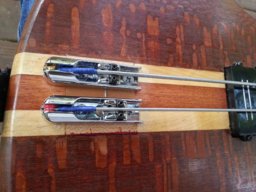
what are they?those bridges do not look robust enough for bass applications imo
<===these are

Except that the ones in your avatar aren't headless tuners.Hipshots


