Right iv just gone over circle of fifths with my teacher and hes just confused the hell out of my, i get that its in a clock shape and the fifth of each chord is the next note but so what? What are you mean to play for a good chord progression, the left and right notes? Sorry if this is a ****** explanation but im seriously confused and it seems like something i should know lol. Any help is appreciated

Enjoy the benefits of a premium membership!
Upgrade Account
-
TalkBass has been independent since 1998. Add your voice.
Create a free account to reply to discussions, view embedded media, and browse with fewer display ads.
Join free Log in
Want zero display ads or expanded classifieds tools? Compare plans.
You are using an out of date browser. It may not display this or other websites correctly.
You should upgrade or use an alternative browser.
You should upgrade or use an alternative browser.
Circle of fifths - Understanding
- Thread starter Mikell
- Start date
More options
Who Replied?
I'm learning this at the moment as well.
the circle of fifths comes in handy when you are trying to work out what key a written (standard notation not tab) piece of music is in by how many sharps or flats it has, and it will also tell you what those sharps and flats are.
so a song in the key of C has no sharps or flats.
but a song that has 4 sharps is in the key of B (?) and the notes G, D, A and E are played as sharp in that piece of music (unless it is individually noted otherwise)
I think that is right,
the circle of fifths comes in handy when you are trying to work out what key a written (standard notation not tab) piece of music is in by how many sharps or flats it has, and it will also tell you what those sharps and flats are.
so a song in the key of C has no sharps or flats.
but a song that has 4 sharps is in the key of B (?) and the notes G, D, A and E are played as sharp in that piece of music (unless it is individually noted otherwise)
I think that is right,

The circle is a visual cheat sheet, memory peg, reference chart - what ever you want to call it. There is a wealth of knowledge on that circle - IF you know how to read it.
Seems like your wondering why C F G is so important.
Well C F G are the I IV V chords used in thousands of songs. If someone said to you OK we will play the next song in G and use the I IV V chords - IF you had a circle of 5th handy you can look at G and see what is to the left and right of G and find that it is G C D. So a I IV V progression in the key of G would contain the G, C, D chords.
That is only the beginning of what can be found on the circle. Sounds like this is what your teacher has you learning first.
Good luck.
Key of D will be D, G, A
Key of A will be A, D, E
You take it from there. This will help. [This invalid link has been removed]
Have fun.
Seems like your wondering why C F G is so important.
Well C F G are the I IV V chords used in thousands of songs. If someone said to you OK we will play the next song in G and use the I IV V chords - IF you had a circle of 5th handy you can look at G and see what is to the left and right of G and find that it is G C D. So a I IV V progression in the key of G would contain the G, C, D chords.
(G) Don't come cryin' to me when (C) it's over
(D7) Don't you come a knocking at my (G) door.
That is only the beginning of what can be found on the circle. Sounds like this is what your teacher has you learning first.
Good luck.
Key of D will be D, G, A
Key of A will be A, D, E
You take it from there. This will help. [This invalid link has been removed]
Have fun.

the first time i heard that term is was in school playing with some jazz players
we were playing something simple and to keep it interesting they said "take it through the circle of fourths" (circle of fifths could have been done as well)
so if we were playing a progression like
G C D
you can take that through the circle and it won't get monotonous
so you would start with
G C D - then
D G A
A D E
E A B
and so on...
of course if you are playing I IV V
you probably don't want to take it through the circle of fifths since it ends on the fifth (bad example)
but the circle of fourths would work well
we were playing something simple and to keep it interesting they said "take it through the circle of fourths" (circle of fifths could have been done as well)
so if we were playing a progression like
G C D
you can take that through the circle and it won't get monotonous
so you would start with
G C D - then
D G A
A D E
E A B
and so on...
of course if you are playing I IV V
you probably don't want to take it through the circle of fifths since it ends on the fifth (bad example)
but the circle of fourths would work well
the circle is also a good way of practicing your scales
i go through the circle fourths a couple times every day
i go through the circle fourths a couple times every day

Don't feel bad if you don't get it right away. Only the past few years I've really understood, if you know what I mean. Just keep at it, and eventually you'll get it.

What the hells the circle of fourths lol, and how do you practise scale using it?
It is the same circle as the circle of fifths, only in the opposite direction.
If you move in a clockwise direction, you are moving by fifths. If you move in a counterclockwise direction, you are moving by fourths.

the cycle of 4ths is the same cycle going in the other direction and spells out II-V7progressions. "the ear follows the knowledge" is a saying my teacher use to repeat to me. ask your teacher to listen to songs you enjoy or want to play AND POINT OUT THESE PROGRESSIONS IN REAL TIME. that approach seemed to work best for me when i was learning theory.

I found "The Chord Wheel: The Ultimate Tool for All Musicians", by Jim Fleser, quite useful in tying together a number of concepts, including Circle of Fifths.
http://www.amazon.com/dp/0634021427
http://www.amazon.com/dp/0634021427
As an Amazon Associate, TalkBass may receive commissions from qualifying purchases made via links on this site.


It is the same circle as the circle of fifths, only in the opposite direction.
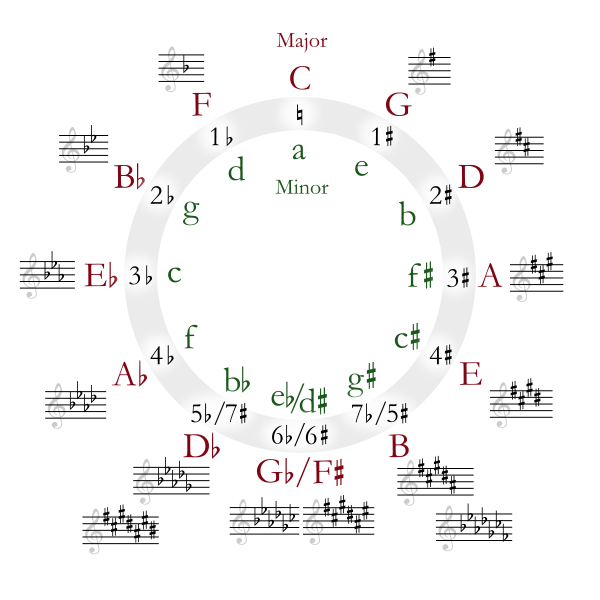
If you move in a clockwise direction, you are moving by fifths. If you move in a counterclockwise direction, you are moving by fourths.
Uh' What?
Think of it this way -- C is in the middle. You look for the 4th going counter clock wise and get the F. You look for the 5th going clock wise and get the G. One side of the circle travels in 5th the other side travels in 4ths. Now the beauty of this is the circle rotates - Look at D. Where is it's 4th? Yep counter clock wise to the G then the 5th or A would be clockwise.
It has to for us to have a I IV V cheat sheet.
Have fun.
It has to for us to have a I IV V cheat sheet.
Have fun.

but a song that has 4 sharps is in the key of B (?) and the notes G, D, A and E are played as sharp in that piece of music (unless it is individually noted otherwise)
I think that is right,
No. The key of B has five sharps, those being F, C, G, D, and A.
No, it's still 5ths. A 4th down from C would be G. In order to get a 'Circle of Fourths', you have to flip the chart, so that the sharp keys are on the left and the flat keys are on the right.If you move in a counterclockwise direction, you are moving by fourths.
As Febs diagram shows, it works like this: the top of the circle is the key C, with no sharps or flats. KEY is the important word here.
- If you move clockwise, a 5th up from C is G, and in that key there is one sharp, F.
- If you move counterclockwise, a 5th down from C is F, and in that key there is one flat, B.
- Clockwise, you add one sharp as you move from key to key.
- Counterclockwise, you add one flat as you move from key to key.


No, it's still 5ths. A 4th down from C would be G. In order to get a 'Circle of Fourths', you have to flip the chart, so that the sharp keys are on the left and the flat keys are on the right.
I've never heard it explained that moving counterclockwise dictates moving down in pitch or that you would count your scale degrees backwards. That's like saying if you're playing a I IV V with the root of the IV chord lower than the root of the I chord you're actuallying playing a I -V V or something...
Doesn't it needlessly confuse the issue to say that F is a '5th' down from C?
F is not the 5th degree in the C major scale; it's the 4th degree in C major.
It is the 5th tone down, but I've never heard of scale degrees being counted backwards.
+1 Always heard the circle explained this way.
Doesn't it needlessly confuse the issue to say that F is a '5th' down from C?
F is not the 5th degree in the C major scale; it's the 4th degree in C major.
It is the 5th tone down, but I've never heard of scale degrees being counted backwards.
No, because F is a perfect fifth below C. It has nothing to do with an F major scale. F is a fifth below C in F major, Bb Major, Eb Major, Ab Major, Db Major, D minor, G minor, C minor, F minor and Bb minor.
You can't relate everything to a single scale. Intervals can be measured in both directions, but their magnitude come from the distance between the lowest and the highest note.
We spend so much time on this board talking about modes and other useless garbage that no one understands a rudimentary theory concept like intervals.

- Dec 13, 1999
- 11,736
- 8,941
- 70
- Disclosures
- Chuck Sher publishes my book, WALKING BASSICS:The Fundamentals of Jazz Bass Playing.

No, because F is a perfect fifth below C.
But F is not the fifth of C.. I've always heard the wheel explained that if you move from C to F, for example, that you are moving to the fourth of C, not that you are moving down a fifth from C.


