I bought a bunch of gear recently. In order to get the pieces I wanted I had to take a few I didn't. Among them is a Class B power amplifier. It's rated at "500 watts per channel" whatever that means. It was part of a fitness club system, for which it's suitable. I understand that the reason Class B amplifiers are so light and relatively cheap is that the transistors cycle on and off to reproduce their respective halves of the waveform, in the process producing "crossover distortion." Would this make it unusable for electric bass or is it only noticeable if you listen closely? Also, any chance of it overheating if pushed for a long time?

Enjoy the benefits of a premium membership!
Upgrade Account
-
TalkBass has been independent since 1998. Add your voice.
Create a free account to reply to discussions, view embedded media, and browse with fewer display ads.
Join free Log in
Want zero display ads or expanded classifieds tools? Compare plans.
You are using an out of date browser. It may not display this or other websites correctly.
You should upgrade or use an alternative browser.
You should upgrade or use an alternative browser.
Class B amplifier: Is it usable for electric bass?
- Thread starter buduranus2
- Start date
More options
Who Replied?
- Feb 12, 2006
- 60,978
- 5
- 220,734
- Disclosures
- Development Engineer-Mesa Boogie, Development Engineer-Genzler (pedals), Product Support-Genz Benz
What you have heard is not correct or accurate. What you described applies to class C, which is not used in audio.
Class AB and B are push pull and hand off with no crossover distortion.
The amp itself, useful depends on the quality of the product and how it’s rated.
Class AB and B are push pull and hand off with no crossover distortion.
The amp itself, useful depends on the quality of the product and how it’s rated.

What you have heard is not correct or accurate. What you described applies to class C, which is not used in audio.
Class AB and B are push pull and hand off with no crossover distortion.
The amp itself, useful depends on the quality of the product and how it’s rated.
Well, I'm way above my pay grade but here's what I've found variously across the web:
"Since the transistors are not biased they remains OFF when there is no input signal and no current flows through the load. Each transistor starts conduction only when the amplitude of the input signal goes above the base-emitter voltage (Vbe) of the transistor which is about 0.7 V. This improves the efficiency but creates a problem called cross-over distortion.
Cross over distortion.
Since the active elements start conduction only after the input signal amplitude has risen above 0.7V, the regions of the input signal where the amplitude is less than 0.7V will be missing in the output signal and it is called cross over distortion. The schematic representation of cross-over distortion is shown in the figure below. In the figure, you can see that the regions of the input waveform which are under 0.7V are missing in the output waveform."
Advantages of Class B amplifier.
- High efficiency when compared to the Class A configurations.
- Push-pull mechanism avoids even harmonics.
- No DC components in the output (in ideal case).
- The major disadvantage is the cross-over distortion.
- Coupling transformers increases the cost and size.
- It is difficult to find ideal transformers.
- Transformer coupling causes hum in the output and also affects the low frequency response.
- Transformer coupling is not practical in case of huge loads."
You'd probably be better off posting pics of what you got, as you probably don't have what you think you have.
If it’s been used to make music in a gym it's probably fine to make music elsewhere, unless you actually got a 70V PA system.
If it’s been used to make music in a gym it's probably fine to make music elsewhere, unless you actually got a 70V PA system.
Specifically if you see something about a 'Class B digital device' that just means it's intended for residential use and has nothing to do with amp topology.
- Feb 12, 2006
- 60,978
- 5
- 220,734
- Disclosures
- Development Engineer-Mesa Boogie, Development Engineer-Genzler (pedals), Product Support-Genz Benz
That’s incorrect.Well, I'm way above my pay grade but here's what I've found variously across the web:
"Since the transistors are not biased they remains OFF when there is no input signal and no current flows through the load. Each transistor starts conduction only when the amplitude of the input signal goes above the base-emitter voltage (Vbe) of the transistor which is about 0.7 V. This improves the efficiency but creates a problem called cross-over distortion.
Cross over distortion.
Since the active elements start conduction only after the input signal amplitude has risen above 0.7V, the regions of the input signal where the amplitude is less than 0.7V will be missing in the output signal and it is called cross over distortion. The schematic representation of cross-over distortion is shown in the figure below. In the figure, you can see that the regions of the input waveform which are under 0.7V are missing in the output waveform."
Advantages of Class B amplifier.
Disadvantages of Class B amplifier.
- High efficiency when compared to the Class A configurations.
- Push-pull mechanism avoids even harmonics.
- No DC components in the output (in ideal case).
So will the crossover distortion be especially noticeable with electric bass?
- The major disadvantage is the cross-over distortion.
- Coupling transformers increases the cost and size.
- It is difficult to find ideal transformers.
- Transformer coupling causes hum in the output and also affects the low frequency response.
- Transformer coupling is not practical in case of huge loads."
UNDER-biased class B can have crossover distortion, but class b and class AB are both biased and the definition of class A, AB, B and C all relate to conduction angle. What they are describing as class B is actually class C.
Factually, the quotes posted are full of inaccuracies.
You'd probably be better off posting pics of what you got, as you probably don't have what you think you have.
If it’s been used to make music in a gym it's probably fine to make music elsewhere, unless you actually got a 70V PA system.
Agreed.
This to is possible and maybe more likely.Specifically if you see something about a 'Class B digital device' that just means it's intended for residential use and has nothing to do with amp topology.
You'd probably be better off posting pics of what you got, as you probably don't have what you think you have.
If it’s been used to make music in a gym it's probably fine to make music elsewhere, unless you actually got a 70V PA system.
I am thinking if it came from a large fitness center it's a multi-channel 70 Volt amp designed to provide lowish power to a bunch of speakers in various zones.
If the OP provided at least a brand name, and a pic of the front and back panels we could all probably provide a useful response.
Analogeezer
I am thinking if it came from a large fitness center it's a multi-channel 70 Volt amp designed to provide lowish power to a bunch of speakers in various zones.
If the OP provided at least a brand name, and a pic of the front and back panels we could all probably provide a useful response.
Analogeezer
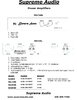
Nope, not 70v but not a bad guess I suppose. It's a Supreme Audio SA5000. The OEM is Grommes-Precision, the old hi-fi company now a private label OEM. Here are some pics and the "spec sheets" such as they are. (Thumbnails to preserve space.)




Best advice - hook that sucker up and see what it will do !
- Feb 12, 2006
- 60,978
- 5
- 220,734
- Disclosures
- Development Engineer-Mesa Boogie, Development Engineer-Genzler (pedals), Product Support-Genz Benz
Ok, I can tell you a bit more going forward with this information.
First of all, this is a convection cooled amplifier and for the application they were intended it's designed around is 1/8-rated power as a duty cycle under low ambient conditions. For bass guitar, we typically double the duty cycle because 1/8-rated power duty cycle isn't adequate.
The specs aren't clear, but often there are limitations against driving rated power into 4 ohms as well. What's odd is that all the regulatory information is missing from the back panel of the amp and the spec sheet, so there's no way to know if the power metric is RMS or peak. 500 watts RMS into 4 ohms in a class B/AB convection cooled amp, even at 1/8-rated power duty cycle is VERY difficult (maybe impossible) to achieve, especially with the cooling on the inside of the chassis.
At low volumes, it should work ok, but have reasonable expectation.
First of all, this is a convection cooled amplifier and for the application they were intended it's designed around is 1/8-rated power as a duty cycle under low ambient conditions. For bass guitar, we typically double the duty cycle because 1/8-rated power duty cycle isn't adequate.
The specs aren't clear, but often there are limitations against driving rated power into 4 ohms as well. What's odd is that all the regulatory information is missing from the back panel of the amp and the spec sheet, so there's no way to know if the power metric is RMS or peak. 500 watts RMS into 4 ohms in a class B/AB convection cooled amp, even at 1/8-rated power duty cycle is VERY difficult (maybe impossible) to achieve, especially with the cooling on the inside of the chassis.
At low volumes, it should work ok, but have reasonable expectation.
Ok, I can tell you a bit more going forward with this information.
First of all, this is a convection cooled amplifier and for the application they were intended it's designed around is 1/8-rated power as a duty cycle under low ambient conditions. For bass guitar, we typically double the duty cycle because 1/8-rated power duty cycle isn't adequate.
The specs aren't clear, but often there are limitations against driving rated power into 4 ohms as well. What's odd is that all the regulatory information is missing from the back panel of the amp and the spec sheet, so there's no way to know if the power metric is RMS or peak. 500 watts RMS into 4 ohms in a class B/AB convection cooled amp, even at 1/8-rated power duty cycle is VERY difficult (maybe impossible) to achieve, especially with the cooling on the inside of the chassis.
At low volumes, it should work ok, but have reasonable expectation.
Man, that's an answer and a half! So in terms I can understand, it's OK for recorded music or maybe floor monitors but not that useful for electric bass except as noted. Many thanks!

floor monitors can be peaky and demanding on power amps tooSo in terms I can understand, it's OK for recorded music or maybe floor monitors but not that useful for electric bass except as noted.
I once (circa 1989) wound up with a bunch of gear I didn't really want. Weird deal with the singer's boss (who owned a stone mason company) who later scammed me on an income tax scam (a separate deal).
One of the pieces of gear was a Kustom power amp (yes THAT Kustom but it was not tuck and roll) which had horizontal sliders for the gain on the front.
I preamped it with my Acoustic 220 head (used the line out of course) and it lasted about a month (driving four 8 ohm cabinets) before it failed.
Took it to the shop and was told "you need replacement part 1A", I asked what that was and they told me "this amp is crap, not worth fixing. Replacement part 1A is to replace the amp" LOL
So I replaced it with a QSC Series 1 1400 which I have used in various roles and continues to work to this day. The thing was the QSC cost $555 back then which was a LOT of money.
But sometimes free/nearly free gear is worth what it cost you LOL
Analogeezer
One of the pieces of gear was a Kustom power amp (yes THAT Kustom but it was not tuck and roll) which had horizontal sliders for the gain on the front.
I preamped it with my Acoustic 220 head (used the line out of course) and it lasted about a month (driving four 8 ohm cabinets) before it failed.
Took it to the shop and was told "you need replacement part 1A", I asked what that was and they told me "this amp is crap, not worth fixing. Replacement part 1A is to replace the amp" LOL
So I replaced it with a QSC Series 1 1400 which I have used in various roles and continues to work to this day. The thing was the QSC cost $555 back then which was a LOT of money.
But sometimes free/nearly free gear is worth what it cost you LOL
Analogeezer

'per channel' would be for left and right speakers, I reckon. It's a PA head. You might well find it handy at some time. It's not built for bass but wouldn't come to any harm. The main differences with bass heads is the EQ.I bought a bunch of gear recently. In order to get the pieces I wanted I had to take a few I didn't. Among them is a Class B power amplifier. It's rated at "500 watts per channel" whatever that means. It was part of a fitness club system, for which it's suitable. I understand that the reason Class B amplifiers are so light and relatively cheap is that the transistors cycle on and off to reproduce their respective halves of the waveform, in the process producing "crossover distortion." Would this make it unusable for electric bass or is it only noticeable if you listen closely? Also, any chance of it overheating if pushed for a long time?
This will be helpfulWhat you have heard is not correct or accurate.
Class AB and B are push pull and hand off with no crossover distortion.

I like how it is designed to "meet the specific needs of the fitness and health club industry" because it hides the volume controls around the back!
I can think of more than a few more applications where that would be an excellent idea...
I can think of more than a few more applications where that would be an excellent idea...

I would sell that on Craigslist to someone who needs a Muzak amp

Many permanent installation amplifiers (and PA amps too) have the controls in the back, as they are a set it and leave it control.I like how it is designed to "meet the specific needs of the fitness and health club industry" because it hides the volume controls around the back!
I can think of more than a few more applications where that would be an excellent idea...

Ok, I can tell you a bit more going forward with this information.
First of all, this is a convection cooled amplifier and for the application they were intended it's designed around is 1/8-rated power as a duty cycle under low ambient conditions. For bass guitar, we typically double the duty cycle because 1/8-rated power duty cycle isn't adequate.
The specs aren't clear, but often there are limitations against driving rated power into 4 ohms as well. What's odd is that all the regulatory information is missing from the back panel of the amp and the spec sheet, so there's no way to know if the power metric is RMS or peak. 500 watts RMS into 4 ohms in a class B/AB convection cooled amp, even at 1/8-rated power duty cycle is VERY difficult (maybe impossible) to achieve, especially with the cooling on the inside of the chassis.
At low volumes, it should work ok, but have reasonable expectation.
I am ignorant on most amp things.
Posts like this help me. Lots of good advice, but Aged Horse is the final word.
- Feb 12, 2006
- 60,978
- 5
- 220,734
- Disclosures
- Development Engineer-Mesa Boogie, Development Engineer-Genzler (pedals), Product Support-Genz Benz
'per channel' would be for left and right speakers, I reckon. It's a PA head. You might well find it handy at some time. It's not built for bass but wouldn't come to any harm. The main differences with bass heads is the EQ.
This will be helpful
It would be helpful if folks that promote one class over another for marketing purposes actually understand what they are talking about and use current technology understanding.
Class B has a conduction angle of 180 degrees exactly. When done right actually has a lower distortion at the crossover than class AB. In practice, biasing about a half a degree into AB makes the most practical sense for wide bandwidth bipolar transistor topology.
Class A, B, AB, C, D, TD are all well defined in the engineering world.


