I'm still hoping for a bass that doesn't take up half my car.
Oh, wait...
Oh, wait...

TalkBass has been independent since 1998. Add your voice.
Create a free account to reply to discussions, view embedded media, and browse with fewer display ads.
Join free Log in
Want zero display ads or expanded classifieds tools? Compare plans.
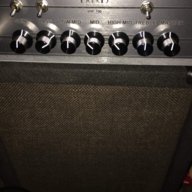
I haven’t heard it, but as with the expensive AER combos, an $1800 combo without reinforced corners doesn’t add up. Additionally, I/O jacks are on the top of the amp, so cabling sticks out and flops over. If your 1/4” cable gets yanked the connectors gonna bend as opposed to popping out of the input.Are you in the speaker design business?
If so, i might be inclined to beleive you, if not, I'll wait to see what happens. I'm sure people have said that speaker design is at the limit many times in the past and been proven wrong.
Would anyone from 1980 or even later than that have believed that a single 10" speaker could handle 300w (rms) in the bass spectrum and sound good on a 10" combo that only weighs 40lbs? Yet that is what Schertler have with their B10, and it is amazing.
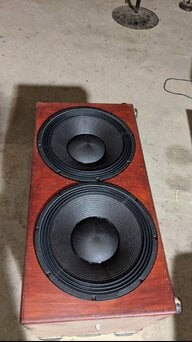


no FOH reminiscent of drive-in movies each table / seat will have it's own speaker, the tips can be paid, and requests for brown eyed girl and freebird can be made from a tablet with a credit card / touchscreen swiper like we are starting to see in restaurants.Microcabinets perhaps? Developing a way to get a great sound out of a single 8" neodymium driver? Also, IEMs for audience with personal volume controls. Like silent disco, but less gimmicky.

One possibility is replacing hardware amps and cabs with software sims and IRs. Maybe run off a hardware device or through a laptop into a PA.At some point the market will morph into something new. Or even old. Any guesses? It took some years for class-D to catch on. In part due to quality, but also unfamiliarity.
The bassist keeps getting smaller and lighter while the guitarist just tucks a laptop under their arm. At what point does the consumer start getting curious for the "real thing?" Or will it be the "next thing" - where the bassist wips out the ol' dumbphone and plays virtual bass uke through the nearest available PA?
everything old is new again...Are you saying that we're all going to become drummers in the future?
I thought most of us left that all behind us.


I guess the obvious question is "what do YOU want from new technology"?
IEM? How quaint. Get with the future! ICCMs are coming. In your cerebral cortex monitors. No buds, no knobs, no wires. Straight to the cortex is where it’s at! Musicians don’t even need instruments, they just will the sound they want. Hell, the audience doesn’t even really need the musicians, they simply hear what they desire. Don’t need the venue, members of the opposite sex or the liquor either, just dial in what you want.
Welcome to the future. We’re looking for people who like to live in tubes
no FOH reminiscent of drive-in movies each table / seat will have it's own speaker, the tips can be paid, and requests for brown eyed girl and freebird can be made from a tablet with a credit card / touchscreen swiper like we are starting to see in restaurants.

Mercedes beat you to it on both counts (the E Class and money).My money is on Class E.

Indeed, it has improved, performance is a million times better but it is still the same basic design. I'm talking about completely different approaches. Here's a quick example via google of one... I'm not thinking this would work for what we are doing, but it's thinking 'outside the box" : Invalid Link RemovedYes and no IMO. Some of the improvements have resulted in major changes in performance, the simple transition from electromagnetic magnets to permanent magnets was one such monumental change, others include things like edge wound voice coils, inside/outside wound voice coils, stronger motors with deeper gaps, differential drive motors, cloth surrounds with unique geometries, linen-Kevlar spiders, polyamide insulation systems, Kapton and fiberglass bobbins, epoxy adhesives, polyester filaments within tinsel wire, advancements in cone materials, double spiders, demodulation rings, vented motors etc. All of these improvements have contributed to speakers with 1/10th the unintended distortion and close to 50x the power handling of earlier speakers while maintaining within 3dB of the best sensitivity of the day.
.
You may be on to something. As (we) baby boomers get older and older and our hearing gets worse and worse, IEM’s for audience members might just be the thing. Imagine sending 6 or so discreet feeds, (stereo drum feed, bass feed, vocal feed, guitar feed, like the mix feeds we use now,) and allowing audience members to create their own mix based on their preferences and/or hearing shortcomings. Or even bypass that for one of a few pre-mixes. The technology is there I think.

That sounds a little like the hearing aid loops used in churches and auditoriums. Those have been greatly appreciated by those folks who have ‘em. And they don’t take a tech support ace to install them and make them work. In a concert you’ll miss out on some of the ambience but I think the upside is pretty clear in your message.It's absolutely here.
mixhalo | a new experience - mixhalo
Metallica had this for some ticket packages on their most recent tour, and I participated in it. The setup is that you connect to a specific wifi network in the venue with your phone, then use the app to stream the audio into your headphones. I had the option of choosing the board mix, or the individual monitor mixes of the band members. I was using my Shure SE215's for this, and since they have a 20dB cut, I had both hearing protection AND excellent audio. It was hands down the best arena sound i've ever heard because of this. I can't imagine seeing a "big" show any other way; it's certainly a lot of additional work to set up for those running the show (and as somebody who works in IT support, i know it would require a whole bunch of additional infrastructure as well as support staff to roll out to a whole venue), but it's REALLY cool.