

Enjoy the benefits of a premium membership!
Upgrade Account
-
TalkBass has been independent since 1998. Add your voice.
Create a free account to reply to discussions, view embedded media, and browse with fewer display ads.
Join free Log in
Want zero display ads or expanded classifieds tools? Compare plans.
You are using an out of date browser. It may not display this or other websites correctly.
You should upgrade or use an alternative browser.
You should upgrade or use an alternative browser.
Classic Yamaha BB5000
- Thread starter Dr. Cheese
- Start date
More options
Who Replied?


I have never seen a poorly made high end Yamaha. Remember, this was the first production BEADG five and the B string is tight. The one problem the very first BB5000’s had was 15mm string spacing.That low B is impressive!
Last edited:

That tight spacing and the weight and chunky necks make them not great for me. But they do sound glorious !! This bass in white was dream me at one time .

Thanks for posting this, Doc... 
A black BB5000 was my first fiver, bought brand new. A stellar instrument in my recollection.
Ah, to be young again....
A black BB5000 was my first fiver, bought brand new. A stellar instrument in my recollection.
Ah, to be young again....
15mm? That would never work for me. That's less than a Warwick.The one problem the very first BB5000’s had was 15mm string spacing.

The later BB5000A took care of the spacing issue. I used mine on a gig last week and at church yesterday and that bass is phenomenal. I've used it on a number of sessions, too. The B-string is enormous and articulate, and every note on the neck is immediate, clear, and full.
It would have been great to have the original passive BB5000 pickups available in a wider spacing, but I have the active P/Js. I've considered dropping in a Flexcore preamp that I have, but the stock 2-band is decent enough.
I sure wouldn't mind finding an all original BB5000, though. I could probably get used to the spacing.
It would have been great to have the original passive BB5000 pickups available in a wider spacing, but I have the active P/Js. I've considered dropping in a Flexcore preamp that I have, but the stock 2-band is decent enough.
I sure wouldn't mind finding an all original BB5000, though. I could probably get used to the spacing.
I would love to have a BB5000A in good condition. I think the Yamaha BBP35 is a worthy successor to the original BB5000.The later BB5000A took care of the spacing issue. I used mine on a gig last week and at church yesterday and that bass is phenomenal. I've used it on a number of sessions, too. The B-string is enormous and articulate, and every note on the neck is immediate, clear, and full.
It would have been great to have the original passive BB5000 pickups available in a wider spacing, but I have the active P/Js. I've considered dropping in a Flexcore preamp that I have, but the stock 2-band is decent enough.
I sure wouldn't mind finding an all original BB5000, though. I could probably get used to the spacing.
Last edited:
It was the very first BEADG five and they literally just stuck another string on a BB2000.15mm? That would never work for me. That's less than a Warwick.
Last edited:
It was the very first BEADG five and the literally just stuck another string on a BB2000.
Well, not quite the very first. It was the first mass-produced 5, I believe. Alembic built the first BEADG 5-strings for Jimmy Johnson in 1976. Those also had narrow spacing, but not quite 5-on-a-4 narrow. I believe that Fodera and Ken Smith were also building BEADG 5-strings by 1984 when the BB5000 was released, but those weren't produced for the masses like the Yamaha.
Still, the Yamaha was pretty seminal in bringing the B-string to the masses, both because it wasn't a boutique custom, and it was being heard on all the latest music of the era through the likes of Nathan East and Abe Laboriel and other session players.
I'm not sure what specific BB bass this is in this clip but I saw this like 20 years ago and always loved the tone of Yamaha BB basses after seeing this:

Great basses. I bought one new in 1985. Toured heavily. Had to retire it after a roadie demolished it and broke the body at the neck. Good times!




At one time, I had collected all three versions of the BB5000.
The OG BB5000 was a response to Nathan East who in the early 80's realized he was going to need some extra low notes to double or compete with keyboard bass which was beginning to show up more an more often. Essentially, Yamaha took a BB3000 and . . . .
Subdivided the existing neck blank/fingerboard for FIVE strings instead of four. That's why the spacing is as tight as it is. Down at the nut, it's barely enough to stick an upright kitchen match between the strings.
Widened the headstock to accept the G-tuner on the high side, for a 4+1 tuning key layout.
Redesigned the P pickup for a 3-wide coil for B-E-A, and two-wide for the D-G, and the brass surround. The blade bridge pickup, honestly I'm not sure if it's not the same from the 4-string BB's. Wired volume, tone, selector switch, Yamaha perfected the blend of the two in those days, and that 3+2 P pickup would not be revisited for years, still not that common in other makes (there's not yet consensus today, you see 5-string P's with either two equal sized shells or the 3+2, depending on whose pickup you're looking at).
Went to a five-string bridge, basically a 'better' bent metal style.
The necks were maple and mahogany, with an unstained Madagascar ebony fingerboard and 'Akembic-ish' mother of toilet seat oval inlays. Yamaha never died these, so you can see these gorgeous chocolate stripes running the length of the fingerboard. The glued-on body wings were alder.
Like most BB's, these axes' native tone was bassy enough with that low mid punch, but hard to make one sound sludge-like thick. In their day, these, as well as the 1200's, 2000's. 3000's and this fella were on a lot of West Coast records.
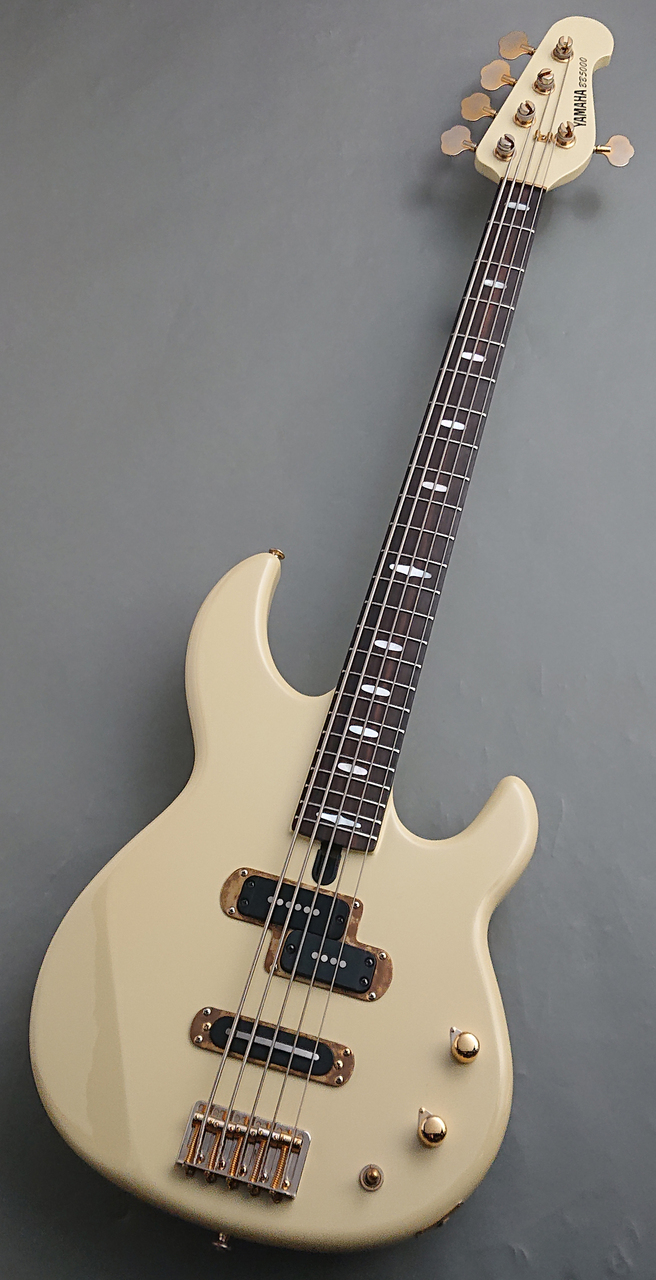
Original BB5000
A few years later, Yamaha updated these to active electronics. So you had these pickups ganged to a volume/balancer/bass +/-, and treble +/-, virtually everything else was untouched. There are a few 'transition' models where instead of this body shape, they went to the same body shape as the A2 models, but with the same pickup/tone network. And then there's some with this body shape and electronics, but TRB pickups.
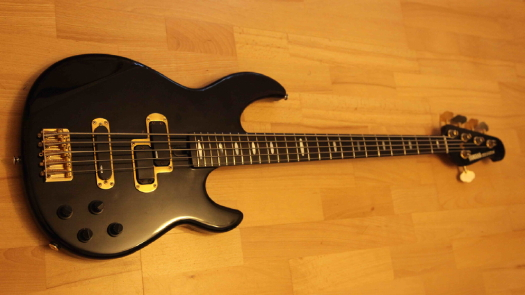
BB500A
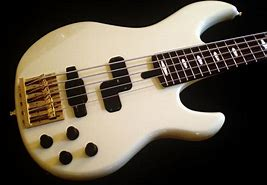
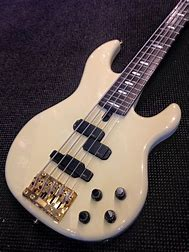
BB5000AII (a2)
Then finally, the 5000AII. THESE were a completely new and different axe. Yamaha had evidently heard enough whiners about the fingerboard width, so this was where they began installing diving boards on necks. Same overall construction and wood blends, just a bigger axe all the way around. Somewhat different tone than the first two, but still very good, with one of the first installs of the TRB pickups. These ran the amazingly intricate Gotoh locking bridge, which was adjustable for intonation (string length), height adjustment, left/right fine-tuning for spacing, and after you got all that straight, each saddle could lock in place. I completely disassmbled mine to lube and shine everything . . . . and it took three hours to reassemble ! ! These were not MIJ, but built in Yamaha's then-new (now closed) Taiwan facility. These were good, but sort of clunky for me, not nearly as graceful as the first two iterations. But you could eat dinner on the fingerboard !
WHEN you could get one (Yamaha was for years NOTORIOUS for back-ordering everything), this was one of the first 'production' five-strings, and you Nate East with his white ones all over MTV, and these cut a lot of records. When you hear Phil Collins' 'Two Hearts' and hear that low C chugging along under the chorus, now you know what you're hearing.
All three were not big production numbers, and I wince when I see some survivors hacked up for different pickups. A real shame.
While we're at it . . .

Master at work, Jimmy Johnson on his Alembic Five.

A little setting the record straight: Several Japanese stores (the Japanese are hugely influenced by Alembic) sell what they call a 'Jimmy Johnson' model. There is no such thing, though this is a pretty close clone to JJ's Series Two fives. Regarding the fingerboard width: Mine were the same as what Jimmy specs his, what Alembic calls their 'classic taper', which on a five is 2" at the nut, and 2.5" at the last fret, a very small amount of flare. In real life, it basically feels like you have the same spacing all the way up the fingerboard, and I it's my favorite taper in a five, but offered nowhere else. The truly eagle-eyed Alembic nerds will notice they reproduced the pin string anchor from one of his axes. It has five 'pins' that you lay the ball end over through the hole. This speeds things up IF you have to change strings RIGHT NOW.
The OG BB5000 was a response to Nathan East who in the early 80's realized he was going to need some extra low notes to double or compete with keyboard bass which was beginning to show up more an more often. Essentially, Yamaha took a BB3000 and . . . .
Subdivided the existing neck blank/fingerboard for FIVE strings instead of four. That's why the spacing is as tight as it is. Down at the nut, it's barely enough to stick an upright kitchen match between the strings.
Widened the headstock to accept the G-tuner on the high side, for a 4+1 tuning key layout.
Redesigned the P pickup for a 3-wide coil for B-E-A, and two-wide for the D-G, and the brass surround. The blade bridge pickup, honestly I'm not sure if it's not the same from the 4-string BB's. Wired volume, tone, selector switch, Yamaha perfected the blend of the two in those days, and that 3+2 P pickup would not be revisited for years, still not that common in other makes (there's not yet consensus today, you see 5-string P's with either two equal sized shells or the 3+2, depending on whose pickup you're looking at).
Went to a five-string bridge, basically a 'better' bent metal style.
The necks were maple and mahogany, with an unstained Madagascar ebony fingerboard and 'Akembic-ish' mother of toilet seat oval inlays. Yamaha never died these, so you can see these gorgeous chocolate stripes running the length of the fingerboard. The glued-on body wings were alder.
Like most BB's, these axes' native tone was bassy enough with that low mid punch, but hard to make one sound sludge-like thick. In their day, these, as well as the 1200's, 2000's. 3000's and this fella were on a lot of West Coast records.
Original BB5000
A few years later, Yamaha updated these to active electronics. So you had these pickups ganged to a volume/balancer/bass +/-, and treble +/-, virtually everything else was untouched. There are a few 'transition' models where instead of this body shape, they went to the same body shape as the A2 models, but with the same pickup/tone network. And then there's some with this body shape and electronics, but TRB pickups.
BB500A
BB5000AII (a2)
Then finally, the 5000AII. THESE were a completely new and different axe. Yamaha had evidently heard enough whiners about the fingerboard width, so this was where they began installing diving boards on necks. Same overall construction and wood blends, just a bigger axe all the way around. Somewhat different tone than the first two, but still very good, with one of the first installs of the TRB pickups. These ran the amazingly intricate Gotoh locking bridge, which was adjustable for intonation (string length), height adjustment, left/right fine-tuning for spacing, and after you got all that straight, each saddle could lock in place. I completely disassmbled mine to lube and shine everything . . . . and it took three hours to reassemble ! ! These were not MIJ, but built in Yamaha's then-new (now closed) Taiwan facility. These were good, but sort of clunky for me, not nearly as graceful as the first two iterations. But you could eat dinner on the fingerboard !
WHEN you could get one (Yamaha was for years NOTORIOUS for back-ordering everything), this was one of the first 'production' five-strings, and you Nate East with his white ones all over MTV, and these cut a lot of records. When you hear Phil Collins' 'Two Hearts' and hear that low C chugging along under the chorus, now you know what you're hearing.
All three were not big production numbers, and I wince when I see some survivors hacked up for different pickups. A real shame.
While we're at it . . .
Master at work, Jimmy Johnson on his Alembic Five.
A little setting the record straight: Several Japanese stores (the Japanese are hugely influenced by Alembic) sell what they call a 'Jimmy Johnson' model. There is no such thing, though this is a pretty close clone to JJ's Series Two fives. Regarding the fingerboard width: Mine were the same as what Jimmy specs his, what Alembic calls their 'classic taper', which on a five is 2" at the nut, and 2.5" at the last fret, a very small amount of flare. In real life, it basically feels like you have the same spacing all the way up the fingerboard, and I it's my favorite taper in a five, but offered nowhere else. The truly eagle-eyed Alembic nerds will notice they reproduced the pin string anchor from one of his axes. It has five 'pins' that you lay the ball end over through the hole. This speeds things up IF you have to change strings RIGHT NOW.
Attachments

Last edited:
At one time, I had collected all three versions of the BB5000.
The OG BB5000 was a response to Nathan East who in the early 80's realized he was going to need some extra low notes to double or compete with keyboard bass which was beginning to show up more an more often. Essentially, Yamaha took a BB3000 and . . . .
Subdivided the existing neck blank/fingerboard for FIVE strings instead of four. That's why the spacing is as tight as it is. Down at the nut, it's barely enough to stick an upright kitchen match between the strings.
Widened the headstock to accept the G-tuner on the high side, for a 4+1 tuning key layout.
Redesigned the P pickup for a 3-wide coil for B-E-A, and two-wide for the D-G, and the brass surround. The blade bridge pickup, honestly I'm not sure if it's not the same from the 4-string BB's. Wired volume, tone, selector switch, Yamaha perfected the blend of the two in those days, and that 3+2 P pickup would not be revisited for years, still not that common in other makes (there's not yet consensus today, you see 5-string P's with either two equal sized shells or the 3+2, depending on whose pickup you're looking at).
Went to a five-string bridge, basically a 'better' bent metal style.
The necks were maple and mahogany, with an unstained Madagascar ebony fingerboard and 'Akembic-ish' mother of toilet seat oval inlays. Yamaha never died these, so you can see these gorgeous chocolate stripes running the length of the fingerboard. The glued-on body wings were alder.
Like most BB's, these axes' native tone was bassy enough with that low mid punch, but hard to make one sound sludge-like thick. In their day, these, as well as the 1200's, 2000's. 3000's and this fella were on a lot of West Coast records.
View attachment 7080720
Original BB5000
A few years later, Yamaha updated these to active electronics. So you had these pickups ganged to a volume/balancer/bass +/-, and treble +/-, virtually everything else was untouched. There are a few 'transition' models where instead of this body shape, they went to the same body shape as the A2 models, but with the same pickup/tone network. And then there's some with this body shape and electronics, but TRB pickups.
View attachment 7080721
BB500A
View attachment 7080727
View attachment 7080734
BB5000AII (a2)
Then finally, the 5000AII. THESE were a completely new and different axe. Yamaha had evidently heard enough whiners about the fingerboard width, so this was where they began installing diving boards on necks. Same overall construction and wood blends, just a bigger axe all the way around. Somewhat different tone than the first two, but still very good. These ran the amazingly intricate Gotoh locking bridge, which was adjustable for intonation (string length), height adjustment, left/right fine-tuning for spacing, and after you got all that straight, each saddle could lock in place. I completely disassmbled mine to lube and shine everything . . . . and it took three hours to reassemble ! ! These were not MIJ, but built in Yamaha's then-new (now closed) Taiwan facility. These were good, but sort of clunky for me, not nearly as graceful as the first two iterations. But you could eat dinner on the fingerboard !
WHEN you could get one (Yamaha was for years NOTORIOUS for back-ordering everything), this was one of the first 'production' five-strings, and you Nate East with his white ones all over MTV, and these cut a lot of records. When you hear Phil Collins' 'Two Hearts' and hear that low C chugging along under the chorus, now you know what you're hearing.
All three were not big production numbers, and I wince when I see some survivors hacked up for different pickups. A real shame.
While we're at it . . .
View attachment 7080744
Master at work, Jimmy Johnson on his Alembic Five.
View attachment 7080746
A little setting the record straight: Several Japanese stores (the Japanese are hugely influenced by Alembic) sell what they call a 'Jimmy Johnson' model. There is no such thing, though this is a pretty close clone to JJ's Series Two fives. Regarding the fingerboard width: Mine were the same as what Jimmy specs his, what Alembic calls their 'classic taper', which on a five is 2" at the nut, and 2.5" at the last fret, a very small amount of flare. In real life, it basically feels like you have the same spacing all the way up the fingerboard, and I it's my favorite taper in a five, but offered nowhere else. The truly eagle-eyed Alembic nerds will notice they reproduced the pin string anchor from one of his axes. It has five 'pins' that you lay the ball end over through the hole. This speeds things up IF you have to change strings RIGHT NOW.
Any idea why they decided to change up the look of the current line up? I really like the classic look of the older BB models with the pickup rings and no pickguard.
Yamaha, like most of the Japanese companies, build their long-range business on a constant churn of new models. VERY rare to see them make the same model for a long time like a Precision or a Les Paul, though a very few like Ibanez' George Benson and Steve Vai models come to mind, albeit with many variations over the years. Start looking at used Ibanez SoundGear basses, and over the years the sheer number of models is crazy, and that's common with Japanese companies.Any idea why they decided to change up the look of the current line up? I really like the classic look of the older BB models with the pickup rings and no pickguard.
As a culture, the Japanese are not into used anything, they only want the latest and greatest.
Instruments are fashion, and fashion changes over time. 80's Japanese basses were profoundly influenced by Alembic. Even a casual glance at the BB's, the Ibanez Musicians, the SB Arias, and you see a lot of Alembic cues and of course neck through construction.
These days, with the bass world utterly dominated by Fender-Shaped-Objects, neck-through instruments are a minority. So the current BB's are a reflection of this, albeit with lots of typical Yamaha engineering simmering under the hood. A current BB735A alongside an active Fender, hell, it's not even fair when you start looking at the features they built into the 7-series BB's. And they answered a long-simmering question in that now, the P and J routs are the 'standard' sizes, where you can sub in anybody's P/J pickups you want to use. In the 80's and up through the 20-teens BB414, 415, etc., they still used bespoke pickups riding in those exclusive pickup rings, and subbing in other pickups involved surgery.
Thanks for the detailed response! That makes a lot of sense, especially the cultural part about Japanese people mostly just being interested in newer items leading to Japanese companies constantly making changes to their products.Yamaha, like most of the Japanese companies, build their long-range business on a constant churn of new models. VERY rare to see them make the same model for a long time like a Precision or a Les Paul, though a very few like Ibanez' George Benson and Steve Vai models come to mind, albeit with many variations over the years. Start looking at used Ibanez SoundGear basses, and over the years the sheer number of models is crazy, and that's common with Japanese companies.
As a culture, the Japanese are not into used anything, they only want the latest and greatest.
Instruments are fashion, and fashion changes over time. 80's Japanese basses were profoundly influenced by Alembic. Even a casual glance at the BB's, the Ibanez Musicians, the SB Arias, and you see a lot of Alembic cues and of course neck through construction.
These days, with the bass world utterly dominated by Fender-Shaped-Objects, neck-through instruments are a minority. So the current BB's are a reflection of this, albeit with lots of typical Yamaha engineering simmering under the hood. A current BB735A alongside an active Fender, hell, it's not even fair when you start looking at the features they built into the 7-series BB's. And they answered a long-simmering question in that now, the P and J routs are the 'standard' sizes, where you can sub in anybody's P/J pickups you want to use. In the 80's and up through the 20-teens BB414, 415, etc., they still used bespoke pickups riding in those exclusive pickup rings, and subbing in other pickups involved surgery.
That's also a good point about the newer basses now using a standard pick up shape/route making it much easier to swap alternate sets of pickups. Still, I do like the look of the models with the pickup rings.

Gorgeous and great sounding bass!
Yep, even though they were well made (as was everything from Yamaha,) due to the tight spacing these did not sell well in the 80's. That all changed when they introduced the TRB-5 model.I have never seen a poorly made high end Yamaha. Remember, this was the first production BEADG five and the B string is tight. The one problem the very first BB5000’s had was 15mm string spacing.

That was one sweet bass!Yep, even though they were well made (as was everything from Yamaha,) due to the tight spacing these did not sell well in the 80's. That all changed when they introduced the TRB-5 model.


