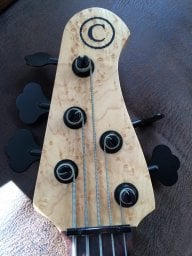
At one time, I had collected all three versions of the BB5000.
The OG BB5000 was a response to Nathan East who in the early 80's realized he was going to need some extra low notes to double or compete with keyboard bass which was beginning to show up more an more often. Essentially, Yamaha took a BB3000 and . . . .
Subdivided the existing neck blank/fingerboard for FIVE strings instead of four. That's why the spacing is as tight as it is. Down at the nut, it's barely enough to stick an upright kitchen match between the strings.
Widened the headstock to accept the G-tuner on the high side, for a 4+1 tuning key layout.
Redesigned the P pickup for a 3-wide coil for B-E-A, and two-wide for the D-G, and the brass surround. The blade bridge pickup, honestly I'm not sure if it's not the same from the 4-string BB's. Wired volume, tone, selector switch, Yamaha perfected the blend of the two in those days, and that 3+2 P pickup would not be revisited for years, still not that common in other makes (there's not yet consensus today, you see 5-string P's with either two equal sized shells or the 3+2, depending on whose pickup you're looking at).
Went to a five-string bridge, basically a 'better' bent metal style.
The necks were maple and mahogany, with an unstained Madagascar ebony fingerboard and 'Akembic-ish' mother of toilet seat oval inlays. Yamaha never died these, so you can see these gorgeous chocolate stripes running the length of the fingerboard. The glued-on body wings were alder.
Like most BB's, these axes' native tone was bassy enough with that low mid punch, but hard to make one sound sludge-like thick. In their day, these, as well as the 1200's, 2000's. 3000's and this fella were on a lot of West Coast records.
View attachment 7080720
Original BB5000
A few years later, Yamaha updated these to active electronics. So you had these pickups ganged to a volume/balancer/bass +/-, and treble +/-, virtually everything else was untouched. There are a few 'transition' models where instead of this body shape, they went to the same body shape as the A2 models, but with the same pickup/tone network. And then there's some with this body shape and electronics, but TRB pickups.
View attachment 7080721
BB500A
View attachment 7080727
View attachment 7080734
BB5000AII (a2)
Then finally, the 5000AII. THESE were a completely new and different axe. Yamaha had evidently heard enough whiners about the fingerboard width, so this was where they began installing diving boards on necks. Same overall construction and wood blends, just a bigger axe all the way around. Somewhat different tone than the first two, but still very good. These ran the amazingly intricate Gotoh locking bridge, which was adjustable for intonation (string length), height adjustment, left/right fine-tuning for spacing, and after you got all that straight, each saddle could lock in place. I completely disassmbled mine to lube and shine everything . . . . and it took three hours to reassemble ! ! These were not MIJ, but built in Yamaha's then-new (now closed) Taiwan facility. These were good, but sort of clunky for me, not nearly as graceful as the first two iterations. But you could eat dinner on the fingerboard !
WHEN you could get one (Yamaha was for years NOTORIOUS for back-ordering everything), this was one of the first 'production' five-strings, and you Nate East with his white ones all over MTV, and these cut a lot of records. When you hear Phil Collins' 'Two Hearts' and hear that low C chugging along under the chorus, now you know what you're hearing.
All three were not big production numbers, and I wince when I see some survivors hacked up for different pickups. A real shame.
While we're at it . . .
View attachment 7080744
Master at work, Jimmy Johnson on his Alembic Five.
View attachment 7080746
A little setting the record straight: Several Japanese stores (the Japanese are hugely influenced by Alembic) sell what they call a 'Jimmy Johnson' model. There is no such thing, though this is a pretty close clone to JJ's Series Two fives. Regarding the fingerboard width: Mine were the same as what Jimmy specs his, what Alembic calls their 'classic taper', which on a five is 2" at the nut, and 2.5" at the last fret, a very small amount of flare. In real life, it basically feels like you have the same spacing all the way up the fingerboard, and I it's my favorite taper in a five, but offered nowhere else. The truly eagle-eyed Alembic nerds will notice they reproduced the pin string anchor from one of his axes. It has five 'pins' that you lay the ball end over through the hole. This speeds things up IF you have to change strings RIGHT NOW.