• TalkBass has been independent since 1998. Add your voice.
    Create a free account to reply to discussions, view embedded media, and browse with fewer display ads.
    Join freeLog in
    Want zero display ads or expanded classifieds tools? Compare plans.

Classical drop-D extension focused build

JIO

Scott Lives
Gold Supporting Member
Commercial User
Jun 30, 2010
49,602
222,027
The Mission SF/CA
www.facebook.com
Disclosures
musician/artist/owner - Gildaxe
Classical double basses in major orchestra's often sport sophisticated extended E string mechanisms. They have beautiful silver levers/stops over an ebony extension - somewhat steam-punk looking but elegantly functional. As a long-time fan and owner of Kubicki Factors featuring his Ex-tended drop-D capo design, I have toyed with the idea of designing a non-headless version. "Non-headless Factor" is sorta like saying "reverse T-bird" or "left handed non-reverse T-bird" as in - a Factor isn't a headless bass, at least not like a Steinberger, the original "headless" bass. Kubicki's Factor stunted 'head' holds the ball-ends of the strings, and provides a platform for the extended 2 frets w/capo for drop-D w/o needing to transcribe on the fly. Open E becomes open D, two extra frets are ready to play and all other fret-notes stay the same. This is what sets his design head-and-shoulders above having a Hipshot drop-D tuner on the E string. How a Factor is similar to the many 'headless' basses is that the tuners are at the butt end of the body. My design will keep the tuners at the hs.

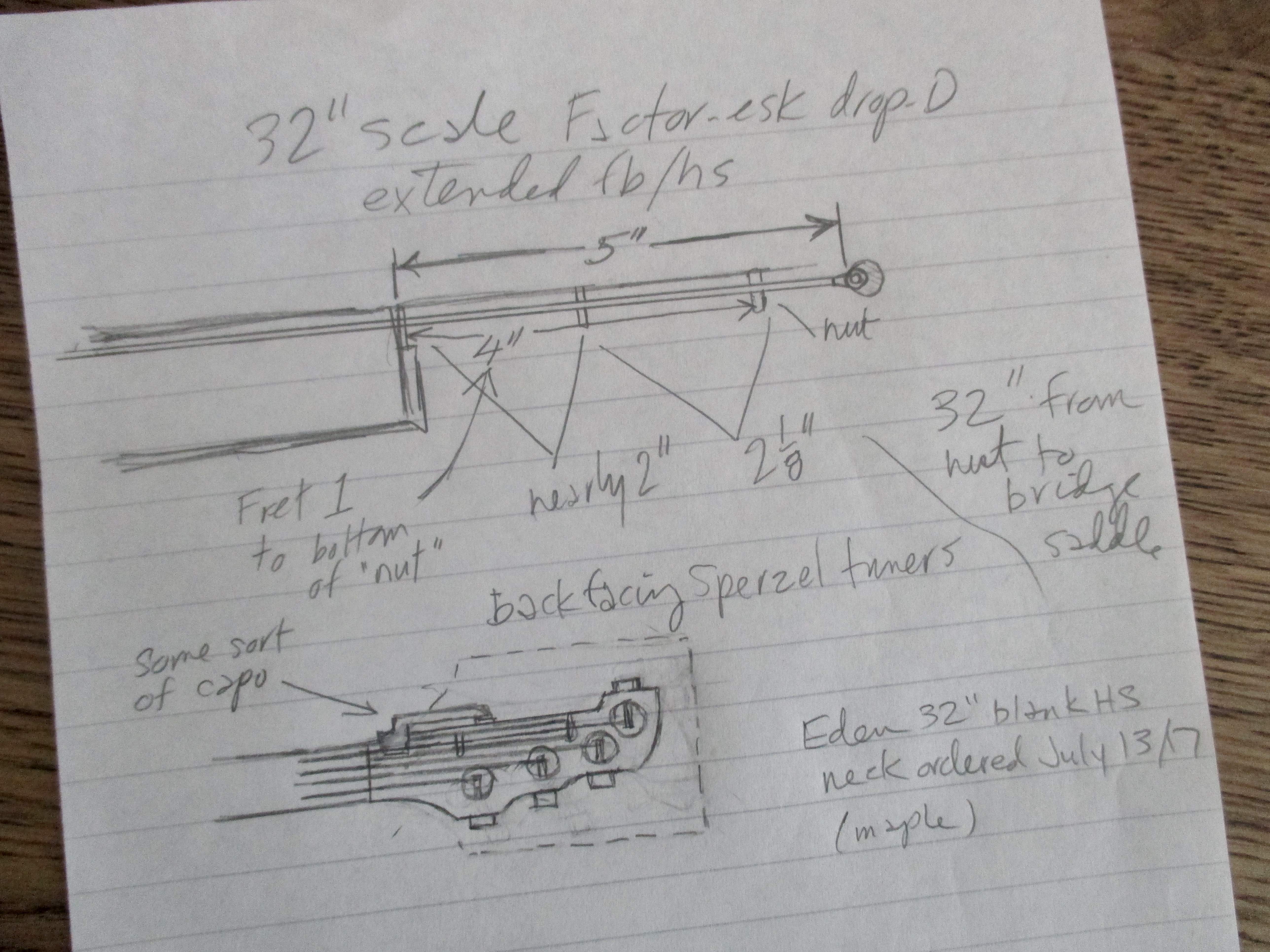
To begin, I ordered a 32" scale Eden paddle-head maple neck and will design the drop-D extension once it arrives. I did a small conceptual sketch that inspired me enough to order the neck (below), but I'd rather have the hs in front of me before going any further. My sketch of the hs design isn't exactly what I want but more of a "something along these lines". I will use back-facing Sperzel locking tuners (like a double bass) and add a maple fb extension with a mini-nut and 2 mini-frets (one at the standard nut position and one to divide the extension). I'll model my capo after Phil's (functionally) and work on how it looks as it develops. No idea what style of body I'll design for it, or what components it will end up with. It's a 32" scale J-style neck (Factors are 32" scale) w/o fb position markers much like the 34" scale Eden maple neck I used on my Gilaxis. So that's all I know at this point. It's sort of an odd challenge to build a bass around the hs design, but I'm odd and like challenges! :) Knowns are as always; needs to be light, ergonomic, balances well, is cool looking and great playing/sounding. Here we go...
fullsizeoutput_cf5.jpeg
 
Subbed.

Really interested to see how this works out.

Jon Shuker does a similar version to the Kubicki. Albeit more elegant in my opinion...
15936340_1118200781612660_587789283178210194_o.jpg


I realise yours will have traditional tuners rather than headless, so may not be that relevant. Also, I'm not sure how the drop D engages/disengages as I've only seen photos from the front......
 
I see a challenge with getting the ends of the strings low enough on the headstock without it being angled at all (which would make the extended frets unusable) given the tuners are actually at the hs as well. Unless I'm not sure exactly how the tuners work by your diagram. Phil achieved that by receding the ball pockets in the fretboard itself. Cool project. Good luck!!
 
  • Like
Reactions: JIO
Subbed.

Really interested to see how this works out.

Jon Shuker does a similar version to the Kubicki. Albeit more elegant in my opinion...
15936340_1118200781612660_587789283178210194_o.jpg


I realise yours will have traditional tuners rather than headless, so may not be that relevant. Also, I'm not sure how the drop D engages/disengages as I've only seen photos from the front......

Thanks for posting this headless take on the concept - the 'capo' is minimal and stealthy but I think I'll stick to a sprung lever as it's pretty easy to engage/disengage.

I see a challenge with getting the ends of the strings low enough on the headstock without it being angled at all (which would make the extended frets unusable) given the tuners are actually at the hs as well. Unless I'm not sure exactly how the tuners work by your diagram. Phil achieved that by receding the ball pockets in the fretboard itself. Cool project. Good luck!!

I'll be creating a ramp-like extension glued to the hs face that should allow this to happen. Like I said, I think it will be clearer what needs to happen once I have the neck in my hands.

Very cool idea, subbed!

Always like having you on board Nexy! :thumbsup:
 
  • Like
Reactions: mapleglo
Hey, JIO;
Yeah, I think this is a workable idea. A few things to figure out, but that's the fun of it! You'll need to do a full size layout to see how the tuners need to be positioned. The tuners will be somewhat bigger than they look in your sketch. The holes for the tuners will probably end up being oval shaped, rather than round, because you need to have a flat spot on the outboard side for the tuner's bushing. It needs the bushing to support the load. Also, you're probably going to need to need some kind of radiused metal contact block at the forward edge of each tuner hole. The string is going to have to bend down at a sharp angle, to get down into the hole and around the post. It can do that, but it needs to rub on a radiused metal surface, not painted wood.

Another detail to think about: when you build a bass with back-facing tuners, you are probably going to have some problems fitting the headstock into standard cases. Most available cases don't have the necessary thickness in the headstock area. This is a problem I've run into with my Scroll Basses.
 
Hey, JIO;
Yeah, I think this is a workable idea. A few things to figure out, but that's the fun of it! You'll need to do a full size layout to see how the tuners need to be positioned. The tuners will be somewhat bigger than they look in your sketch. The holes for the tuners will probably end up being oval shaped, rather than round, because you need to have a flat spot on the outboard side for the tuner's bushing. It needs the bushing to support the load. Also, you're probably going to need to need some kind of radiused metal contact block at the forward edge of each tuner hole. The string is going to have to bend down at a sharp angle, to get down into the hole and around the post. It can do that, but it needs to rub on a radiused metal surface, not painted wood.

Another detail to think about: when you build a bass with back-facing tuners, you are probably going to have some problems fitting the headstock into standard cases. Most available cases don't have the necessary thickness in the headstock area. This is a problem I've run into with my Scroll Basses.

:thumbsup: All good points noted Bruce - as you stated "that's the fun of it", figuring it all out. I thought about oval openings, maybe even tear-drop shaped. The Sperzels are pretty minimal and should be perfect for their use here. Even fitting a case - the hs is a Fender-style (scallloped flat) so as long as the case has a sufficient cradle the tuners should have enough room.
 
I like that terraced HS sketch. Very curious to see how it all evolves. Factor bodies are a little too modern to me, but considering how you sometimes like "Future Retro" styles, I'm thinking that the Factor body shape kinda sorta reminds me of those wacky Reverend pickguards, and those have some terracing too:

1823-RUM-TUR-1.jpg


Part of the fun of watching your builds is seeing how you choose and combine your visual references, so design away!

1dc.gif
 
Look forward to seeing what you do. There are sometimes similar headstocks on classical guitars, often ones with 8 or more strings and occasionally more than one string will have the headstock extension - occasionally different amounts of extension for different strings. Anyway, if you look at some of these you may find some inspiration/ideas.
 
  • Like
Reactions: JIO
I like that terraced HS sketch. Very curious to see how it all evolves. Factor bodies are a little too modern to me, but considering how you sometimes like "Future Retro" styles, I'm thinking that the Factor body shape kinda sorta reminds me of those wacky Reverend pickguards, and those have some terracing too:

1823-RUM-TUR-1.jpg


Part of the fun of watching your builds is seeing how you choose and combine your visual references, so design away!

1dc.gif

Thanks and good eye Chris! It will be hard to beat that retro-modern design (but I'll try!) :)

Looking forward to it. I always liked the ExFactor concept. Never could afford one though.

Yes, unfortunately Factors have finally reached a resale it always deserved. When I got my first in '94 (a very played '86) I called Phil to inquire about it and he asked how much I bought it for. ($750) After telling him he said; "for that price, I would have bought it!"

I always enjoy your builds... This one is no exception.

Subbed.

Moonshine :bassist:

Thanks! :) The feeling is mutual!

Look forward to seeing what you do. There are sometimes similar headstocks on classical guitars, often ones with 8 or more strings and occasionally more than one string will have the headstock extension - occasionally different amounts of extension for different strings. Anyway, if you look at some of these you may find some inspiration/ideas.

Interesting - I will check that out Geoff. When I think of tuning articulators I always think of Micheal Manring - he lives in the Bay Area, knows people I know and I've seen him play a number of times. 4 strings, all with hipshot de-tuners and a de-tunable bridge (and two E-Bows taped together). What he does with that is simply amazing - such a beautiful player!
 
  • Like
Reactions: saltydude
I had a bass with a drop D extension on the low string back in the 70s, with a lever to hold it in E, or when flipped open, an Eb fret, or open D could be used.
The bass was built by a luthier named Robert Pascoe who made the bass in the style of a gamba, similar to the 5 string he made for me a few years later, below.
IMG00195-20110307-1942.jpg

and a recording of the 1st bass.
Invalid Link Removed
 
  • Like
Reactions: Eli_Kyiv
I had a bass with a drop D extension on the low string back in the 70s, with a lever to hold it in E, or when flipped open, an Eb fret, or open D could be used.
The bass was built by a luthier named Robert Pascoe who made the bass in the style of a gamba, similar to the 5 string he made for me a few years later, below.
IMG00195-20110307-1942.jpg

and a recording of the 1st bass.
Invalid Link Removed

Nice playing! :bassist: I've got a couple of those "Promotional Copy- Not for Sale" LP's - sounded right in there with other music of that era. :thumbsup: The 5-string is interesting - would the 9th fret act as a nut/capo playing the fretless section below?
 
I'm thinking the tuners will get in the way of (or at least make awkward) playing those extra frets, in a non-headless mode.

In a broader sense, I tend to think BEAD is the simple approach to the low-range extension, but then, I'm the sort of (no doubt about it, limited) player that has almost no use for high-range and could probably get by on 3 low strings and about 6-8 frets.
 
The bass in my photo, is partially fretted/partially fretless so not cappoed(is that a word?)per se, but yes. the drop D worked sort like a capo for any songs in keys like E where a low Eb or D were not needed. Dropping the lever was easily accomplished in a flash, not quite so quickly getting it back to open E though, but easy enough between songs.
And on my custom bass, the tuners did not get in the way, because they were set up in string bass fashion, pointed back, and out of the way, as opposed to up and down like most bass guitars.
And on my bass, the highest note was Bb above the double octave, so was also easy for playing very high notes.
BTW, thanks for the compliment.
 
Last edited:
  • Like
Reactions: JIO
An interesting one I found in my travels today...

[Invalid or Expired Link Removed]

Yes, I like the hs design but it looks to be a 'stop-and-engage' capo as compared to an 'on-the-fly' capo like Phil Kubicki's Ex-Factor. I'll aim for this design as I think it's more efficient.

I'm thinking the tuners will get in the way of (or at least make awkward) playing those extra frets, in a non-headless mode.

Good point and will be part of the problems to solve.
 
A completely different thought process here.... what about a 3 string nut (A,D & G strings) placed in the second fret position? Use a sort of mechanical capo for the E string. This would allow the conventional headstock style to be utilized. Obviously this would change your bridge placement to compensate for the slight scale change ( and you were going shorter scale anyways). The nut for the E string could be a zero fret.
 
A completely different thought process here.... what about a 3 string nut (A,D & G strings) placed in the second fret position? Use a sort of mechanical capo for the E string. This would allow the conventional headstock style to be utilized. Obviously this would change your bridge placement to compensate for the slight scale change ( and you were going shorter scale anyways). The nut for the E string could be a zero fret.

That could work - food for thought...
 
  • Like
Reactions: wmhill