• TalkBass has been independent since 1998. Add your voice.
    Create a free account to reply to discussions, view embedded media, and browse with fewer display ads.
    Join freeLog in
    Want zero display ads or expanded classifieds tools? Compare plans.

Classical drop-D extension focused build

This is the 4th bass I built. A multiscale fretless (would you believe) that I entered in a TB 3 wood build comp. Flat board, headless, trapezoidal neck profile and... a D extension.
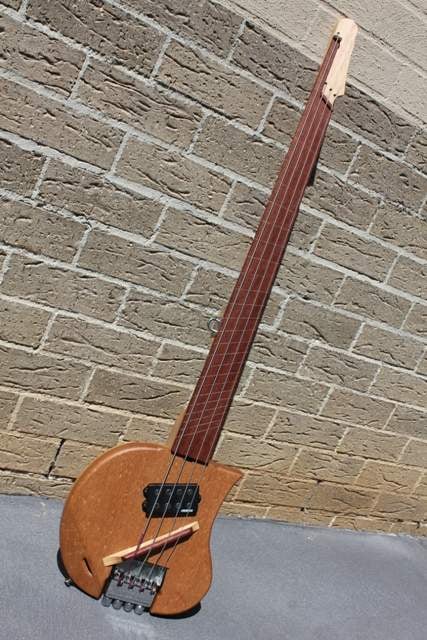
fanned01.jpg


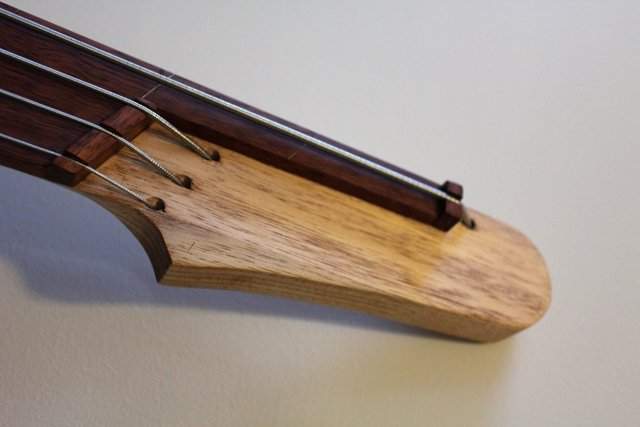
I was modelling the headstock off the Factor bass.
headstock.jpg


neck.jpg


Let me tell you what I learned. Every edge and lower point on the headstock got in the way of playing Eb. The bass itself sounded enormous, but the D extension was a pain because of the fendery point and the sharp edges. I suspect the tuners will be similar in getting in the way. On the subject of upright bass (I've been playing for 24 years), C extensions are pain in the rear for all the same issues. Tuners, knobs, etc, etc all get in the way of your left hand. The best C extensions have mechanical actions like the one below.


I'm not saying, "don't do it", but you'll need to build a few models to find a way that doesn't feel like you're trying to wrap your left hand round the remains of a broken, grandfather clock.
 
Hmm. I'm sure that I am missing something (and please be sure to smack me down if that's the case) but I can't visualize how putting tuners (especially with rear-ward facing keys) would make that extra fret very playable from an ergonomic point-of-view.

I love the idea and I was obsessed/intrigued with the concept from the ExFactor when I was in high school, but, unless your fingers are really long and have an extra joint, I don't see hitting that fret very comfortably with tuners on the head.

(Maybe with the headstock angled back but the fingerboard extension remains flat...?)
 
  • Like
Reactions: T_Bone_TL
Although the bass in the photo is not the bass with the extension (the extension bass disappeared at least a decade ago) this 5 string bass
fullsizeoutput_4d2.jpeg
was built be the same luthier.
You can easily see how an extension on the low string could be accessed by the stretch of the 1st finger beyond the nut.
At least is was for me. The extension simply extended the length of 2 frets, above the nut, and did not interfere with tuning in any significant way.
Just as in a string bass I had with a C extension, which was longer than 6 inches.
 
This is the 4th bass I built. A multiscale fretless (would you believe) that I entered in a TB 3 wood build comp. Flat board, headless, trapezoidal neck profile and... a D extension.

View attachment 1179383

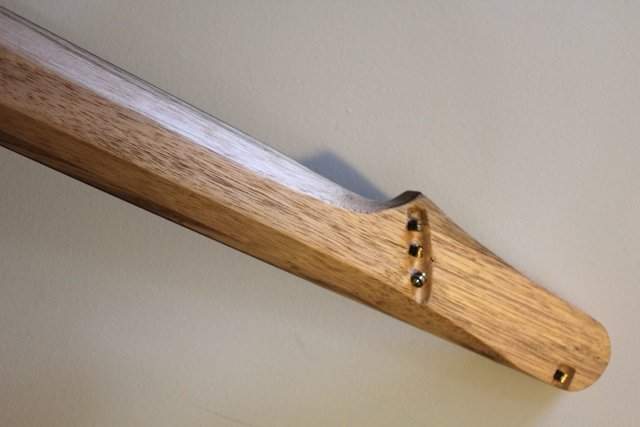
I was modelling the headstock off the Factor bass.
View attachment 1179377

View attachment 1179378

Let me tell you what I learned. Every edge and lower point on the headstock got in the way of playing Eb. The bass itself sounded enormous, but the D extension was a pain because of the fendery point and the sharp edges. I suspect the tuners will be similar in getting in the way. On the subject of upright bass (I've been playing for 24 years), C extensions are pain in the rear for all the same issues. Tuners, knobs, etc, etc all get in the way of your left hand. The best C extensions have mechanical actions like the one below.


I'm not saying, "don't do it", but you'll need to build a few models to find a way that doesn't feel like you're trying to wrap your left hand round the remains of a broken, grandfather clock.


Awesome build reverandrally! (your fan-fret)

The neck I ordered should show up any minute now (due today) - I've done nothing yet while waiting for it and appreciate all the related info on extensions. Frankly the aspect I like most about the Ex-Factor which I will try to emulate is an easy capo flip to an open D that doesn't affect standard fretting. (as in, an F/G/A etc is in the same place on the fb) Not having this is what I don't like about a Hipshot D-tuner. I mean, it's not like I'll be playing a solo on the extension ramp right? (bass solo's are feared as it is...) So it will be a goal to make playing in that zone available/accessable but it doesn't seem unreasonable that I can do it with minimal tuning keys incorporated. And finally - only going for open D, not low C.
 
Last edited:
Although the bass in the photo is not the bass with the extension (the extension bass disappeared at least a decade ago) this 5 string bassView attachment 1179826 was built be the same luthier.
You can easily see how an extension on the low string could be accessed by the stretch of the 1st finger beyond the nut.
At least is was for me. The extension simply extended the length of 2 frets, above the nut, and did not interfere with tuning in any significant way.
Just as in a string bass I had with a C extension, which was longer than 6 inches.

That's some crazy cross-stringing going on there!
 
Hmm. I'm sure that I am missing something (and please be sure to smack me down if that's the case) but I can't visualize how putting tuners (especially with rear-ward facing keys) would make that extra fret very playable from an ergonomic point-of-view.

I love the idea and I was obsessed/intrigued with the concept from the ExFactor when I was in high school, but, unless your fingers are really long and have an extra joint, I don't see hitting that fret very comfortably with tuners on the head.

(Maybe with the headstock angled back but the fingerboard extension remains flat...?)

We'll see...
 
  • Like
Reactions: CosmoReverb
First pass at the concept - this one using the Sperzel tuners in a standard side mount. The E/D 'ramp' being added on the standard beveled hs face so it continues at the same level from the fretboard. Not shown but probably a bar string-flattener across the A/D/G strings (re: string tree) to lower the hs sting profile close to the hs face. Dotted line is a back-side scallop/taper for less obstruction/more comfort above the standard nut level. Capo pretty much like a slimmed-down Factor, at least to start with.

It's a little odd looking, but certainly unique and it more or less addresses the functional needs. Will work up another sketch with the tuners mounted like an upright.

IMG_1535.jpg
 
Last edited:
Ah, that makes sense. I dig it!

Would it be simpler (and perhaps more "even" sounding) to just extend the zero fret across the whole fingerboard?

Do you mean the stubby E fret continued below the A/D/G nut? That is a good point yes... I'm not so versed in zero frets so if anyone has further insights here I'm all ears.
 
That sketch is outstanding. The curve of the outside of the tuners and the tip of the headstock is really special. It's pretty rare that the tuners are included in the flow of the headstock!

I'm curious how your tuners will be set depth-wise, considering how close the E/D is to the edge of the fretboard extension. If the tuning posts sit low enough it would be great if you could avoid a string retainer for the others so you don't have to step on those beautiful lines and curves.
 
  • Like
Reactions: mbelue and JIO
Do you mean the stubby E fret continued below the A/D/G nut? That is a good point yes... I'm not so versed in zero frets so if anyone has further insights here I'm all ears.

A zero fret is the doing the job of the nut, as far as the string height is concerned, the nut proper is merely for string spacing then, and the nuts placement doesn't figure into scale length (as it's be hind the zero fret). The zero fret is higher than the others, I think by about 10/1000th- but please don't hold me to that, my memory ain't what it used to be.
 
  • Like
Reactions: BritFunk and JIO
That sketch is outstanding. The curve of the outside of the tuners and the tip of the headstock is really special. It's pretty rare that the tuners are included in the flow of the headstock!

I'm curious how your tuners will be set depth-wise, considering how close the E/D is to the edge of the fretboard extension. If the tuning posts sit low enough it would be great if you could avoid a string retainer for the others so you don't have to step on those beautiful lines and curves.

:) Thanks Chris! Well, starting with a blank canvas (paddle hs) I have options, but a standard Fender-style has (essentially straight from the neck with a scalloped face) a string-retainer, as compared to a set-back Gibson style hs. The need for a flat plain is compounded because (minimal) right-hand access is required to fret the 2 above nut frets (if needed). I'm imagining the type of thin tubular upside down "staple" bar that you see on the 60's Teisco's etc - minimal and effective.

A zero fret is the doing the job of the nut, as far as the string height is concerned, the nut proper is merely for string spacing then, and the nuts placement doesn't figure into scale length (as it's be hind the zero fret). The zero fret is higher than the others, I think by about 10/1000th- but please don't hold me to that, my memory ain't what it used to be.

That sounds right - the (higher) fret is at the correct 32" to bridge scale and the nut is above it acting only as a spacing stabilizer. My next question is related to the fret - as in exactly how is it elevated higher than the others? And another question - what if I ordered one of those nut/zero fret thingies and installed that on this neck. Would that work?
 
That sounds right - the (higher) fret is at the correct 32" to bridge scale and the nut is above it acting only as a spacing stabilizer. My next question is related to the fret - as in exactly how is it elevated higher than the others? And another question - what if I ordered one of those nut/zero fret thingies and installed that on this neck. Would that work?[/QUOTE]
It's just a regular fret, only higher and placed where the nut would be traditionally. I'm not sure how you would compensate for the Eb fret and the nut height, but i'm sure there would be a method. Here is a pic of the zero fret on my bass, note the nut is behind it.

zerofret 20170720_211414.jpg
 
  • Like
Reactions: JIO
There have been many long, argumentative threads here on TB about zero frets and whether they should be equal in height to the other frets, or raised slightly higher. I like zero frets, and use them on almost all of the basses I build. I trim my zero frets to 0.010" to 0.015" higher than the others. That's the number that has worked best for my basses. Actually, I use the same size fretwire for the zero fret as the others. Then I level all the others down, without touching the zero fret, until I get that 0.010" height difference. I measure it using a homemade gauge, which puts a straight bar on frets 1-3, and has a dial indicator touching on the zero fret.

Some will argue that the zero fret should be the same height as the others, and there's some theoretical validity to that. But most of us who work with fretwork and zero frets all the time know from experience that it just works better to leave the zero fret a bit higher. Lower action and less buzz. Without getting into a complicated argument, the reason why this is, in my opinion, is that most necks get thicker right at that spot where the zero fret is, where it blends into the headstock. As a result, when the neck pulls into a relief curve under string load, the curve ends up with a flat spot right about at the nut. The thicker area of the blend keeps the neck from curving right there. The extra height of the zero fret or the nut slots compensates for that flat spot, bringing the contact surface up to where it should be on the relief curve.

Anyway, you could do this headstock with zero fret(s). Use a single piece of fretwire all the way across at the normal zero line, and the same size wire as all the others, including the ones on the extension. Then, level all the frets on the A, D and G without touching the zero fret. Take them down to 0.010" below the zero fret. Then level the long D/E string frets all the way up to, but not including the last short fret. So, the zero fret will end up with a 0.010" step down as it goes under the D/E string. Leave the little short fret out at the end of the extension untouched, 0.010" high.

Add an aluminum string spacer for the A, D and G strings just beyond the zero fret. A simple way to make one is from a piece of 1/4" square aluminum, with filed slots and held down by two 4-40 socket head machine screws, threaded right into the neck wood. You may need a similar little string spacer up at the end of the extension. Or maybe not. It's so close to the tuner that the string may not move around at all.
 
Thanks all for getting me up to speed on zero fret technology - need to filter it through the geometer :) Also need to order some Sperzil tuners. I have at least 2 hiding somewhere in a box of parts I can't locate since my recent move... once I order more, they will most likely appear.
 
  • Like
Reactions: moonshinegtrs
While waiting for my Sperzel tuners to arrive, I wanted to post this Geo tangent...

I essentially started Gildaxe years ago after seeing The Cocteau Twins guitarist Robin Guthrie play a super cool custom guitar on an early 90's Jay Leno show. (their 1st US TV appearance) So 'of the time' with Robin wearing plaid (!) and the acoustic guitarist wearing a homely dress & necklace (with black ankle-socks and boots!) Ah, the emo/grunge years...


Anyway - never knew where it came from until just now I saw this - Link Removed ...the very guitar he was playing! In fact, Russell Fong is currently based in East Palo Alto! (via London & NYC) - just south of here. I think I should make contact with him!

russell fong - robin guthrie guitar.jpg


Here was my response to seeing that guitar - it was also my 1st Gildaxe sale! Etched silver leaf over black w/tinted red area. I call it my "Shatterburst" finish. I tried to make the red circle look 3D with shading, like a molten core smashing through the ambe'd silver shards. I know, kinda trippy... :rolleyes: but a nice sounding/playing bass and the owner loves it!

Gildaxe Shatterburst .jpg
Gildaxe Shatterburst -back.jpg