• TalkBass has been independent since 1998. Add your voice.
    Create a free account to reply to discussions, view embedded media, and browse with fewer display ads.
    Join freeLog in
    Want zero display ads or expanded classifieds tools? Compare plans.

Club Sadowsky!!!

how about both? :D

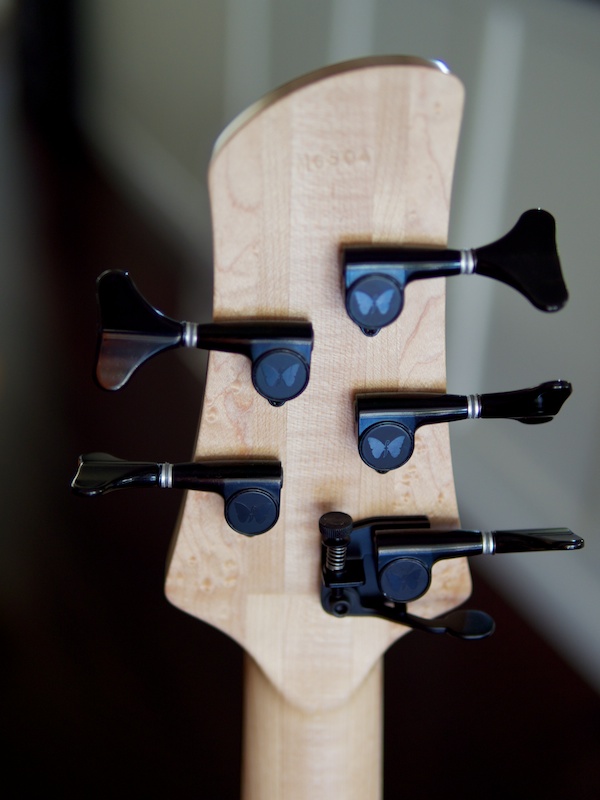
mgs-6.jpg
Leave it to Harpo to toss the wrench in the works, since until this moment, we were all referring to 5's as implying a low B.

Take yer coffee vending coat elsewhere please. ;) :D
 
Yep, this is what I was getting at, except I think it's more than a few in recent years.

But yeah, still the lion's share is good with 4 strings. Then you talk to people like Jeff Berlin, Victor Wooten, and many others, who are perfectly fine long term on 4's... if not as their sole instrument, at least their primary (noting Victor does own and fairly regularly plays a 5, too).

Always an interesting discussion. IMO, no one 'needs' a 5 string or a 6 string (and Tony Levin, years ago, showed that really no one 'needs' a 4 string:D).

IF, like me, you are comfortable playing a 5 string (i.e., if you have mastered the muting of that extra string), then IMO, unless you slap ALL the time (muting that B can be a bother when slapping), there is very little downside to that extra string. Of course, the 6 string guys say the same thing to the 5 string guys. I never could master the muting of a 6 string though, and the necks are just too big for me (or course, the same argument is valid for guys who prefer 4 strings to 5's).

The only thing that makes little sense to me is that drop D tuning on a 4 string. Probably due mostly to my ignorance of it, but just having an extra step down on one string seems pretty trivial. The 5 and 6 string 'advantage' is IMO, primarily the ability to vary/change hand positions and play difficult passages a bit more easily in some cases.

Of course, being able to cover a few synth parts 'as written' is cool on the 5, but is a minor thing IMO. And, of course, if you are a 'chording/soloist', the C string is great (whether on a 6 string or a 5 tuned # to C).

There is no gig, nor actually any tune that I couldn't play on a 4, 5, or 6, so IMO it isn't really about that.
 
Hi


D tuner is cool for me because I play a lot of tunes that were written that way. In other words, pull offs and such that are done with the E string tuned to D. If I was playing 5, I'd have to dune my e to d so I might as well leave it home.

Rob
 
Chef said:
why D tuners instead of a 5th string?

bass12 said:
D-tuners just confuse me. I can`t adjust to the switch in note location on the neck.
You think thats a mind destroying task? Try a badg tuning.....a dropped e to low b is a mind bending task to say thw least.
I can play as well on a dropped d as I do on standard tuned e.
In fact I've tuned to dropped d and set the dtuner to drop to c.

Plus to my ears, a detuned e down to d sounds better than a fretted d on a 5.

I prefer to play a 4 anyday. And if I know the gig doesnt require me to play lower than d I'll take a 4 everytime.
That being said a 5 was my main bass for years at one point.

With the double stop lever I've taken my 4 on gigs where I would have normally taken a 5.
 
KJung said:
The only thing that makes little sense to me is that drop D tuning on a 4 string. Probably due mostly to my ignorance of it, but just having an extra step down on one string seems pretty trivial.

There is no gig, nor actually any tune that I couldn't play on a 4, 5, or 6, so IMO it isn't really about that.


Trivial unless you play a lot of songs that require that low D, then its pretty important. Of course the real reason to use a detuner is to prevent tuning/detuning in between songs.
 
fwiw I used to ignore or even remove D-tuners. The latest bass came with one and I decided to mess around with it. Now I'm sold. Yes, you have to keep your wits about you after you flip the lever, but being able to pedal that low D on certain tunes while comping or doing other lines can be very cool. I now use it probably 3 or 4x a gig.
 
My first bass was a 5 string, and I have huge hands, so I never really felt comfortable on a 4. But lately, as I've been doing more studio work, I'm starting to think that I want to get one 4 string...like Ken mentioned above it's hard to completely mute the B string when slapping. Not a big deal at all when playing live, but there are times in the studio if I'm asked to do slap that I'll listen back and can hear a bit of ringing.

I've also noticed that B strings work as well in the studio - even on great basses like Sadowsky, Alleva-Coppolo, Ken Smith, etc. When I go to a B string I can see in the audio wave file the increase in volume which ends up affecting how it fits in the mix.

No issue with live playing at all...but I may want to get used to a 4 string at some point just for the studio.
 
Not a Sadowsky player, but I am a fan of both Jazz basses and Roger's take on them. Roger's strings are also fantastic. And like a few others, I wish he offered them in a 6 string version or a high C option.

Anyway...

I'm a 5 string guy, thru and thru. That's what I started on. I have huge hands as well and a 5 string neck just feels right to me. With that being said, I've rarely used the low B when I've had it. I've tried all different types of strings and have had some really great basses that are known to have good-great B strings. I recently strung a 5er up E-C and I hated it at first. But I have really come to enjoy that tuning. I don't solo in a band setting, but I have found that I can get the meat of my work done on the E-G strings and add that C in for some flavor occasionally. I just haven't found a B string that I've really enjoyed. If the tension feels good, they tend to sound unnatural to the rest of the set. If they sound natural with the rest of the set the tension is too low for me. :(
 
Not a Sadowsky player, but I am a fan of both Jazz basses and Roger's take on them. Roger's strings are also fantastic. And like a few others, I wish he offered them in a 6 string version or a high C option.

Anyway...

I'm a 5 string guy, thru and thru. That's what I started on. I have huge hands as well and a 5 string neck just feels right to me. With that being said, I've rarely used the low B when I've had it. I've tried all different types of strings and have had some really great basses that are known to have good-great B strings. I recently strung a 5er up E-C and I hated it at first. But I have really come to enjoy that tuning. I don't solo in a band setting, but I have found that I can get the meat of my work done on the E-G strings and add that C in for some flavor occasionally. I just haven't found a B string that I've really enjoyed. If the tension feels good, they tend to sound unnatural to the rest of the set. If they sound natural with the rest of the set the tension is too low for me. :(

I can't imagine not having a low B string. I've played fives for so long that I find it confusing and limiting to only have four strings. But I've also struggled with "the right B-string" issue from time-to-time. For the most part, I like low-gauge strings (40-100), but with a 130 B. If I'm playing Sadowsky strings, the B's tapered of course. But for D'Addario, MTD or DR, I prefer a fully-wound B.

I just put DR medium gauge Low-Riders on this bass after struggling with light-gauge Sadowsky Blue steel strings for a while. Much better (probably due to the higher gauge)!

SadowskyMPfull.jpg


The C string sounds like fun, but I'll bet your ideal B is out there somewhere!

Greg
 
Hi


Lol. Having fun. Lets be honest though. Anything you cover from the 50s, 60s, 70s, 80s is an automatic no 5 string needed. And just a few tunes the last 15 to 20 years since they've become popular. I even play a church gig the last 5 years and have been required to have one.

For stuff from the 50s, 60s and 70s it depends on whether you're playing the songs in the original keys. My fives have definitely come in handy on the odd oldie that has been transposed to a lower key to suit the singer's needs. As for the 80s - five stringers might not have been prevalent at the time but there was a ton of synth bass lines which made use of notes lower than a low E (and perhaps a surprising number of detuned E strings as well). How many of those tunes you're likely to play in a cover band, of course, is another story - but I remember always being frustrated playing INXS' "Need You Tonight" on a four! :D

 
For stuff from the 50s, 60s and 70s it depends on whether you're playing the songs in the original keys. My fives have definitely come in handy on the odd oldie that has been transposed to a lower key to suit the singer's needs. As for the 80s - five stringers might not have been prevalent at the time but there was a ton of synth bass lines which made use of notes lower than a low E (and perhaps a surprising number of detuned E strings as well). How many of those tunes you're likely to play in a cover band, of course, is another story - but I remember always being frustrated playing INXS' "Need You Tonight" on a four! :D

Agreed. Playing in a cover band with a 40 year old male singer frequently required notes below E. The 5er is helpful in those situations.
 
guy n. cognito said:
Agreed. Playing in a cover band with a 40 year old male singer frequently required notes below E. The 5er is helpful in those situations.

This is exactly the situation I've found myself in. After 20+ years with a 4 I moved to a 5 last year. The size of the neck and extra string is not always comfortable, but I'm getting used to it and find the 5 very useful. My current band tunes to E flat, but I keep my MV5 tuned standard and rely on the B string for the low E-flat.