• TalkBass has been independent since 1998. Add your voice.
    Create a free account to reply to discussions, view embedded media, and browse with fewer display ads.
    Join freeLog in
    Want zero display ads or expanded classifieds tools? Compare plans.

Club Sadowsky!!!

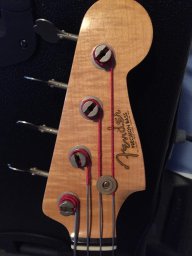
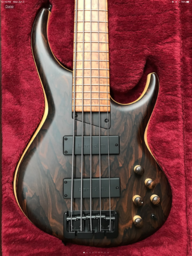
A quick shot of my new-to-me NYC modern jazz. It's the perfect complement to my MV5.

It's ash with flamed/spalted maple top, ebony board. I believe it's 60's position SC pickups. Chambered and weighs about 8 lb. It's in perfect condition, made in 2010.

IMG_7350_zpsa35baeb5.gif

Nice score!!
 
Thank you very much for your input !

I will let you know the result.

Yes, that was for you. It sounds like you may be adjusting the bridge when you should be first adjusting the truss rod to flatten the neck. With the string fretted at the two ends of the fingerboard there should be very little distance between frets and string at the 12th fret.

If that doesn't work, neck pocket shims work perfectly.
 
Single coils installed per forum recommendations. Totally different bass. Tone sounds like a 60s Jbass. Much more mids and the bridge pup can now get a barky tone I'm used to. I'm keeping the HCs though, because the slap tone of the HCs was something special, but now the bass really is much warmer/fuller/woodier sounding. It lost a little of the articulation it had on the high end when slapping, but overall it was a move (dramatically) in the right direction for the collection of basses I own. Thanks for the input guys.
 
Two questions fellow Sadowsky players (or those with knowledge):

1. I have a fairly new RV4, had it less than 4 months, and after not playing it for about three weeks it no longer works in active mode. Switched the 9v, checked connections etc, and still only works in passive. I am by no means an electrician, nor do I have a lot of experience with preamps, but I'm not afraid to work on the bass myself. Anyone have some troubleshooting suggestions? Ideas of what may be going on?

2. Also, anyone have a good recommendation for an aftermarket bridge for the RV4 with adjustable string spacing? Say, 17-19mm? I would like to tighten them up just a bit. I've used a badass before, would that fit on the RV?

Thanks for any help!

Sounds like the circuit might have failed. If you are in Chicago, I recommend you bring it to Carl Perdigo at:
http://www.chicagobassdoctor.com/. If you are the original owner, I will cover this under warranty. If you feel you can replace the circuit board yourself, please email me.

We offer a 19mm 4 string bridge (yours is 20mm). I can also recommend the Hipshot Style A which comes in several adjustable string spacings. I do not recommend the Badass.

Roger
My recommendation doesn't amount to a hill of beans next to Roger's, but I'll nevertheless heartily endorse Carl. I've been going to him for 7 years for all necessary work, and he is an amazing craftsman as well as a great guy. He still works part-time for Lakland (they're in the same building, FYI) while otherwise doing his own thing.:)
 
Vic,

do you mean that to put a shime is a good thing ?
Or do you warrenty pickles ?
(or Pickles is right ?)
Sorry guys my english a bit short....:rolleyes:
LOL!

A thin shim is just a simple and effective way to increase your ability to lower the action on a guitar/bass if you run out of saddle adjustment and everything else is correctly set up. It's done all the time on instruments at every quality/price level. It's no big deal.

I'm just saying pickles' advice is exactly right. Try making sure the setup is correct first, and if that doesn't get you there, a tiny shim will do the rest. On a shim, a very little goes a long way too.

Enjoy.
 
A quick shot of my new-to-me NYC modern jazz. It's the perfect complement to my MV5.

It's ash with flamed/spalted maple top, ebony board. I believe it's 60's position SC pickups. Chambered and weighs about 8 lb. It's in perfect condition, made in 2010.

IMG_7350_zpsa35baeb5.gif

Beautiful Bass.:bassist:

Looks like whoever owned it before you spent some time soloing in the way upper registers, no?
 
Thank you Vic !

Do you have any suggestion about the material to use as a shime and the thickness ?


LOL!

A thin shim is just a simple and effective way to increase your ability to lower the action on a guitar/bass if you run out of saddle adjustment and everything else is correctly set up. It's done all the time on instruments at every quality/price level. It's no big deal.

I'm just saying pickles' advice is exactly right. Try making sure the setup is correct first, and if that doesn't get you there, a tiny shim will do the rest. On a shim, a very little goes a long way too.

Enjoy.
 
Do you have any suggestion about the material to use as a shime and the thickness ?
You're going to laugh, but I always just cut a strip out of a business card for my shims. Shaped it to fit the heel end of the neck pocket, and made it only about maybe 10mm wide or so.
 
Ok, I don't usually get involved with this discussions, but since I love Sadowsky basses (owned several of them, still have one), I'd like to give my 2 cents concerning the issue "action not low enough",shimming, etc:

(disclaimer: IME/O)

1. file the bottom of the saddle so the string can go low enough.
This is the easiest, but the one I like the least = the break angle behind the saddle diminish creating a potential loss of down force and possibly thinning the sound.

2. shimming the neck.
This is the most common way with a lot of related misconceptions and drawbacks/neck deforming risk = most install the shim all the way to the bottom of the neck pocket - towards the bridge side - creating a high risk that in few months/years the neck develops a 'sky jump' at the last frets - been seeing this too many times. The right way (IME/O) is to install the shim where the two second/last mounting neck screws (close bridge side) so the pressure is on top of the shim and not creating a void that can flex.

3. filling/sending the neck pocket on the body (most expensive of the three).
This is my favorite way, it is permanent, but who's gonna reverse to a wrong setup? What I do is to create a tilted/slanted neck pocket surface so the neck sits tilted/slanted in respect to the body. Best contact surface - no void under the heel and no risk of sky jumps. It can be sanded to create even a little more action -raising that is - at the bridge.

Well, there you go :)

M
 
Ok, I don't usually get involved with this discussions, but since I love Sadowsky basses (owned several of them, still have one), I'd like to give my 2 cents concerning the issue "action not low enough",shimming, etc:


(disclaimer: IME/O)


1. file the bottom of the saddle so the string can go low enough.

This is the easiest, but the one I like the least = the break angle behind the saddle diminish creating a potential loss of down force and possibly thinning the sound.


2. shimming the neck.

This is the most common way with a lot of related misconceptions and drawbacks/neck deforming risk = most install the shim all the way to the bottom of the neck pocket - towards the bridge side - creating a high risk that in few months/years the neck develops a 'sky jump' at the last frets - been seeing this too many times. The right way (IME/O) is to install the shim where the two second/last mounting neck screws (close bridge side) so the pressure is on top of the shim and not creating a void that can flex.


3. filling/sending the neck pocket on the body (most expensive of the three).

This is my favorite way, it is permanent, but who's gonna reverse to a wrong setup? What I do is to create a tilted/slanted neck pocket surface so the neck sits tilted/slanted in respect to the body. Best contact surface - no void under the heel and no risk of sky jumps. It can be sanded to create even a little more action -raising that is - at the bridge.


Well, there you go :)


M


Good shim advice imho.
 
1. file the bottom of the saddle so the string can go low enough.
This is the easiest, but the one I like the least = the break angle behind the saddle diminish creating a potential loss of down force and possibly thinning the sound.
Agreed. I also don't really like the idea of altering the bridge such that the mass/coupling from string to string is inconsistent. Maybe it's no big deal, but I'd sweat over it a little.

2. shimming the neck.
This is the most common way with a lot of related misconceptions and drawbacks/neck deforming risk = most install the shim all the way to the bottom of the neck pocket - towards the bridge side - creating a high risk that in few months/years the neck develops a 'sky jump' at the last frets - been seeing this too many times. The right way (IME/O) is to install the shim where the two second/last mounting neck screws (close bridge side) so the pressure is on top of the shim and not creating a void that can flex.
Good point on the location. Any shims I do from now on will be there.

3. filling/sending the neck pocket on the body (most expensive of the three).
This is my favorite way, it is permanent, but who's gonna reverse to a wrong setup? What I do is to create a tilted/slanted neck pocket surface so the neck sits tilted/slanted in respect to the body. Best contact surface - no void under the heel and no risk of sky jumps. It can be sanded to create even a little more action -raising that is - at the bridge.
Definitely the best solution, but not one that could be done outside of a shop with special tools and/or jigs and LOTS of experience.
 
Ok, I don't usually get involved with this discussions, but since I love Sadowsky basses (owned several of them, still have one), I'd like to give my 2 cents concerning the issue "action not low enough",shimming, etc:

(disclaimer: IME/O)

1. file the bottom of the saddle so the string can go low enough.
This is the easiest, but the one I like the least = the break angle behind the saddle diminish creating a potential loss of down force and possibly thinning the sound.

2. shimming the neck.
This is the most common way with a lot of related misconceptions and drawbacks/neck deforming risk = most install the shim all the way to the bottom of the neck pocket - towards the bridge side - creating a high risk that in few months/years the neck develops a 'sky jump' at the last frets - been seeing this too many times. The right way (IME/O) is to install the shim where the two second/last mounting neck screws (close bridge side) so the pressure is on top of the shim and not creating a void that can flex.

3. filling/sending the neck pocket on the body (most expensive of the three).
This is my favorite way, it is permanent, but who's gonna reverse to a wrong setup? What I do is to create a tilted/slanted neck pocket surface so the neck sits tilted/slanted in respect to the body. Best contact surface - no void under the heel and no risk of sky jumps. It can be sanded to create even a little more action -raising that is - at the bridge.

Well, there you go :)

M

Hey, maurilio--

So in option #2, what you mean is that the shim should be placed in the body on top of the _rearmost_ (i.e., bridge end) screw holes, right?

Wanted to make sure I followed ya, on that.
 
Maurilio,

thank you very much for your answer. Really apreciated.

I want to be clear, my Sadowsky is an excelent bass. There is no a bad setting or any problem with.
It is just, as I love this bass, I want to get it in the "perfect in my taste" set up.

Vic, please, send me your business card. ;)
 
Recently traded a Metro Will Lee...and while I love the sound and the playability, I've noticed a bit of neck dive

Anyone else experience this?

yes, I've experienced it on two Metros that I have owned, a WL and an RV4.
Both were light for Metros (between 8-9 lbs), which is what I was after, but didn't realize that a light body could impact the overall balance of the bass as much as it did.
I traded the RV4 before I could do anything about it.
On the WL, I opted to swap out the stock tuners for Hipshot ultralights, and that solved 90% of the balance issue for me, to the point where I could deal with it. But alas, the never ending GAS led me to sell that WL too. PM me if you want more info.
 
yes, I've experienced it on two Metros that I have owned, a WL and an RV4.
Both were light for Metros (between 8-9 lbs), which is what I was after, but didn't realize that a light body could impact the overall balance of the bass as much as it did.
I traded the RV4 before I could do anything about it.
On the WL, I opted to swap out the stock tuners for Hipshot ultralights, and that solved 90% of the balance issue for me, to the point where I could deal with it. But alas, the never ending GAS led me to sell that WL too. PM me if you want more info.

IMHO, almost all Fender style basses have neck dive if played while seated. I think the biggest factor affecting neck dive with a strap is how slippery or grippy the underside of the strap is.

Roger