• TalkBass has been independent since 1998. Add your voice.
    Create a free account to reply to discussions, view embedded media, and browse with fewer display ads.
    Join freeLog in
    Want zero display ads or expanded classifieds tools? Compare plans.

Combining 8-Ohm and 4-Ohm Subs with PA

I have a QSC PLX3402 which supports 2-Ohms per channel in UN-bridged mode. I'm running stereo using one channel for an 18" 1000 watt RMS (supposedly) sub, and the other to power monitors.

Would it be OK to to daisy-chain a second 4-Ohm 18" sub in the chain with the existing sub? The one I want to add in is actually a Carvin BR118 bass sub that in this application would be used as a PA sub, which I think should be fine, since we AUX-feed the sub channel with bass, kick and light toms.

FWIW, we use a Rane active crossover strictly as a low-pass filter on the sub-channel.

Thanks in advance.
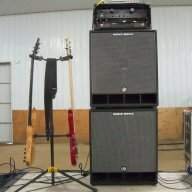
 
How did you come to those figures? I would daisy-chain both subs to one channel. At 2-Ohms, the QSC puts out 1700 watts per channel, so 1700 watts would be available to the two subs, and I think they would both get equal watts since they are daisy chained, right?
 
How did you come to those figures? I would daisy-chain both subs to one channel. At 2-Ohms, the QSC puts out 1700 watts per channel, so 1700 watts would be available to the two subs, and I think they would both get equal watts since they are daisy chained, right?

If one sub is 4 ohm and the other is 8 then you are actually running a 2.66 ohm load.
 
Yes, I know that, and it is within the specs of the amp, so I'm good there. But I did not know one sub would get different wattage than the other. I did not research that yet, though, but if that is the case, then I cannot put one on either side of the stage, and I should center-cluster.
 
Yes, I know that, and it is within the specs of the amp, so I'm good there. But I did not know one sub would get different wattage than the other. I did not research that yet, though, but if that is the case, then I cannot put one on either side of the stage, and I should center-cluster.

Unless the subs are the same centerclustering them may be worse.
 
mixing different subs is even worse than mixing different bass cabs.

if you really gotta try it, and they're both a similar design (both reflex 18s, for example) they might play well enough together to center-cluster (center-clustering is always stronger when they do match up).

you'll need to give each one its own power amp channel and try to volume match them by ear; hooking them together puts them in parallel, and the 4Ω box would get almost twice as much amp power as the 8Ω box.
 
What Walter said – it’s not a good idea to mix different subs, especially if one is notably inferior to the other. Their combined performance will always be “dumbed down” to the level of the lesser sub.
Are you sure you want to take that standpoint, because whether you meant to imply it or not, but what you just actually makes it sound like GOOD idea to combine them.

If MORE wattage is somehow distributed to the 4-Ohm sub, then obviously the 4-Ohm sub would be LOUDER than the 8-Ohm sub, making the 8-Ohm sub the "inferior" sub. Now, if what you said were true about them being "dumbed down", then that means that the 4-Ohm sub would be tamed and then perform like the 8-Ohm sub, which then make them more balanced.
 
Are you sure you want to take that standpoint, because whether you meant to imply it or not, but what you just actually makes it sound like GOOD idea to combine them.

If MORE wattage is somehow distributed to the 4-Ohm sub, then obviously the 4-Ohm sub would be LOUDER than the 8-Ohm sub, making the 8-Ohm sub the "inferior" sub. Now, if what you said were true about them being "dumbed down", then that means that the 4-Ohm sub would be tamed and then perform like the 8-Ohm sub, which then make them more balanced.

It's not *IF* more wattage is somehow distributed.......

You cannot change physics and ohms law. The 4 ohm cab WILL get 2/3 your total power output, and the 8 ohm will get only 1/3.

And NO......just because a cab gets *more power* does not make it the superior one. It just makes it the inferior one being driven too hard.
 
Now THAT explanation is more accurate. I was pretty sure nothing would be "dumbed down" in this application, and neither of the two subs, even run this way, would really be "inferior". As you said, this is simply a fact of ohms law. On the other hand, if we were talking about using multiple batteries in a device, where one battery had lower power than the others, then yes, the other two batteries would be "dumbed down".

As I asked in my intital post, I knew this configuration would be fine scientifically/technically, in that I would not harm the amp or the speakers, but was looking for thoughts on whether or not this would work practically. I did not know, however, about the difference in power received by each speaker. So, I guess the answer is "yes", if I could somehow attentuate the volume on the 4-Ohm cab to match the 8-Ohm cab's output, and live with the volume relative to approximately 567 watts per speaker. While this might be worth the effort, because two speakers with 567 watts each certainly beats 1 speaker with 700 watts, I'm not so sure there is easy and cheap access to an L-pad type attentuator that would safely manage a potential 500+ watts being thrown at it.

BTW, have any of you actually tried running different ohm'd cabs?

Thinking outside the box, is there a way to somehow rig a resistor/capacitor or something that would reduce just the 8-Ohm speaker two 4-Ohms? I would think if I only had the 8-Ohm hooked up, this could be done easily with something in-line, but how could this be done without affecting the 4-Ohm speaker since the 4-Ohm is being daisy-chained?
 
I just found out that Carvin made two BR118 cabs. One is 4-Ohms, one is 8-Ohms. That certainly would change things here! :-)

The bass player is not around to ask right now. He did say he has a BX1200 system, and he has the 2x10s cab over the BR118 sub, but rarely uses the 18, since we run everything through the board anyway. The whole reason this all came up was because we typically only run the one 1000watt 18 sub I mentioned in the original post, but when I found out about this unused BR118x cab, I thought we MIGHT have a use for it at an event he have coming up.

Does anyone, by chance know if his full stack would have come with a 4-Ohm or 8-Ohm 18"? Given what I see about Carvin amps, and that he bought the two cabs as a system, wouldn't they have had to use an 8-Ohm speaker in the that system, especially since the top itself has two speakers? I ask, because if they used a 4-Ohm in that 18" bottom, wouldn't Carvin have had quite a mis-match themselves, not to mention have reduced that to a 2.x Ohm load themselves, which means the amp would have had to support 2-Ohms, and many do not.
 
Does anyone, by chance know if his full stack would have come with a 4-Ohm or 8-Ohm 18"? Given what I see about Carvin amps, and that he bought the two cabs as a system, wouldn't they have had to use an 8-Ohm speaker in the that system, especially since the top itself has two speakers? I ask, because if they used a 4-Ohm in that 18" bottom, wouldn't Carvin have had quite a mis-match themselves, not to mention have reduced that to a 2.x Ohm load themselves, which means the amp would have had to support 2-Ohms, and many do not.

Still unknown because Carvin DOES sell full stack systems that have mismatched impedance cabs.

They do this because Carvin amps do go down to 2 ohms, and in the case of the amp in question, it is a dual amp model made to run cab(s) off of each side (like a power amp) or bi-amped via a built in crossover.
 

Are you sure you want to take that standpoint, because whether you meant to imply it or not, but what you just actually makes it sound like GOOD idea to combine them.

If MORE wattage is somehow distributed to the 4-Ohm sub, then obviously the 4-Ohm sub would be LOUDER than the 8-Ohm sub, making the 8-Ohm sub the "inferior" sub. Now, if what you said were true about them being "dumbed down", then that means that the 4-Ohm sub would be tamed and then perform like the 8-Ohm sub, which then make them more balanced.
A sub’s performance and/or capability has nothing to do with its ohm specification. So yes I'll stick to my statement.

Regards,
Wayne A. Pflughaupt


Administrator, Pedulla Club #45
Administrator, Tobias Club
Big Cabs Club #23
Pedulla Club #45


Still unknown because Carvin DOES sell full stack systems that have mismatched impedance cabs.

They do this because Carvin amps do go down to 2 ohms, and in the case of the amp in question, it is a dual amp model made to run cab(s) off of each side (like a power amp) or bi-amped via a built in crossover.
OK, then bottom line is that I need to know which Carvin 18" the guy has. If it's 8-Ohm, it's worth at least trying. At least I match impedance, and it only comes down to whether or not the two sound close enough to be used Aux-fed with kick and low bass in a PA reinforcement application. If it is 4-Ohm, it's probably not worth the headache for one event, regardless of how much it pays. ;)
 
I mix subs. I have a Peavey 118 that I reloaded with an 18" Eminence driver and I have a Carvin RL118. Both are 4 ohm. The Eminence driver hits harder than the Carvin does. Other than that no problems. I push each of them with 1000 watt power amps though and I match the output level by ear.