
Enjoy the benefits of a premium membership!
Upgrade Account
-
TalkBass has been independent since 1998. Add your voice.
Create a free account to reply to discussions, view embedded media, and browse with fewer display ads.
Join free Log in
Want zero display ads or expanded classifieds tools? Compare plans.
You are using an out of date browser. It may not display this or other websites correctly.
You should upgrade or use an alternative browser.
You should upgrade or use an alternative browser.
Combining two outputs into one in power supply
- Thread starter HumpZiZ
- Start date
-
- Tags
- power supply
More options
Who Replied?

Hi!
Is it possible to combine a 400mA output and a 200mA output into one 600mA output with a current doubler adapter cable? Or is it a problem that the currents of the outputs are different?
Thanks!
It's not the current outputs that should be a concern, it's ensuring that the voltages are the same. (We run batteries in parallel all the time without issue.) If the voltages are a little bit different (e.g. one is 9.1v, the other is 9.2v), the two supplies will fight each other. Since the internal resistance of a power supply is low, this will cause some of your current budget to go towards equalizing the 0.1V difference.

Azure Skies
Commercial User
Hi!
Is it possible to combine a 400mA output and a 200mA output into one 600mA output with a current doubler adapter cable? Or is it a problem that the currents of the outputs are different?
Thanks!
Assuming the output resistance of the supplies are the same, and there is reverse polarity protection so that one supply isn't feeding another, then the supplies will provide an equal amount of current up to the point that either one reaches it's maximum. At this point, the supply will either sag or shut down completely. So in short, it is unlikely you will be able to get 600mA out of a 200mA and 400mA supply because the 200mA supply will start to sag/shutdown once it's limit is reached.

Even if it would work without any problem, it seems impractical, since 600 mA, (and greater) power supplies are cheap, and easily obtained.
I buy "wall wart" type supplies of various voltages, and current ratings at second hand stores, (Goodwill) for 99 cents each. Sometimes I cut the output cable assembly off of one, and attach it to a different one, as the application requires.
I buy "wall wart" type supplies of various voltages, and current ratings at second hand stores, (Goodwill) for 99 cents each. Sometimes I cut the output cable assembly off of one, and attach it to a different one, as the application requires.

You can connect unlike current sources in parallel as long as their voltages are the same but you may NOT connect them in series (which you wouldn't want to do anyway because this would double the voltage). Connecting 400ma and 200ma sources of the same voltage in parallel will yield a 600ma supply. EDIT: I'm wrong. This only works if the sources are batteries. Properly ganging electronic supplies is considerably more complex, as sanity alluded to.
Last edited:
You can connect unlike current sources in parallel as long as their voltages are the same but you may NOT connect them is series (which you wouldn't want to do anyway because this would double the voltage). Connecting 400ma and 200ma sources of the same voltage in parallel will yield a 600ma supply.
Ok! Thanks a lot for your answers everyone! So, is the current doubler cable the right way to do that? Like this one: Invalid Link Removed
I have three 12V 550mA pedals and four 9V 100mA and it feels like I really can't find a perfect power supply solution for all of those and that's that's the reason why I'm asking these questions


Best way to prevent back feeding is to use diodes:
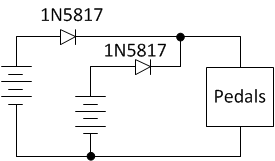
Diodes can be bought here: Invalid Link Removed
You can also add a little resistance in series to force some load sharing but given that the sources are unequally rated that would be tricky.
Diodes can be bought here: Invalid Link Removed
You can also add a little resistance in series to force some load sharing but given that the sources are unequally rated that would be tricky.
Yes, you can use that but remember you must keep the different voltages separate. AND make sure your polarities are same.Ok! Thanks a lot for your answers everyone! So, is the current doubler cable the right way to do that? Like this one: Invalid Link Removed
Best way to prevent back feeding is to use diodes:
View attachment 742031
Diodes can be bought here: Invalid Link Removed
You can also add a little resistance in series to force some load sharing but given that the sources are unequally rated that would be tricky.
Thank you very much for your answers everyone! I appreciate this!!
And play4sanity can you explain that pic a little more? I'm sorry I'm really not an expert with these electricity things
Thank you very much for your answers everyone! I appreciate this!!
And play4sanity can you explain that pic a little more? I'm sorry I'm really not an expert with these electricity things
Actually I think I got it now!
Well let's break it into it's pieces. First the power supply:
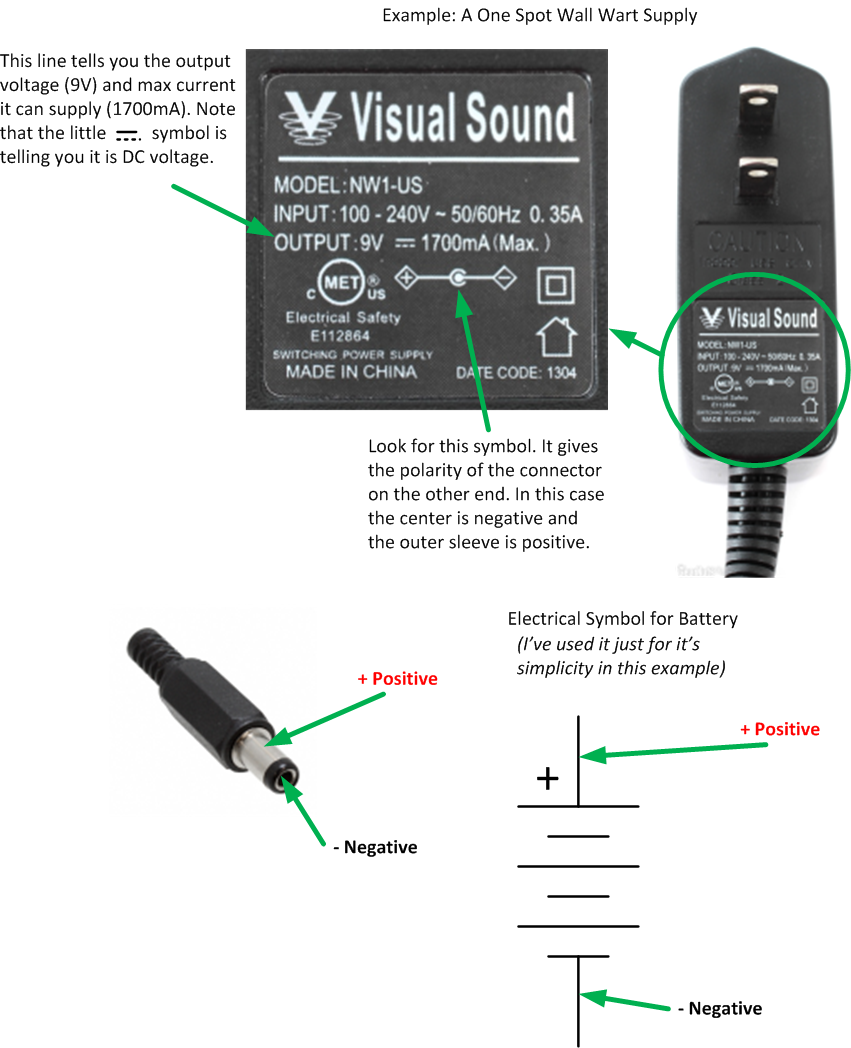
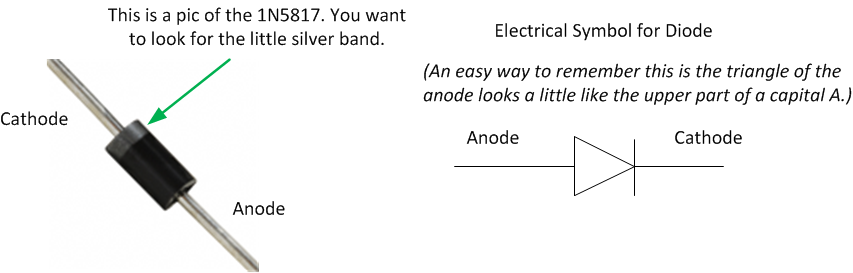
Then the diode:
And finally the pedal:
As others have pointed out it is important that the voltages all line up. In this case, they are all 9V and DC. It is also VERY important to understand that the polarities are all aligned too. In this case, the sleeve is positive and the center is negative. The reason that we add the diodes is because of the ability to allow current to flow from the anode to the cathode and block current flow from the cathode to the anode. This means that the current can flow from the supply to the pedal, which is what we want. And not from the pedal, or in this case the second supply, back to the original supply. Getting all of this wired up will take some work. One way would be to splice the diodes into the cables, and heatshrink the result. This would be pretty cheap and quick but you would need to exactly which of the 2 wires is positive which may not be obvious. A second way would be to build a little project box or "Y" cable with the diodes in it. Unfortunately, I don't know a good way to do this that doesn't involve some soldering. At the end of all of this, while it is the most expensive way, as another has mentioned, you could just buy 1 supply to meet all of your needs like the One Spot used in this example. It provides way more (1700mA) than the two supplies (200mA + 400mA = 600mA) that you are asking about.
Then the diode:
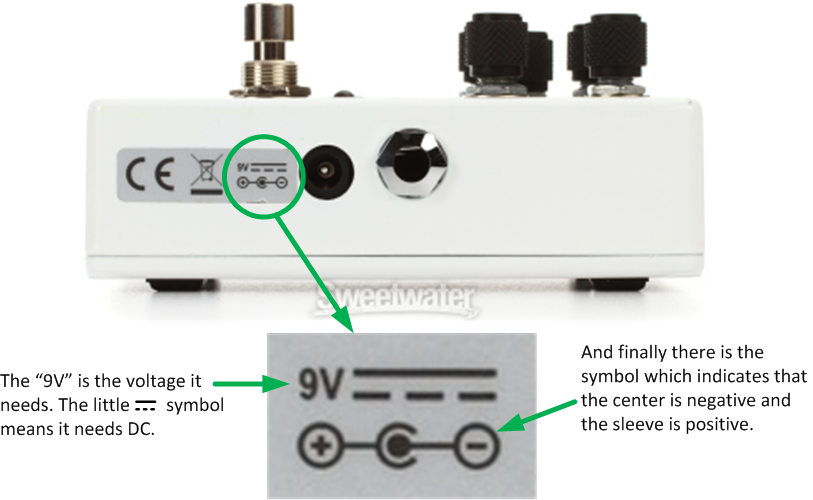
And finally the pedal:
As others have pointed out it is important that the voltages all line up. In this case, they are all 9V and DC. It is also VERY important to understand that the polarities are all aligned too. In this case, the sleeve is positive and the center is negative. The reason that we add the diodes is because of the ability to allow current to flow from the anode to the cathode and block current flow from the cathode to the anode. This means that the current can flow from the supply to the pedal, which is what we want. And not from the pedal, or in this case the second supply, back to the original supply. Getting all of this wired up will take some work. One way would be to splice the diodes into the cables, and heatshrink the result. This would be pretty cheap and quick but you would need to exactly which of the 2 wires is positive which may not be obvious. A second way would be to build a little project box or "Y" cable with the diodes in it. Unfortunately, I don't know a good way to do this that doesn't involve some soldering. At the end of all of this, while it is the most expensive way, as another has mentioned, you could just buy 1 supply to meet all of your needs like the One Spot used in this example. It provides way more (1700mA) than the two supplies (200mA + 400mA = 600mA) that you are asking about.
The more I read the more I learn how much I don't know. But it looks to be a bad idea. Even if they were rated for the SAME current and voltage, one or the other will output slightly higher voltage than the other and that's the one that will end up doing all of the work, with the other possibly behaving as a load. Don't do it. Get a bigger supply instead.
Last edited:
Unregulated supplies will typically have the output current supplied through diodes, and linear regulated supplies will typically have the current supplied through the emitter of a series pass transistor.
As long as the supply voltages are reasonably close, the supplies will not feed current into each other.
The supply with the higher voltage will supply all of the load current up to it's current limit. If the load requirements exceed the maximum current of the supply with the higher voltage, then that supply's voltage will sag and go into current limit mode. But it will continue to supply it's maximum rated current. The supply with the lower voltage will then supply the excess current required.
Note that one supply will be operating at maximum current continuously, and so needs to be able to operate in that condition without overheating.
-
As long as the supply voltages are reasonably close, the supplies will not feed current into each other.
The supply with the higher voltage will supply all of the load current up to it's current limit. If the load requirements exceed the maximum current of the supply with the higher voltage, then that supply's voltage will sag and go into current limit mode. But it will continue to supply it's maximum rated current. The supply with the lower voltage will then supply the excess current required.
Note that one supply will be operating at maximum current continuously, and so needs to be able to operate in that condition without overheating.
-
Remember K.I.S.S. (no, not the band)
It is a motto to live by: "Keep It Simple Stupid"
For you, that means getting a single power supply that meets your requirements.
Trust me on this one.
It is a motto to live by: "Keep It Simple Stupid"
For you, that means getting a single power supply that meets your requirements.
Trust me on this one.

Ok! Thanks a lot for your answers everyone! So, is the current doubler cable the right way to do that? Like this one: Invalid Link Removed
I have three 12V 550mA pedals and four 9V 100mA and it feels like I really can't find a perfect power supply solution for all of those and that's that's the reason why I'm asking these questions
can i ask what are the pedals?
i notice most users here always estimate their power requirement at a high side...
First: I really want to thank you for your answers, this have been really helpful for me!
Second: those pedals are:
Markbass Compressore
Markbass Super Synth
Markbass Chorus/Flanger
Electro-Harmonix Bass Big Muff
Electro-Harmonix Nano Steel Leather
Palmer Übertreiber
Korg Pitchblack Poly
Those requirements what I said are the requirements that can be found straight from the pedals but I don't know what are the real power consumptions and requirements per pedal. :/
Second: those pedals are:
Markbass Compressore
Markbass Super Synth
Markbass Chorus/Flanger
Electro-Harmonix Bass Big Muff
Electro-Harmonix Nano Steel Leather
Palmer Übertreiber
Korg Pitchblack Poly
Those requirements what I said are the requirements that can be found straight from the pedals but I don't know what are the real power consumptions and requirements per pedal. :/
Well let's break it into it's pieces. First the power supply:
View attachment 742162
Then the diode:
View attachment 742163
And finally the pedal:
View attachment 742168
As others have pointed out it is important that the voltages all line up. In this case, they are all 9V and DC. It is also VERY important to understand that the polarities are all aligned too. In this case, the sleeve is positive and the center is negative. The reason that we add the diodes is because of the ability to allow current to flow from the anode to the cathode and block current flow from the cathode to the anode. This means that the current can flow from the supply to the pedal, which is what we want. And not from the pedal, or in this case the second supply, back to the original supply. Getting all of this wired up will take some work. One way would be to splice the diodes into the cables, and heatshrink the result. This would be pretty cheap and quick but you would need to exactly which of the 2 wires is positive which may not be obvious. A second way would be to build a little project box or "Y" cable with the diodes in it. Unfortunately, I don't know a good way to do this that doesn't involve some soldering. At the end of all of this, while it is the most expensive way, as another has mentioned, you could just buy 1 supply to meet all of your needs like the One Spot used in this example. It provides way more (1700mA) than the two supplies (200mA + 400mA = 600mA) that you are asking about.
Thanks a lot for your answer! Now I really understand something more about the situation what's going on there. But I still have one problem: actually I need a really lot more power than just 600mA, I just askel that because some supplies has 200mA and 400mA outputs and I was just wondering if I can combine those or not. But like I said, I need something like 1700-2000mA power and the problems here are the markbass pedals because of the high power requirements.
In the end I'm still really intrested and open with every single solution possibilities which could be the way to resolve my problem

Ok! Thanks a lot for your answers everyone! So, is the current doubler cable the right way to do that? Like this one: Voodoo Lab Current Doubler Adapter PPAP
I have three 12V 550mA pedals and four 9V 100mA and it feels like I really can't find a perfect power supply solution for all of those and that's that's the reason why I'm asking these questions
Here's a single cable for less than half that price, which gets rid of the need for another cable.


