• TalkBass has been independent since 1998. Add your voice.
    Create a free account to reply to discussions, view embedded media, and browse with fewer display ads.
    Join freeLog in
    Want zero display ads or expanded classifieds tools? Compare plans.

Double Bass Comprehensive groove analysis?

It depends on what you mean by swing and groove. A little tendency, yes.
But what about even 8ths „swing“, can be very open too, or is it not swing?

I think swing and groove differ in the division of the quarter note. Triplet with mostly 2:1 length division (approximately) for swing and even 8ths for groove.

For every style there is a certain typical structure of heavier and lighter (sub-) beats. Swing on the one with the backbeat on 2 and 4, shuffle similar, but rather heavy on the „eighth“ before the one. For groove there are much more patterns of heavy and light (sub-)beats. Rock mainly on the beats (at least the one), Latin highly anticipated (different in Caribbean, Cuban, Puerto Rican and Brazilian styles and almost never on the one), even 8ths Jazz etc.

Some patterns are fixed even thought variation that keep that pattern going (different distribution of pattern beats in the instruments) is possible.

Even in European-based classical music a certain kind of beat subdivisions and basic patterns exist, as well as in most other music.
 
  • Like
Reactions: Whousedtoplay
26015687[/URL], member: 72930"]I would say swing and groove are very separate. Swing is open and breathes. "Grooves" tend to be boxed in.

It seems that both terms were used from the swing era on, to describe musical phenomens. From a linguistic perspective it’d be interesting to do a research about their use in writings from the 40s.

I’d suspect that back in the day they were pretty much synonymous, as the predominant way of musical time was just that what today we describe as “forward motion”, that is kind of specific for jazz. Later, from the 50s on, it’s language developed a use less based repetition of patterns but more on variation of those, hence “being open and breathing”. The term “swing” stuck with that sound.

My guess is that the term “groove” would later, with the advent of other popular genres having their roots also in afro-american music (starting with R&B), be used more often to describe musical qualities that had intensities caused by repetition, but not so much based on “swing”.

So, a “groove” today can describe a lot of musical situations, but it doesn’t need to “swing”. (But it could, if it would.)
 
  • Like
Reactions: Whousedtoplay
It seems that both terms were used from the swing era on, to describe musical phenomens. From a linguistic perspective it’d be interesting to do a research about their use in writings from the 40s.

I’d suspect that back in the day they were pretty much synonymous, as the predominant way of musical time was just that what today we describe as “forward motion”, that is kind of specific for jazz. Later, from the 50s on, it’s language developed a use less based repetition of patterns but more on variation of those, hence “being open and breathing”. The term “swing” stuck with that sound.

My guess is that the term “groove” would later, with the advent of other popular genres having their roots also in afro-american music (starting with R&B), be used more often to describe musical qualities that had intensities caused by repetition, but not so much based on “swing”.

So, a “groove” today can describe a lot of musical situations, but it doesn’t need to “swing”. (But it could, if it would.)

I think the linguistic history is rather inconsistent, as I've long been jumping between genres as wide as classical, jazz, electronica and seen a lot of inconsistent usage of these terms in particular from people that otherwise all seem to share mostly the same musical vocabulary.

But modernly the term 'groove' has become the broader term to describe any type of 'off the grid' push or pull (and sometimes accents).

This has been solidified in some of the most seminal applications such as Logic and Ableton
Create groove templates in Logic Pro
Invalid Link Removed

Which also reminds me, there may not be a 'comprehensive analysis' therein, but Logic and Ableton have many templates for these that could be something you could study, if you so wished, in an orderly graphic way.

I don't have any reference for whether I think they've historically accurately developed those templates as I've only ever used those tools in Ableton to extract a groove from my own playing to apply to other items. Nor do I have expertise in all those styles if I wanted to review them.
 
  • Like
Reactions: downlowuponit
Drum Genius is a great app with so many different grooves. I got it to help with this same kind of thing, and be able to communicate with drummers- not just “swing” :) it is a bit more jazz and Latin heavy stylistically. The Cuban stuff is great. Jazz is great, actual (programmed) drums from famous drummers. I do wish it had all the different shuffles as to learn the names and intricacies better.
 
  • Like
Reactions: iAsh
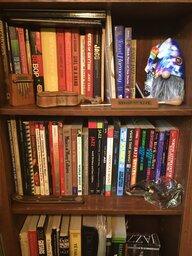
This is the book I grew up with:
Screen Shot 2022-01-07 at 4.44.36 PM.png
 
  • Like
Reactions: Tom Lane
Every style of music has its own signature grooves where some beats push and pull against each other. Even hyper-quantized pop and electronic music is distinctive in the mechanical evenness of the beats and subdivisions. I've also kind of been looking for a resource like this my whole life, and I think it doesn't exist because (1) the differences in grooves are subtle, even microscopic; (2) the differences are numerous, even within one sub-genre, or between individual songs; (3) the grooves are constantly changing and evolving, even on standards.

For example, I'm trying to freshen up my groove feel by getting some contemporary rap/trap/drill/hip-hop grooves under my fingers. Superficially, these don't seem like complicated beats, mostly a bunch of variations on clave grooves - big deal, right? But the tunes all swing, and there is a subtle rhythmic interplay between the pitched bass note and the percussive sub-bass hit, and - of course - every good song tries to switch it up a little so that it doesn't sound like "generic trap beat #6".

Long story, short, whatever style you want to learn, I think your best bet is to pour it into your head througg the ear holes,, and play along, as much as you can. You can't intellectualize it too much, because it's like trying to develop a reflex.
 
  • Like
Reactions: downlowuponit
Thanks for your replies. Both helpful, but I wouldn't to add that I'm not just thinking of swing vs shuffle; I was just using them as an example. Off the top of my head I can think of several different grooves that I can *roughly* define, but it's just my own personal nomenclature and is doubtlessly wrong in many cases. Some examples:
- swing
- shuffle
- latin
- bossa nova
- samba
- swinging latin
- swing waltz
- jazz waltz
- straight-8ths
- funk
- swung ballad
- straight ballad
- blues
- jazz blues
- grinding blues
etc
This series by Rory Stuart is really good. This is volume 3.
https://roryrhythmbooks.com/wp-content/uploads/2019/08/v3-preview.pdf
 
I started swingin'
All she did was rock;
Kept on swingin'
She said "Now listen, pop:
You got to boogie real slow with the blue lights way down low..."
...
I looked around; the shades were down;
The chicks were in the groove
I didn't see how those cats could dance
When their feet didn't even move...