• TalkBass has been independent since 1998. Add your voice.
    Create a free account to reply to discussions, view embedded media, and browse with fewer display ads.
    Join freeLog in
    Want zero display ads or expanded classifieds tools? Compare plans.

COMPRESSION vs. LIMITER vs. none at all ...

Thanks for the tip, R...I think I'm done with comps for live work, though. Now that I'm back on the tubers, I dig feeling the response without it. They can compress me in FOH and that's fine.
 
Part of the problem is that people expect to hear the compression working, or hear some magic improvement to their tone (extra "fatness" for example), so they turn it up until they can hear a big change. But most of the time the correct setting of a compressor is found when you can't hear it working. Extreme compression can be useful and cool-sounding in some specialized circumstances; but the vast majority of the time you'd actually benefit most from a transparent "invisible hand" keeping your levels under control without messing things up. And that requires lighter settings. If there will be any tonal improvements from the compressor, expect them to be very subtle.

+1,000

I'm one of the players who really digs what a good compressor - set appropriately - can do for one's sound. But the key is: subtlety! :eyebrow:

It's not a "magic box", and it shouldn't be used as a crutch to compensate for sloppy technique. But it is a great device for creating a tone that's bigger, smoother and more fluid that it would otherwise be, i.e. raising the overall level, without raising the peaks, etc.

To get a good idea of what good compression can do - used expertly - listen very closely to Paul McCartney's work in the mid-to-late period Beatles material. George Martin sometimes had Paul going through two or even three separate stages of compression - before tracking to analog tape (even more natural compression). As a result, the bass just has such an impressive presence in the mix - without overwhelming anything.

Simply marvelous! :cool:

MM
 
I'm a big fan of the BBE Opto stomp. It's pretty flexible, although it can't do anything crazy like some rack units, and simple. Quiet, true bypass, solidly built. Caveat: Mine was modded slightly by a tech in ways that I am not really cognizant of, so I can't speak to how similar it is to a stock opto (although I would say probably very).

I got it because I wanted a little smoothing for fingerstyle, and it does exactly what I want. Not a big fan of a rack compressor because, well, it adds another 6-10lbs to my rack when I can instead just stick something on a pedalboard I'm using for my tuner anyway (since I prefer stomp tuners for some reason).

If I had a pre with a built in comp I'd use it though, lots of them are very decent.
 
I find myself using my rack compressor (dbx 160a) and then again taking it out of my chain after a while. It looks like I can't decide. What I'm using it for is to either balance the string volume or to sometimes "thicken" my sound by taking out the dynamics and cutting the above third of signal volume. But that's of course not what you always want to do.

So the biggest question of all is: do you need a compressor or a limiter to create an effect or do you try to hide articulation / play dynamics issues (like I sometimes do? ;)) Unless you really do have a need for it or somebody tells you to use it to even out your sound, it'd stick with NO COMPRESSOR at all. As long as you can, use the pure sound of your bass. I did a lot of mistakes of gear acquisition in false belief that it will increase the quality of my sound/performance. The bitter truth is, 95% of how we sound is in ourselves and our fingers.
:)

Warm regards,

Karol
 
i've tried a few compressors live, but they just didn't work out for me. in our 24 track analog studio, that's another matter. i always use one, and my preference for compression/limiting goes in this order:

Universal Audio 175 Tube limiter:
UA175.jpg


or one of these Urei 1176's:

UREI-1176.jpg


or one of these Distressors:

Distressors.jpg
 
I play a lot of "smooth" fingerstyle to "aggressive" slap grooves in the tunes we do (a lot of medleys that run for up to 20 minutes in some cases). I could use a footswitch to change settings I suppose but love the "set and forget " that a good compressor gives me.
I usually set it to only kick in when I am punching the slap grooves - just to take the edge off the "pop".
Love the sound of early Level 42 type stuff so thats pretty much the compression I try for - using a Markbass Compressorie pedal for my smaller rig and an Eden WT1000N for my main rig.

Example - of well set up compressor to me..:)


Do you "NEED" compression - NO, but if you like it and it represents your 'sound" to you then go for it.
just my 2 cents..... :)
 
I think the BBE is a decent pedal.Yeah, it's not a rack unit, but for my needs it's plenty. I tried the Demeter, too. I liked it but I think I like the BBE better.

My setting is almost non-existent when I use it. I really only notice it when I peak my signal a little - like the chorus of "Peg" for example.

I'm still on the fence about using it. The less I have to hook up the better.
 
If one is after natural sounding compression it's hard to beat the Rane DC24 running dual-band compression. Even with fairly radical thresholds and ratios on each side of the set frequency it can sound subtle. Also can really allow one to get tube-head-like volume levels out of a given equivalent wattage.
 
I guess about 70% of my playing is just bass -> comp -> amp with the rest of my board bypassed. I like what a LITTLE compression does for my sound when playing clean like that.

I first learned to like compression with my now-departed Behringer amp, which had an onboard comp. That led me to start experimenting with comp pedals, all of which blew the Behringer's onboard comp away.

Boss ME-50B: I played with all its comp settings, and really liked both the "natural" and "Dyna-Comp" emulations. The latter point led me to try a real MXR Dyna-Comp.

MXR Dyna-Comp: When I tried the real thing, I was disappointed by the noticeable low end loss. Turned out that the digital emulation was actually better than the original. Weird. I hear this pedal can be modded to help with the low end loss, which would be nice since this pedal kinda has its own tone, but I've never tried the mods myself.

BBE Opto Stomp: Bongo's reviews led me to this pedal, and my experience largely agrees with his. If you want a very subtle, "natural" compressor and don't play with filters, I highly recommend this pedal. For limiting filter spikes and other situations where you need a harder, faster squeeze, not so much.

Demeter Compulator Comp-1: My current and favorite comp. I got it "barely used" off eBay for like 30% off new, from one of those people who didn't know how to use compression. :p For clean play, I keep the compression at 10 o'clockish; bump it up, and it easily tames wild duck filter quacks. Great pedal. My only real gripe with it is the power plug: it is reverse polarity, and is located on the side by the output jack instead of on top, which makes the connections a bit awkward. It is technically not true bypass, but the bypass is so clean that I can't tell the difference. I heard that Demeter is coming out with a Comp-2 version, and I am anxious to see how it works out.
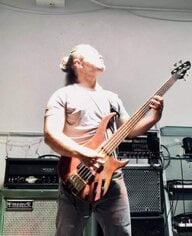
 
I've used compression/limiting back when I had an SVT-4. I used a nice outboard compressor with my current head- Mesa Bass 400.

The way I see it is- natural tube compression/saturation is the way to go.

If I was playing dub or R&B and just needed a giant low sound and not a lot of punctuation, maybe I'd use compression.
 
To get a good idea of what good compression can do - used expertly - listen very closely to Paul McCartney's work in the mid-to-late period Beatles material. George Martin sometimes had Paul going through two or even three separate stages of compression - before tracking to analog tape (even more natural compression). As a result, the bass just has such an impressive presence in the mix - without overwhelming anything.

MM

Listen, for example, to the difference in the bass sound between the raw studio take of 'Paperback Writer' here (starting at about 1:00):


Latest posts