• TalkBass has been independent since 1998. Add your voice.
    Create a free account to reply to discussions, view embedded media, and browse with fewer display ads.
    Join freeLog in
    Want zero display ads or expanded classifieds tools? Compare plans.

Confessions of a Flatwound convert...

Status
Not open for further replies.
Wow. I'm a month into my experiment with Flats on my jazz.

I'm using Chromes, .40 - .100. These sit so FAT in the mix, with great fundamental and definition. Last night I played an outdoor gig, and the bass tone was huge! After 30 years with rounds, I'm definitely impressed. These will stay on for quite some time!

Just wait until they really break in!

I decided to give chromes another chance after hearing this:

http://www.youtube.com/watch?v=Cm_4M-nBpCE

For me, it took about 6 months to get mine to this point. LOL...... I'm extremely "protective" of my P with the chromes...... I'm afraid of having to go back to a new set and playing them in for 6 months. Sorta like an old broken in baseball glove..... nothing feels better!
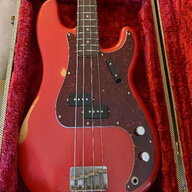
 
I am a recent flats convert. Bought a set of Rotos and slapped `em on my active J Deluxe = sweeet ! I agree with some of the earlier posts about amp selection r/t string choice. In the past, I just had a small combo and tried some flats and thought "Wow - these suck." Now that I have a nice combo as well as a stack, I have a whole new perception of them. I also never really liked P basses, either, for the same reason. Jazzes just seemed to work better with small amps, IMO. Now that I`ve got some real firepower, I bought a cheap P and put a pup in it to try out = sold on P`s now, just don`t like the fat necks. So I am currently gathering parts...for a J necked P with flats !
 
I prefer flats only on active jazz or P's..doesn't have enough punch on a passive bass unless you are playing an acoustic gig or with a trio. I just put a set of Jamerson's on my active Squire fretless and it's insane...

I disagree with you here. My Chromes are on a passive Hot Rod Jazz, and I'm playing in a seven piece band with horns, guitars, keys, and a percussionist as well as a drummer. These strings have plenty of punch.
 
I disagree with you here. My Chromes are on a passive Hot Rod Jazz, and I'm playing in a seven piece band with horns, guitars, keys, and a percussionist as well as a drummer. These strings have plenty of punch.

I agree with you. I play a passive bass with Chromes in a pretty loud, 5 piece, classic rock band and it kills. I rewired my bass (from active to passive) in order to get more punch. I find active basses to be too thin or modern sounding to really bring out the wonderful characteristics of flats.
 
The record speaks for itself. Probably 75% or more of the great hits were recorded with flats on passive basses. My basses is active and sounds HUGE with TI flats, but it also sounds really great with the neck pickup soloed, and in passive mode-very P like.
It is really all about the total rig one has-amp, speakers, even cables-not just one factor like active or passive.
 
It is really all about the total rig one has-amp, speakers, even cables-not just one factor like active or passive.

Most definitely true.

You know when I started this thread I made a point that with everything else (bass, amp, cabs) being the same, the only thing that jumped out about the major improvement in my tone and the overall sound of the rhythm section was my change in strings, from rounds to flats. A major change that was really, an epiphany.

But yes, one can't say for sure that one component will be like this or that, unless put into context. Flats can sound great, or suck, depending on the other variables.

I may very well hate flats if I would have been using a different rig or bass at the time, but I found that magic mojo with it all working together and flats were just the last missing piece to the puzzle. So much so, that any changes to my rig now must be able to work with my flats. :)
 
Compared to Rotosound flats, chromes, LaBella flats, maybe even GHS precision flats. That isn't to say they are dark, just very thumpy, especially on the E string. There is definitely some brightness, but not in the mid range like LaBellas. Also they didn't have that weird metallic sounding shimmer that chromes have new. They almost sound like they are made of rubber or plastic, but in a good way.

I tried them on both my jazz and my p-bass and got pretty different results. They sounded bright on the P, and extremely deep and rich sounding on the jazz.

I really liked them, and they almost became my main string, but I need versatility out of both of my basses. They would be great on an instrument that was just for reggae, afrobeat, deep funk or blues.

Thanks for the clarification. Not sure I would like them. I live on the E and A strings ;) But I am happy with my LaBella's anyway :D
 
wow this topic has opened my eyes, so to speak. i play a MIA p-bass w/the strings thru the body. whats the verdict on flats, thru the body or top load? also what bout half-rounds? thanks

Half rounds are still rounds with more of the inherent character of rounds, yet none of the benefits of flats, save for a smoother feel.

I would guess that strung through the body, there would be potential for more sustain. Something usually lacking a bit with flats (depending on other factors of course).

The thread was intended to open some eyes and hopefully some minds, but the real deal is opening your ears to a sonic difference in how one perceives bass.
 
I would say there's zero tone difference in string-through v top-load. however, I think the break-angle of string-through helps in intonation a lot.

I would agree that there is zero tone difference. But with the string through the body, more of the mass of the body couples with the bridge and may give flats a bit more sustain. They won't (or shouldn't anyway) sound any different.
 
a lot of tb'ers might already know about this site but i just found it. bass-strings.com, good basic string info. more helpful to me on ghs, d'addario, la bella than those actual sites!(as in nickel coated or pure nickel, type of core, etc.) and the TI site is a joke! didn't even list a flatwound string, or am i doing something wrong (probably the case). i be interested in checking other sites on the subject if ya'll know of any.
 
I would agree that there is zero tone difference. But with the string through the body, more of the mass of the body couples with the bridge and may give flats a bit more sustain. They won't (or shouldn't anyway) sound any different.

I would guess that strung through the body, there would be potential for more sustain. Something usually lacking a bit with flats (depending on other factors of course).

Agreed! I believe that is what Leo originally intended anyway - to increase note value, volume, and sustain. Though sustain didn't mean as much then, as the Precision Bass was intended to supplant/replace the "Dog-house" (stand-up) bass, which had little applicable sustain in plucked form, as used in rock n roll.

String-thru may increase lower frequency vibrations a bit, which would effect tone.
 
time to remove foot from mouth, went back to TI site, must have been my connection/computer. found good info. i do want to try TI's (along w/pure nickels, & halfrounds) & how good or bad the site doesn't matter. after all it's the product that matters. with the info gathered here i believe i'm gonna have fun with my tone in the coming months! :D
 
I would say there's zero tone difference in string-through v top-load. however, I think the break-angle of string-through helps in intonation a lot.

But that break angle is not good for flats. From an engineering perspective, the angle creates more problems than benefits. Flat windings are meant to stay flat.... the angle crams the windings together on the inside of the bend, and pull apart on the outside of the bend, creating more stress on the core. You have less of this going on with rounds because the windings can "roll up" on each other instead of cramming together and pulling apart.

That is the reason Labella doesn't recommend their normal flats going string through.

I ran string through on my '08 P with a set of chromes when I first acquired it, and both the D and A strings developed some serious overtones. I tried running the same set top load, and the problem was still there, so I ended up having to put on a new set. Hard up for flats on another bass (top load only), I ended up putting the old set..... the A string broke where the break angle was inside of a week.
 
But that break angle is not good for flats. From an engineering perspective, the angle creates more problems than benefits. Flat windings are meant to stay flat.... the angle crams the windings together on the inside of the bend, and pull apart on the outside of the bend, creating more stress on the core. You have less of this going on with rounds because the windings can "roll up" on each other instead of cramming together and pulling apart.

I've done it with Sadowsky, TI, and EB flats with zero issues.
 
Status
Not open for further replies.