• TalkBass has been independent since 1998. Add your voice.
    Create a free account to reply to discussions, view embedded media, and browse with fewer display ads.
    Join freeLog in
    Want zero display ads or expanded classifieds tools? Compare plans.

Constant dead E string problem

I do now. When I first started playing again last year I had a tech do it, but now I string them myself.

What's your procedure? Are you setting your witness points? What's the nut slot look like? Add pics if you'd like.

Just trying to rule out the simple stuff and you haven't given us much information. The fact that each and every E string (different brands) sounds dull / dead leads me to believe there's a set-up fault or, quite possibly, operator error.

Riis
 
What's your procedure? Are you setting your witness points? What's the nut slot look like? Add pics if you'd like.

Just trying to rule out the simple stuff and you haven't given us much information. The fact that each and every E string (different brands) sounds dull / dead leads me to believe there's a set-up fault or, quite possibly, operator error.

Riis

I've had it set up by two different techs, and I told the second one the issue and he couldn't give me any info.
 
Time to find a third a third tech. Where are you located?

Okay, one more time: are you setting your witness points when installing strings?

Riis

I don't think I've ever actually heard that term before. The two techs I've taken it to didn't say anything about that. And my original bass teacher never taught me how to restring it properly (he wasn't that great, but when I was 13 I didn't know much about proper learning of instruments)
 
I don't think I've ever actually heard that term before. The two techs I've taken it to didn't say anything about that. And my original bass teacher never taught me how to restring it properly (he wasn't that great, but when I was 13 I didn't know much about proper learning of instruments)

Okay, first thing I would do is get that rascal strung properly...maybe even check out the set-up parameters. Any in-the-know TBer's live nearby? Your strings are probably fine; the installation and set-up may leave something to be desired.

Riis
 
Okay, first thing I would do is get that rascal strung properly...maybe even check out the set-up parameters. Any in-the-know TBer's live nearby? Your strings are probably fine; the installation and set-up may leave something to be desired.

Riis


Actually there's none nearby that I know of. But like I said, I took it to a guy who's been doing it for years and it still happened, so its not always setup or stringing.
 
I had this problem for awhile, around 2010 and 2011.

.105 E strings seem to be more likely to be dead out of the pack, than smaller ones. I use different basses and am confident in my ability to set them up/string them up.

Generally speaking, i've had the best luck with tapered/exposed core E strings and strings that have a smaller percentage of core material VS. wrap material. (see, these strings are usually more flexible). I've also found that .102 E strings are a good compromise, if you are like me and like the thickness of a .105 set VS. a .100 set.

*I've also never had premature death problems with roundcore .105 E strings. of which I've had 2 DR Dragon Skins sets, 1 set of DR Fat Beams, and 1 set of Fodera Stainless Steel.
 
I don't think I've ever actually heard that term before. The two techs I've taken it to didn't say anything about that. And my original bass teacher never taught me how to restring it properly (he wasn't that great, but when I was 13 I didn't know much about proper learning of instruments)

When stringing up, with the string at tension, press each string down hard with your thumb at the 'witness points', i.e. at the nut (the fingerboard side) and the saddle (the pickup side).
 
When stringing up, with the string at tension, press each string down hard with your thumb at the 'witness points', i.e. at the nut (the fingerboard side) and the saddle (the pickup side).

Thank you...that's a start. The nut slot integrity should be verified by competent tech. I've run across a handful of Ricks with "V" shaped slots...not good. Don't forget adequate break angle and strings wound down to the "deck" (headstock).

FWIW, if you decide to go with a tapered E string set, be prepared to make some minor bridge modes. Like the Alembic and several others with fixed radius bridges, the step-down brings the E string to close to the fingerboard and may be problematic. The obvious solution: raise the bridge on the bass side. Easy, right? Problem is the adjustment will also kick up the A, D, & G strings as a result. Two solutions: either go back to a conventional full-wrap E string or work (file) the remaining bridge saddles to bring the string height back into spec. Alembic actually sells brass bridge saddle blanks for just this purpose....for Alembics, of course!

Riis
 
I keep having the same problem on my Cort P bass, E string gets dead super quickly. The bass was set up by a professional, changed plenty of strings (Fender, Ernie Ball), adjusted pickup height... I don't know what to do anymore, perhaps it's a problem with the nut?
 
I keep having the same problem on my Cort P bass, E string gets dead super quickly. The bass was set up by a professional, changed plenty of strings (Fender, Ernie Ball), adjusted pickup height... I don't know what to do anymore, perhaps it's a problem with the nut?

Put yourself in the OP's position, go back to the original post, and answer each of the questions posed in my subsequent posts.

Quit telling me you took it to a professional...it all-too-frequently means nothing. With apologies to J, Walter, 202, and all those who I actually trust. FWIW, a poorly cut nut would have been identified by a competent tech; it's part of a basic set-up.

Riis
 
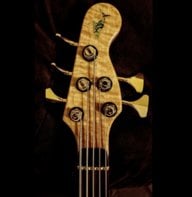
Okay so I went back, read everything, returned back to my bass and looked at it for a while. I tried looking at the nut but I noticed at the tuners the E string was wound around like 4 times...so I took the string off, chopped it off a bit, put it back on and wow...it actually sounds kinda good. So there it is... the problem might be actually in your tuners, sound weird.
 
I've only ever had this problem when it's caused by the string (dead out of the pack), and that's when I switch brands. Rotosounds were the worst, GHS had that problem too. I switched to DR, and even those came with dead strings right out of the pack. I finally switched to Ernie Ball Hybrid Slinky, and that was in 1996. I haven't had a problem since then.
 
Okay so I went back, read everything, returned back to my bass and looked at it for a while. I tried looking at the nut but I noticed at the tuners the E string was wound around like 4 times...so I took the string off, chopped it off a bit, put it back on and wow...it actually sounds kinda good. So there it is... the problem might be actually in your tuners, sound weird.

Hmmm...unusual. As long as your last wrap hits the base of the tuner post, you should be okay as this creates the necessary break angle over the nut. We've seen a couple pics with excessive wraps working their way towards the top of the tuner post. Also, make sure the strings are seated squarely in the slots. Set your witness points by pressing the string down firmly on the fingerboard side of the nut and bridge saddle. This creates a clear delineation of the vibrating string path. If ignored, the string (especially thicker gauges like the B & E) forms a "lazy loop" as it passes over the nut and bridge saddle.

Edit: this may not cure all ills but it certainly removes the simple stuff from contention.

Riis