We were taught to look at Jellyroll Morton's and Thelonius Monk's influences.
Jazz band was really in depth for a 7am high school class.
Jazz band was really in depth for a 7am high school class.

TalkBass has been independent since 1998. Add your voice.
Create a free account to reply to discussions, view embedded media, and browse with fewer display ads.
Join free Log in
Want zero display ads or expanded classifieds tools? Compare plans.

Holy words, holy words .. don't listen primarily or only to bass, listen and understand the harmonic principles of each tune that remains in your mindForget about "new scales". Start listening to the music, and not just the bassists. Start hearing how the language sounds. There's not a lot of overlap in the music you've been playing and the rhythmic and melodic vocabulary in jazz, so you need to start getting how that sounds in your ears.
Wow - just took a look at this - THANK you, this is a treasure trove!Every jazz teacher and advisor (as well as Jamey Aebersold jazzbooks.com and many of those who've already responded here) emphasizes that you need to listen to good jazz players. If you're going to learn you need to LISTEN, not merely have jazz playing in the background while you do something else.
Go to jazzbooks.com and scroll to the bottom where you see FREE JAZZ and download the Jazz Handbook PDF. It's free and it's truly the jazz rabbit hole.

This is a plus. A bass, an amp. That's all you need.happily you will do fine with minimal gear.

Forget scales; learn chord theory.Besides the obvious studying new scales, what would be some of your first steps if you were attempting to convert to Jazz?
"Forget scales;"Forget scales; learn chord theory.
Besides the obvious studying new scales, what would be some of your first steps if you were attempting to convert to Jazz?
Way to quote half a sentence entirely out of context. I'm not suggesting that you stop knowing what scales are - I don't know how you would be able to understand what a chord is without knowing what a scale or mode is, but you need to change the way you think about them if you're coming from metal. Instead of linear scales, you need to think in terms of chord tones, how they relate to one another functionally, to the note you're currently playing, how it fits into the next chord (without giving it away), and to the underlying progression. You also need to add descending melodic minor (don't revert to Aeolian) to your lexicon, and get familiar with the modes and chord voicings you build from it."Forget scales;"
You have GOT to be kidding! Please tell us you're kidding.
Way to quote half a sentence entirely out of context. I'm not suggesting that you stop knowing what scales are - I don't know how you would be able to understand what a chord is without knowing what a scale or mode is, but you need to change the way you think about them if you're coming from metal. Instead of linear scales, you need to think in terms of chord tones, how they relate to one another functionally, to the note you're currently playing, how it fits into the next chord (without giving it away), and to the underlying progression. You also need to add descending melodic minor (don't revert to Aeolian) to your lexicon, and get familiar with the modes and chord voicings you build from it.


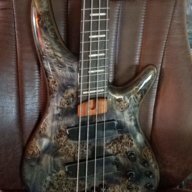
Yes, Acoustic Alchemy, Snarky Puppy to name a couple, I also play steel string and nylon string acoustics as well as electric guitar and I'm moving in the same direction with everything.Is here a particular artist whose music you want to play?
Something else to consider is your tone. Consider using flatwound or tapewound strings to get a tone a little closer to that of an upright bass.
 I put La Bella Deep Talkin bass flats on my PJ bass and TI Jazz Flats on my 5 string Jazz
@Koshchei actually has a point, to an extent. You need to know both chord theory AND scales equally as well. I think what he's trying to say is that most people playing pop music (anything that isn't jazz is pop music in this context) put so much emphasis on learning scales that they neglect other aspects of theory. Jazz theory really benefits from knowing chord structure and voicing (7th, 9th, 11th, dim, etc) front and back, up and down, clockwise and withershins, and any other orientory descriptors you can conjur. A lot of the jazz soloing I'd do would essentially be rooted in running the scale of whatever chord we were on (with a little embellishment to keep the blue bloods awake) and then shifting things around to move with the piece of music as the chords progression changed. This of course was not always the case - nothing ever is with jazz - but it's a good start as far as wrapping your head around how to approach soloing in jazz pieces."Forget scales;"
You have GOT to be kidding! Please tell us you're kidding.