• TalkBass has been independent since 1998. Add your voice.
    Create a free account to reply to discussions, view embedded media, and browse with fewer display ads.
    Join freeLog in
    Want zero display ads or expanded classifieds tools? Compare plans.

Cool 60's basses (OTHER than main-stream brands)

And may I present my WATKINS Sapphire?
Year of manufacture unknown and converted to fretless by me.

That's funny - Wilson - Watkins ... would have loved to be in the room when the advertising boys were coming up with these names! Most likely they were influenced by the buyers from the US and England. The St George (1st pic on page 1) was inspired by a US store owner/buyer named Anthony George. He had music stores in California and New York.
 
Most likely like this one I posted on page 1 -

View attachment 3042503

Yeah, I'm diggin' that. Groovy tuners, to boot!


The Guild in the thread has always held a place in my heart, too. Too bad they put the pointy bit on the headstock on the wrong side, instant eject of said protruberance if the instrument escapes its strappage and hits the floor — to get to the point, most I've seen had some form of damage to that part of the headstock.
 
The Guild in the thread has always held a place in my heart, too. Too bad they put the pointy bit on the headstock on the wrong side, instant eject of said protruberance if the instrument escapes its strappage and hits the floor — to get to the point, most I've seen had some form of damage to that part of the headstock.

That body has had a few different hs's over time. One w/4-on-one-side, and two different ones with 2x2. I like the pointy 2x2 best, but the 4-on-one-side is cool too. Peter Tork (Monkee's) played one of the 4-on-one-side versions.
 
Here's a German made Fasan bass made in the mid 60's. Pretty rare but very cool.

2120260_Fasan_Bass_02web.jpg
2120260_Fasan_Bass_03web.jpg


TD
 
Kustom only made instruments for three years, 1966-69. Here is the K200D.
View attachment 3048829
A K200-A guitar was my first electric, and I wish I hadn't refinished it a dozen times, hacked it up replacing the bridge pickup, and sold it. They're worth over $1000 today.

I wanted one of their tuck-n-rolled amps back then - wasn't aware they made basses. Very Ric inspired. Thanks for the info/pic.
 
  • Like
Reactions: Lownote38
The controls layout and neck attachment strongly suggest Gretsch.

Yes - this is one of the hallmarks of that decade of making-hay-while-the-sun-shines capitalizers. Make a product that is visually reminiscent of the big 5 or 6 guitar makers, sell it for less and flood the market with it. The peak (selling/manufacturing) year for guitar sales/interest was 1965 - after that year it steadily went down. Of course, the late 60's was the peak of rock music so the peak/falloff had more to do with everyone initially buying guitars than making music with them. Probably a matter of product saturation leading to over-saturation.
 
TL;DR - 1961 Ibanez Model 1902

I don’t think I’ve shared this here - I know Ibanez is now a major brand, but in the early 60’s they had just entered the electric bass market with their Model 1901 & 1902 (1 or 2 based on number of pickups).

I found this and being a lover of old Ibanezes I was fascinated, but researching it to find its authenticity was very hard - hardly any info available on these. Still I’ve only found 2 websites that have an image and/or info on these.

Funny, when I first saw it I thought “beautiful bass but what idiot cut the pickguard like that?!?” Nope, that’s stock - just 60’s pseudo futuristic styling! It’s made of a very thick, kind of pearlescent piece of plastic.

It’s got a lot of other neat little features....The pickups have a beautiful, stained-glass looking piece of blue material in the slots in the metal. The grain on the slab of rosewood is much more interesting than most scene today.
I’m thrilled the little metal brand badge is still on after all these years!

I haven’t had the time or means to get her up and playing yet - as can be seen, it needs a few parts to get the tuners operational. (I did strung up a cpl strings to test electronics)
Sourcing vintage replacement parts will be near impossible, and I’d rather not put on all new tuners, so I think I may have to see if I can have someone craft the parts that need replacing. We’ll see.

Other than that, it’s fully functional; all pots, pickups & knobs work great!

Well, I’ve rambled on long enough, I just think this is such a cool piece of Ibanez history!

Here it is, my 1961 Ibanez Model 1902

38E8162A-C269-4F96-BFEA-AF7713E88E14.jpeg
F9B5F465-E243-43F4-8962-E7016F5F305E.jpeg
4EE3FFED-AB1C-4492-9D23-81FB76BD9096.jpeg
 

Thanks for posting your bass Rob - you are correct about Ibanez being one of the many newcomers back then. There were a number of examples of pickguards that contrasted the curvy contours of the body with hard-edge jagged designs. I agree in part with the "space-age" angle - in general another way to visually set their guitar apart. Ibanez later went the opposite direction taking the lead in making direct copies of Fenders, Rics, etc and finally evolving into a brand known for it's own unique designs. Yamaha went through a similar trajectory. I visit eBay/Reverb "vintage Japanese bass parts" regularly to see what turns up - you might be able to eventually score replacement tuners for your bass and get it playable.

This is where I go to research old weird guitars:
Guitars

I made a connection regarding this site that @M.R.Ogle was kind enough to post earlier in this thread - the book I recommended; "The History of Japanese Electric Guitars" is by the same guy - Frank Meyers (Drowning In Guitars) If you have an interest in the details of that decade for Japan - this is a really in depth resource book with lots of great pic's and info.
 
Thanks for posting your bass Rob - you are correct about Ibanez being one of the many newcomers back then. There were a number of examples of pickguards that contrasted the curvy contours of the body with hard-edge jagged designs. I agree in part with the "space-age" angle - in general another way to visually set their guitar apart. Ibanez later went the opposite direction taking the lead in making direct copies of Fenders, Rics, etc and finally evolving into a brand known for it's own unique designs. Yamaha went through a similar trajectory. I visit eBay/Reverb "vintage Japanese bass parts" regularly to see what turns up - you might be able to eventually score replacement tuners for your bass and get it playable.


I made a connection regarding this site that @M.R.Ogle was kind enough to post earlier in this thread - the book I recommended; "The History of Japanese Electric Guitars" is by the same guy - Frank Meyers (Drowning In Guitars) If you have an interest in the details of that decade for Japan - this is a really in depth resource book with lots of great pic's and info.

Yesterday I attended a sorta brass band that a guy from my group plays in.

The bass player had an old Ibanez, it caught my eye for being much the same shape as my Challenge (Teisco), and pretty much identical bridge cover. So, a Jaguaresq shape; the vol and tone looked like they might be mounted on top of the pickguard like an old Star bass; a Fender like headstock but with Ibanez horizontally across it. Looked like a short / mid scale (maybe just an illusion).

Spoke to the guy for 30 seconds, he said an Ibanez that he bought in 1960. At least that’s what I thought he said.

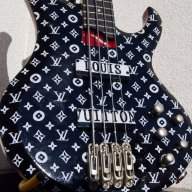
Meets the Cool rule I think
 
  • Like
Reactions: JIO
Yesterday I attended a sorta brass band that a guy from my group plays in.

The bass player had an old Ibanez, it caught my eye for being much the same shape as my Challenge (Teisco), and pretty much identical bridge cover. So, a Jaguaresq shape; the vol and tone looked like they might be mounted on top of the pickguard like an old Star bass; a Fender like headstock but with Ibanez horizontally across it. Looked like a short / mid scale (maybe just an illusion).

Spoke to the guy for 30 seconds, he said an Ibanez that he bought in 1960. At least that’s what I thought he said.

Meets the Cool rule I think

Wow - that is cool. I don't even have a picture of me playing my first bass ('66 MIJ Stadium-same as the first pic of the St George I posted in this thread) And speaking of the Jaguar/Jazzmaster resemblance - the majority of these inexpensive mostly short-scale basses then resembled/referenced that shape. Some looked like P's and J's, but more looked like Jag's/J-masters. It might have been because these Fender designs were brand new in the early 60's and the Japanese makers wanted to capitalize on the latest guitar design.

Ibanez was one of 19 different brands that were imported by Hoshino Gakki (established in 1908) who later (50's) became the exclusive exporter of Tokyo Sound (Guyatone) guitars. The earliest Ibanez branded guitars were sold to the European Craft Co. in LA and Hoshino Gakki still is the man behind Ibanez today.
 
  • Like
Reactions: RedVee