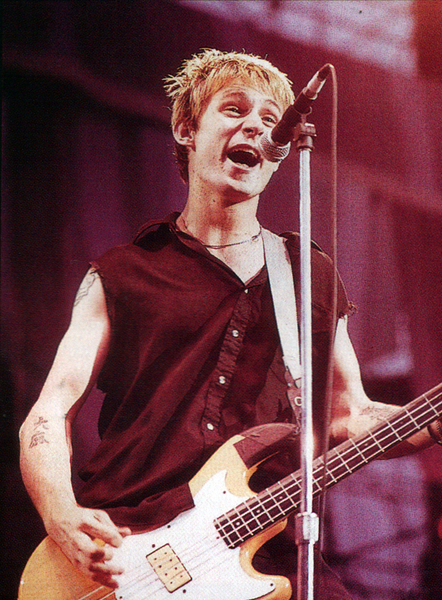
They thought maybe copy New York Dolls, but then they could see that Alice Cooper Band was selling more records.No wonder they went the makeup route. lol
Ace's Lily Tomlin phase.

TalkBass has been independent since 1998. Add your voice.
Create a free account to reply to discussions, view embedded media, and browse with fewer display ads.
Join free Log in
Want zero display ads or expanded classifieds tools? Compare plans.
They thought maybe copy New York Dolls, but then they could see that Alice Cooper Band was selling more records.No wonder they went the makeup route. lol
Ace's Lily Tomlin phase.


Happy birthday to Eddie Cochran, who would have been 84…
View attachment 4832352
A tragic loss at such a young age like his friend Buddy Holly, he was not only a great writer, another chronicler of teen frustration, but also an ace guitarist and experimenter in the studio back when there wasn’t much to experiment with. I’ll forgo the obvious song; here’s my favorite…
And if this intro isn’t distant roots of surf, metal, and punk(drums courtesy Earl Palmer), I don’t know what is…
Gives new meaning to the "Green Room."

Gene of course having lost his idol and best friend was devastated, becoming the original Lost Boy, he never got over it. who knows what Eddie would have done other than continue to find the most profitable course for his talents after covering so much musical ground already, his earlier stuff with Chuck Foreman is arguably better than his later rocking material, having the Jazz sophistication of competing duos like Speedy West and Jimmy Bryant while he was just a kid being allowed to quit school to focus on his career. he got an early jump on everybody else and was making the most of it at a time when everything was positively exploding, the world was his oyster and then got royally gypped with a short life. at least his memory and music is eternal, but we sure lost out on some exciting future music, much like when losing Hendrix.OK, I went to YT and watched Summertime Blues from the same live show.
Here's the History Channel's "This Day in History" for April 17.
1960
April 17
Eddie Cochran dies, and Gene Vincent is injured, in a UK car accident
Eddie Cochran, the man behind “Summertime Blues” and “C’mon Everybody,” was killed on April 17, 1960 when the taxi carrying him from a show in Bristol, England, crashed en route to the airport in London, where he was to catch a flight back home to the United States. A raw and exciting rocker with a cocky, rebellious image, Eddie Cochran was very different from the polished and packaged idols being heavily marketed to American teenagers in the years between the rise of Elvis Presley and the arrival of the Beatles. And while he may have faded from popular memory in the years since his tragic and early death, his biggest hits have not.
Cochran was on a triumphant concert tour of Britain in the spring of 1960—a tour that had been extended 10 weeks beyond its scheduled run due to intense demand for tickets. In America, a tamer brand of pop was in fashion, exemplified by the likes of Frankie Avalon, Paul Anka and Bobby Darin. In England, however, harder-edged rhythm-and-blues artists and rock-and-rollers like Eddie Cochran and his tour-mate Gene Vincent (of “Be Bop a Lula” fame) were far more popular. Theirs was the kind of music that the future members of the British Invasion were listening to in the late 50s and early 60s. It was “Be Bop A Lula,” in fact, that John Lennon was playing at the 1957 garden party where he first met Paul McCartney, and it was Cochran’s “Twenty Flight Rock” that Paul taught John to play that same afternoon, shortly after being invited to join Lennon’s Quarrymen. At least one Beatle, George Harrison, saw Eddie Cochran in Liverpool during his final tour, and both his guitar-playing and his stage persona made a strong impression. “He was standing at the microphone and as he started to talk he put his two hands through his hair, pushing it back,” Harrison later recalled. “And a girl, one lone voice, screamed out, ‘Oh, Eddie!’ and he coolly murmured into the mike, ‘Hi honey.’ I thought, ‘Yes! That’s it—rock and roll!”
Gene Vincent was traveling alongside Eddie Cochran in the cab to London after what would prove to be Cochran’s final performance. Tour manager Patrick Thompkins and Eddie’s fiancée, songwriter Sharon Seeley (she wrote Ricky Nelson’s #1 hit “Poor Little Fool”) were also in the Ford Consul that was later estimated to have been traveling in excess of 60 mph through a dark and winding section of the two-lane A4 in the village of Chippenham. Gene Vincent would break his collarbone, but beyond that, the only serious injuries among the passengers were Eddie Cochran’s. Having been thrown from the vehicle when it smashed into a light post, Cochran sustained a serious head injury. He died at hospital in Bath in the early hours of April 17, 1960.


Gene of course having lost his idol and best friend was devastated, becoming the original Lost Boy, he never got over it. who knows what Eddie would have done other than continue to find the most profitable course for his talents after covering so much musical ground already, his earlier stuff with Chuck Foreman is arguably better than his later rocking material, having the Jazz sophistication of competing duos like Speedy West and Jimmy Bryant while he was just a kid being allowed to quit school to focus on his career. he got an early jump on everybody else and was making the most of it at a time when everything was positively exploding, the world was his oyster and then got royally gypped with a short life. at least his memory and music is eternal, but we sure lost out on some exciting future music, much like when losing Hendrix.
with Sharon Sheeley recording at Gold Star.
View attachment 4833254
Mamie is still going strong
View attachment 4833255



Great movie!!The Hong Kong Cavaliers

together again in Hillbilly HeavenLoretta Lynn and Conway Twitty
[Invalid or Expired Link Removed]
[Invalid or Expired Link Removed]
[Invalid or Expired Link Removed]
great and new to me photo, they've actually got decent combo amps hereEarly version of The Beatles in the Cavern Club in Liverpool, England.