• TalkBass has been independent since 1998. Add your voice.
    Create a free account to reply to discussions, view embedded media, and browse with fewer display ads.
    Join freeLog in
    Want zero display ads or expanded classifieds tools? Compare plans.

Could someone explain wattage in a way easier to understand?

Alright. So, for example if I were to get an 800 watt amp, what should I look for in a cab generally? More, less wattage than the head? Thanks. :)
You will see all kinds of amps rated with high amounts of watts it's misleading. For a bass amp playing with a live group is the real test. Many amps will sound good to you in a store but they may not cut it in a live situation. This is where tone and watts meet. Amps/speakers that have a scooped mid sound don't cut through and some class D ratings for watts can sound like less than a 50 watt tube head. If you buy from somewhere you can return it if not satisfied you are safe.
 
Alright. So, for example if I were to get an 800 watt amp, what should I look for in a cab generally? More, less wattage than the head? Thanks. :)
The simplest way to go about it is to get a cab that is rated for at least as much as, or preferably a little more than, the continuous output of your amp at the same impedance as that cab. Impedance is important, because amps put out different power levels at different impedances, and the impedance differs with what cabs you use, and how many.

So, you might have an amp that puts out 800 watts at 4 Ohms but that same amp might put out only 400 or so at 8 Ohms. Hence, if you want to use a single 8 Ohm cab, it should then be rated at 400 watts or more, and if you use a single 4 Ohm cab it should be rated at 800 watts or more. As you can see, in both instances the power handling of the cabs will need to match or exceed the output of the amp at that impedance.

You can also use two 8 Ohm cabs to get the full 800 watts out of the amp, because when you use two 8 Ohm cabs together, the total impedance will be halved (thereby taking it to 4 Ohms, so the total output of the amp will then be 800 watts), and they will split the power equally between them, so that each cab will receive 400 watts, and therefore they will only need to be rated at 400 watts or more.

When it comes to actual volume, however, more speaker area equals louder sound, because more speakers move more air. So at the same power level, a 410 cab will be louder than a 210 cab.

In this way you can juggle the different factors - power output, impedance and number of cabs/speakers - to get the performance you need.
 
Last edited:
so would you say that even more important than the amp i get would be the speaker? Or just to make sure that the speaker is good enough to keep up with the amp? Or is that not what you were saying at all? :dead:

Putting too many watts into a speaker is like microwaving your steak for too long. Bad news!

Don't spend all your budget on an amp - make sure you can afford the speakers first.

So- watts DO correlate to volume, just not directly where you would notice every watt. Correct me if i'm wrong. :)

Generally yes!

For example, my Mesa guitar combo is switchable 10/25/35 watts. It's loud at all three, but when you go from 10 to 35, you notice a fullness more than a loudness. Hard to describe, but the closest thing is like going from a low volume setting one music to one where suddenly everything becomes more alive.
 
Hi all. I have been looking at finally upgrading my bass rig. . . . I'm so confused when it comes to wattage.. . . . what would be the reason to go for the 300 over the 500 . . . . Is there a certain amount of wattage I should be going after? . . . . how would the wattage of the amp reflect on a cab?

I am not a technician. These are my rules of thumb. . . .

You need to he heard. Watts are cheap, so it's better to have more watts/volume than you need. IMO amps don't sound good when they are running flat out. I don't run my amps with the volume beyond 12 o'clock. Some manufacturers make 12 o'clock flat out! Don't buy any amp that does that.

Have more watts in the cabs than you have in the amp. Cabs don't sound good when they are running flat out. IMO cabs sound best when they are just ticking over.

It's a signal chain. Each link can work with or against the other links. Some amps will sound good with some cabs and not so good with others. Make sure you have links that compliment each other.

If you are red lining gear you will be missing its best sound. If you want more volume, first get more speakers. Good speakers will make most basses and amps sound better.

IMO clean amps sound better. If you want "grit" in your sound, don't push the volume, buy a pedal.

I run Aguilar amps into Barefaced cabs. That works for me. Last night I used a 700 watt amp (volume just over 10 o'clock) into 2 600 watt cabs for a medium loud band. Plenty of headroom and great tone.

YMMV
 
What's missing is a factor called sensitivity, which is roughly speaking a measure of how much volume the speaker cabinet delivers per watt. All else being equal, which it decidedly isn't, the greater the area of speaker cones the more volume. 800W into 8 ten inch speakers is a lot louder than 800w into 1 ten inch speaker
 
Last edited:
so would you say that even more important than the amp i get would be the speaker? Or just to make sure that the speaker is good enough to keep up with the amp? Or is that not what you were saying at all? :dead:
Is actually the combination of both. You want, if ever needed, that wattage to be converted in sound. The amps will give their optimal operation specs. Make sure you match the Ohms required and that the speaker(s) surpass comfortably the wattage delivered by the amp.
 
Don't fret about Watts, focus on how the amp and speakers sound first and foremost. In your example of the two Markbass amps, besides the wattage they probably have a different sound signature which is quite apparent in their marketing/branding as well. If the lower rated one has a sound that fits you better, go with that.

Also, don't fret over matching amp and speaker power ratings. My most used setup is a 450 watt amp into a 750 watt/5.3 ohm speaker. I've got no clue how much Watts the amp supposedly outputs when connected to a 5.3 ohm speaker, but it doesn't matter. The combination sounds good and provides me ample volume on stage. And when it needs to be compact I play a 750 watt head through a 300 watt 112. I didn't choose the head because of its power rating but because it's compact and sounds good to me.

The only thing to watch out for is not to hook up speakers below the minimum resistance specified for your amp. Most often that's 4 ohm but some go down to 2.6 or 2 ohm. Besides that, buy what sounds good to your ears. 500 watt is more than enough as long as you have enough efficient speakers to get up to the desired volume.
 
  • Like
Reactions: J-Bassomatic
I would also argue you should be looking to add more speakers and sacrifice a higher wattage.

Actual volume and "perceived" volume aren't always the same. Most here would agree they'd sound louder with 300 watts into 2-4 speakers than 500 watts into 1 speaker.

EDIT: Beyond just sounding "louder", more speakers may also help sound more full and defined.
 
One of your questions was why two Markbass amps were $850 but the Ninja is 1000 watts, the D2 Vintage is 500 watts. The Vintage has a tube pre-amp. I'm not a tube amp expert but they will have a different feel and tone. Once you get to 500 watts I wouldn't worry about loudness, you'll be heard. I have two Markbass heads, a 250 watt and a 500 watt. The 250 watt head is loud enough for small gigs in a band setting, the 500 gives me more headroom so I'm not pushing it pedal to the metal. I mostly go through the FOH main speakers anyway so there is zero reason for me personally to ever need 1000 watts to get the tone or volume I need. If you want to lug an 8 x 10 cabinet around, maybe, but those days are over for me.
 
Difference in price is because you don't just pay per watt. Higher wattage amps will be more expensive because you have to scale up various components to be able to handle that kind of output, but that doesn't necessarily mean they will sound better than a well designed amp with lower output. You can buy ludicrously high wattage power amps for not a whole lot, but that's no guarantee of them sounding any good simply because the output rating is higher.

If you really want to beat around the 'horsepower' analogy, then a Ford Fiesta and a Lamborghini will both reach 100mph comfortably, but that doesn't mean they're the same driving experience.
 
Hi all. I have been looking at finally upgrading my bass rig from my combo Ibanez SWR65. I've had this one for a while in hopes of my next amp purchase to go towards a full rig (head/cab) and have specifically been looking at markbass heads. I'm so confused when it comes to wattage. For example. The Little Mark IV and the Little Mark IV300. same amp, just one's 500, and the other is 300 watt. I understand that wattage and volume are not the same, but in this case would that be the only difference? And what would be the reason to go for the 300 over the 500? Price maybe? And how come some amps will be crazy expensive but have 300 watts and others will be less expensive with what seems like significantly higher wattage? Is there a certain amount of wattage I should be going after? Also, how would the wattage of the amp reflect on a cab? I also understand that some big cabs can't handle high wattage, while some small cabs have crazy high wattage for this size. Would this mean the smaller cab can get louder than the same amp on a bigger cab with less wattage? This is all very confusing to me. If someone could explain it in easier to understand terms that would be greatly appreciated. Also, maybe give me some ideas on what to look for when it comes to wattage when looking at amps. Thanks in advanced!!

I cannot ever imagine a scenario where 300 to 500 watts of bass amp power would not be enough.

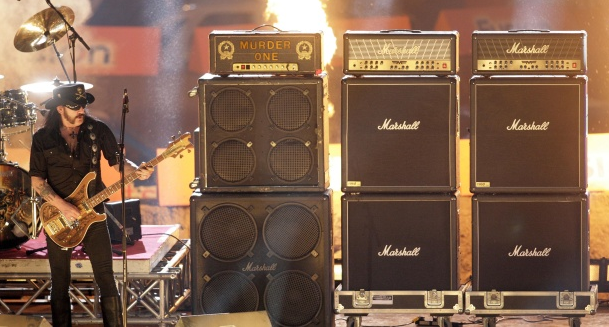
Full Marshall stacks are 100 watts and they will make you get serious hearing loss

d356381c63c1fe784464e12fe631d7a6.png
 
Watts = amps * volts
[how strong is a river] = [how wide the river] * [how fast the water flows]

The speaker where the wattage lands dissipates this wattage by moving the air. The specs (ohms, quality) are important.

Back to the river analogy, the difference a speaker would make is the same as putting a thin stick in the river or putting a sheet of playwood.
The way I got through my Electrical Engineering courses was to think in terms of plumbing, very similar to the analogy above. I think of voltage as water pressure, resistance (Ohms) as pipe diameter, Amperage as speed, diode as a "check valve", etc. Power ("Watts") = voltage times amperage (P = VI), or the total amount of "water flow". Low pressure (low voltage) through a small pipe (high resistance) will not flow as much water as a larger pipe (low resistance) under high pressure (high voltage).

Series vs. parallel can be thought of in the same way. You have two 12" sections of 1/2" ID pipe. If you butt them end-to end, you add the "resistance" of the two pipes together (series), but if you run them side-by-side (joined with "Y" fittings on both ends), that reduces the effective resistance of the "circuit" (parallel).

As related to amps and speakers, as noted above, a good rule is to use speaker(s) that are rated at least the power of the Amp, and to make sure that your total load/resistance is not below the resistance that the Amp is designed for (don't run a 2 Ohm speaker load on an Amp designed for 4 Ohm minimum speaker load).

Hope this helps! ;)
 
Last edited:
  • Like
Reactions: DrummerwStrings
But
See, I understand that wattage measures power and not sound, but differentiating the effects that this will have on different amps is difficult for me to put in to perspective and how much of an affect it does take on sound and volume. So. When you say speakers are you referring to the cab? Or speakers in like a live setting? Because I saw in another post it's OK to have more wattage than said output can handle, as long as it's not all the way up. Better to have more than less? Not sure. Let me know. Thanks for your input, definitely helpful :)
Sorry. But it's important in forum context to know that the relationship between the Wattage rating on your amplifier and the sound level of speakers is not linear. Even when you dispense the marketing and level off everything, accounting for the various ways power can be labeled, the speakers are not a unique form load. You can find 10 different combos or heads and cabs from different vendors and each speaker driver can consume different amount of energy and produce different sound output.

That's my point and you caught me in my natural state (which is smart Alec) earlier.

Wattage (power) is a function of Volts and Amps, V x A. (Someone will point out those are not the proper symbols, bear with me, I'm a mechanical not electrical engineer and I'm trying to smooth it over)

OK. Think about a river.
Water runs from the hills, across the plains into the sea. The difference in height from where the water enters the river (could, mountain, hill, waterfall, whatever you imagine) to the sea level, that difference is Voltage. Volt = Potential. The difference between your wall service outlet and your bass amp which "wants" to rock is 120 Volts, approximately.

Amperes (Amps) is the Amount of water flowing in that river. Gallons per minute, for example. Or cubic feet per minute. Amps is the amount of the flow.

Watts is the Energy that carries it all. Think about the height the river falls times the amount of water in the river! That's the power of the river.

Now you see you can increase that "power" by changing either the flow or the differential. (Volts, Amps). You'll also see this expressed as VA but that's not commonly used in consumer devices.

Here we are at your speaker.
All of the resistance, impedance, friction (yes, that's a thing inside wires), all the opposing forces that take 100 Watts from your amp and limit it in the form of heat loss, mechanical resistance/motion of your speaker (which is a machine), let's get back to the river analogy.
The impedance of your system can be expressed (imagined) as all the rocks and sand and dams and curves in the river that the water flows AGAINST within the river bed (All those cables and all the components in circuits).

Just like a river, some of the water evaporates (hysteresis), some is diverted to maintain the system's operation, some is stuck swirling when the current batters the bridge pier (eddy). Eventually what's left falls into the sea (your rock'n'roll wall of sound). This is Ohms.

Come at me if some of y'all don't love my analogy. But Some of the Watts from your amplifier are lost/consumed before your speaker makes sound. I hope this helps.

All this I say because you need to know that a 200W amplifier is not twice as loud as a 100W amplifier. These are systems with a lot of variables.
Volts, Watts, Amps, Ohms are units that all interrelate. And you can't look at the "boilerplate" on the back of a Mesa and GK head and make an accurate assessment of rock'n'roll output. All you can do is compare with same load(speakers) or compare different speakers with the same amp.

800 Watts is more than 400 Watts but how much more in terms of musical volume depends on Everything Else.
 
  • Like
Reactions: WRM
Power reserve. The more watts, the more power is available for making noise through a cab. Having the power doesn't mean it's always being used, just as you don't use your car's full power when getting groceries.

The problem is that different manufacturers claim wattage in different ways. The more reputable ones typically use RMS, which just means that it's a responsible method of stating real-world usable power.

Also, noise isn't made by watts. Noise is made by speakers mounted in speaker cabinets. More/better speakers are a quicker way to making more noise than having more watts.

the higher the SPL of a speaker the more efficient , the more perceived loudness from same power amp.
 
The way I've always understood it can be roughly illustrated by looking at a clear pipe coming from a water source. The voltage is the amount of water in the pipe, the resistance in Ohms is the diameter and the length of the pipe, the current in Amps is the rate of flow in the pipe and the open end of the pipe and the resulting energy and work done is the Wattage.
 
Putting too many watts into a speaker is like microwaving your steak for too long. Bad news!

Don't spend all your budget on an amp - make sure you can afford the speakers first.


Generally yes!

For example, my Mesa guitar combo is switchable 10/25/35 watts. It's loud at all three, but when you go from 10 to 35, you notice a fullness more than a loudness. Hard to describe, but the closest thing is like going from a low volume setting one music to one where suddenly everything becomes more alive.
My 20W Marshall Origin combo has 3 settings- 20W/3W/0.5W. Currently my band is practicing at my house and our guitarist has been using it on about 4/10 volume on the 0.5W setting as it's so damn loud. I'm playing a 250W TC Electronic bass amp at about 5 and both of us together are way too loud. The Marshall is earth shaking on 3W.
 
I cannot ever imagine a scenario where 300 to 500 watts of bass amp power would not be enough.

Full Marshall stacks are 100 watts and they will make you get serious hearing loss

d356381c63c1fe784464e12fe631d7a6.png

As I mentioned before, watts don't make noise. Noise is measured in decibels, which are produced by speakers in cabinets, of which Lemmy had a truckload.

Plus, that 100 watt rating is probably at a low level of distortion; at the distortion levels Lemmy used, it's probably closer to 300 watts. Those are very dirty watts he had!
 
My 20W Marshall Origin combo has 3 settings- 20W/3W/0.5W. Currently my band is practicing at my house and our guitarist has been using it on about 4/10 volume on the 0.5W setting as it's so damn loud. I'm playing a 250W TC Electronic bass amp at about 5 and both of us together are way too loud. The Marshall is earth shaking on 3W.

I have the JTM-1H that goes down to 0.1w.

Even that got me scolded at one church I played at!
 
It is nice to see that many others now understand that double the wattage does not sound twice as loud. To get double the "perceived loudness" you need 10x the power. SO - the audible difference between say, a 300W amp and a 500W amp are negligible.

OK - So why are there 500-1000W amps? So you can drive more speakers! When you double the cone area, the perceived loudness also doubles.

As far as Volts / Ohms / Watts - it is really easy to compare electrical power to water in a hose. Volts is your water pressure. Ohms is the size of the nozzle. Watts is how much water is actually coming out. EASY!
 
  • Like
Reactions: WRM
Alright. So, for example if I were to get an 800 watt amp, what should I look for in a cab generally? More, less wattage than the head? Thanks. :)
You forgot a crucial number: How many ohms does the amp need in order to put out 800 watts? When picking a cab you need to consider watts AND ohms. But as far as watts, you want a cab rated for AT LEAST the number of watts that the head puts out.

For example, my Ampeg PF500 can put out 350 watts at 8 ohm, or 500 watts at 4 ohms. I have a 500-watt 8 ohm cab and that works fine because it will never get more than 350 watts from the head. I could go with a 350-watt 8-ohm cab too, but having more watts allows me to change heads in the future with the same cab.
 
  • Like
Reactions: WRM