Another technique as espoused by many bass amp owners is to gently back off the highs and mids, leaving the bass at mid point. This has a similar effect and allows for a little more gain without blowing something. I have tried it on my rig (Eden World Tour) and it works well in average/small rooms. Can't vouch for other brands but it must be worth a try when you consider the power drain caused by boosting lows a long way. Don't forget if you over-drive the output you will clip the waveform and possibly cook coils and/or tear cones.

Enjoy the benefits of a premium membership!
Upgrade Account
-
TalkBass has been independent since 1998. Add your voice.
Create a free account to reply to discussions, view embedded media, and browse with fewer display ads.
Join free Log in
Want zero display ads or expanded classifieds tools? Compare plans.
You are using an out of date browser. It may not display this or other websites correctly.
You should upgrade or use an alternative browser.
You should upgrade or use an alternative browser.
More options
Who Replied?
I crank the Bass on my on board pre (Spector HAZ pre) and lower the bass on the amp. I find this works better for me. YMMV
I went a step further. I went back to my old school biamp pre, an Ashly BP41, and put a Bag End S18 under my Goliath Jr 2x10. I boost the bass and dial back the treble a bit on the EQ and crank the low end side of my Peavey ISP3000DSP power amp. To say the bass is "authoritative" is understatement.

Cut Mids=more Bass
Sounds better too
My amp is an early B15N. Cranking the bass sounds terrible on it. It’s got plenty...
If you are playing in a room with no PA and you have an SVT, that’s different
Sounds better too
My amp is an early B15N. Cranking the bass sounds terrible on it. It’s got plenty...
If you are playing in a room with no PA and you have an SVT, that’s different

I have not read all this yet but love your new found love for some bass.
I always crank it as high as I can get away with and that varies a great deal with room, genre of music and the tone settings the rest of the band has at any given time - sometimes even means cutting bass but that is live music. I like it even more now that I always run an fdeck on my pedal board - there are some cool sounds that can be had with cranking some bass and bumping up the cutoff of on the fdeck at the same time, can help keep it low and tight. Kinda like on the Sadowsky with cranking up the onboard treble while also closing up the passive tone control - interesting sounds can be had with a little knob tweaking.
I always crank it as high as I can get away with and that varies a great deal with room, genre of music and the tone settings the rest of the band has at any given time - sometimes even means cutting bass but that is live music. I like it even more now that I always run an fdeck on my pedal board - there are some cool sounds that can be had with cranking some bass and bumping up the cutoff of on the fdeck at the same time, can help keep it low and tight. Kinda like on the Sadowsky with cranking up the onboard treble while also closing up the passive tone control - interesting sounds can be had with a little knob tweaking.
Remember.......
All dancing Butts move to bass (rhythm) and groove so, sound authorative, but keep it musically balanced.
All dancing Butts move to bass (rhythm) and groove
so, sound authorative, but keep it musically balanced.The word "bass" has 2 separate meanings in regards to music. One relates to the tonal qualities which you adjust with your settings on your bass guitar and amplifier. The second is in regards to the pitch range that you are playing in. There is suprano, alto, tenor and bass, from high pitch to low pitch. So when you say that you are playing bass, it means the second example, not the first. When you play bass, you are referring to the pitch range, not the tonal qualities. You can be playing bass with the treble settings on full and the bass settings on low and you are still playing in the same low pitch range. If a guitarist is playing in the upper register it doesn't mean that he is playing "treble", it means that he is playing "suprano" or "alto". Many folks get the 2 meanings of the word "bass" confused it seems to me. Should the guitarist when playing in the upper register turn his treble settings to 10 and lower his bass settings to 0? Of course not. Tone and pitch are 2 completely separate entities. JMO.We play the BASS. Not the MID.

I am going to admit something that may get me raked over the coals...I love cranking the bass knob! Didn't always...took me a long time to warm up to the idea. But now I'll turn the bass up all the way if I need to. Gotta be judicious about it sometimes...don't want to overcrank the lows in a dark sounding room with a lot of natural reverb or anything dumb like that. And mids are still important if you want some note definition as well. But over the past years, I've gotten less shy about warming up the room real good, and I think it's working out great, and I don't get why so many people on here tell bass players not to do it. The lows are what people mostly hear out of your bass in a mix. Might as well let them have it.
There. I said it. I do something considered wrong by conventional TB wisdom, and I do so unapologetically. Take that.
Yeah man... get it!!
I saw an interview with bubby once where he said he would turn the bass EQ knob all the way up on certain songs playing live with Snoop Dogg.
I do it at church sometimes to rumble the house

I agree. The first band I was in had three guitar players and no bass. I thought it would be nice if I conceded to play bass. I played bass like a guitar player. Up one octave and concentrated more on the melody than the rhythm. Observing the bass on hit recordings I noticed the notes were played on the lower frequency three strings near the nut and were expressing rhythmic patterns. I later learned this is referred to as "Playing in the money."I am going to admit something that may get me raked over the coals...I love cranking the bass knob! Didn't always...took me a long time to warm up to the idea. But now I'll turn the bass up all the way if I need to. Gotta be judicious about it sometimes...don't want to overcrank the lows in a dark sounding room with a lot of natural reverb or anything dumb like that. And mids are still important if you want some note definition as well. But over the past years, I've gotten less shy about warming up the room real good, and I think it's working out great, and I don't get why so many people on here tell bass players not to do it. The lows are what people mostly hear out of your bass in a mix. Might as well let them have it.
There. I said it. I do something considered wrong by conventional TB wisdom, and I do so unapologetically. Take that.
To find what works you need to play with a full band and try different tones and octaves and listen for the best mix. I have also found songs have certain keys they will and won't work in. I once played The Thrill Is Gone with a guitarist who played it up a tone or two and it lost its power. In most situations I find my bass playing sounds best with the bass turned up and played in a lower octave. It also helps to play fewer notes and let them sustain. Played in this way basses achieve rhythmic power.

I usually keep my settings flat, a lot of us probably do that too. But to be honest, I've increased the bass knob a few times when recording bass, to thicken the song up a bit. Sounds a lot better. I don't crank it to the max, but turn it to about 7, instead of flat 5, just to add that thickness. Definitely got a thumbs up from my band mates. 
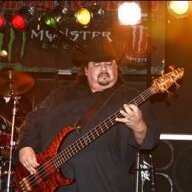
For me it depends. In Judas Priest there are two guitarists, and one is always playing rhythm. They only thing the bass does is ride the root note of the rhythm guitar. The tone of the bass is ultra low. You feel it more than you hear it, and that mix is fine. For one guitar player bands you need the bass to be heard. I'll put in more high mids in this type of band so that I can cut through the mix and carry the melody when the guitarist is soloing.
I also believe the guitars and bass need to have their own assigned frequency range. In metal a lot of guitarists love that low, heavy crunch so they pump up the bass. It sounds great when they are playing alone, but not when playing with the band as a whole. If the sound engineer emphasizes the same frequencies in the bass and the guitar the mix gets muddy. It's best when the lows are cut or limited on the guitar and the bass is allowed to fill in those lows.
I also believe the guitars and bass need to have their own assigned frequency range. In metal a lot of guitarists love that low, heavy crunch so they pump up the bass. It sounds great when they are playing alone, but not when playing with the band as a whole. If the sound engineer emphasizes the same frequencies in the bass and the guitar the mix gets muddy. It's best when the lows are cut or limited on the guitar and the bass is allowed to fill in those lows.
I usually keep my settings flat, a lot of us probably do that too. But to be honest, I've increased the bass knob a few times when recording bass, to thicken the song up a bit. Sounds a lot better. I don't crank it to the max, but turn it to about 7, instead of flat 5, just to add that thickness. Definitely got a thumbs up from my band mates.
I've found that my bass, my amp, and my cabinet are already engineered to emphasize the lower frequencies. I don't have to crank the low end knob to get a lot of beefy sounds out of my rig.

Thanks. Seems like an awful lot of kit for a grand!It was a great gig due to a very enthusiastic crowd but one of the weirdest rooms i've played. A couple of times i could hear the crowd talking and singing along as much or more than i could hear ourselves and thought the FOH had been turned right down....not so. We kept bringing the foldback up (love being able to do that on stage ourselves with the Ui12) but it didn't help and actually made the FOH muddier.
I love it. I wish i'd waited, saved a bit more and got the Ui24 if only for the multi-track recording. As it is, the Ui12 works perfectly for us. With a couple of RCA-XLR adapters i have even expanded it to run 10 channels at a couple of gigs. We immediately got better sound from the first gig.
At the price point the features are pretty much unbeatable.
Two things pushed me to this over the Behringer XR mixers.... firstly and most importantly, i'm an old bugger and the user interface looks like a real mixer. Once you know where each page is you can use it just like an analogue mixer. Secondly, you don't have to spend any extra money to be able to have more devices hooked up. You can connect up to 10 devices of any type (Apple or Android) at once enabling everyone to control their own stage mix on a tablet or phone.
The Ui12 and 16 have some connectivity issues which are completely cured by using an external router. I believe the Ui24 hasn't suffered from this at all but being a wifi controlled device there can occasionally be issues in areas with a LOT of wifi hotspots and traffic. Make sure you at least have access to someone with some I.T. and wifi knowledge.
In saying all that about them, i still take an analogue desk to every gig as a backup..... but then again, i've seen gigs derailed when an analogue desk crapped out too.
Sorry for the derail..... back to normal programming.
I like to hear and feel a lot of bass on stage, and since we seldom can afford a sound man in the clubs we play in, I go out into the middle of the room to tweek the sound which means I may not like the stage sound as much. I am more interested in how it sounds in the mix in the middle of the room. When we play a bigger venue that pays more and have a sound man I have more choice about my stage sound. I have active preamps on my basses and use different placement of my plucking hand to get more or less bass also. A room that has mostly hard surfaces, no backdrop on stage and little wood if any, and few people in the first part of the first set makes all this difficult and we do the best we can. I also always use ear plugs after the sound check which cuts out certain frequencies so I can still hear next year.
Last edited:
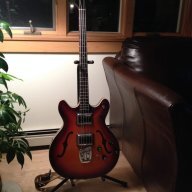
If you are at a paying gig, your only concern should be making sure the band sounds good. Low frequencies are felt by the audience more than heard. If you value your bassline getting heard by the audience, you should be boosting the bass a bit, then the mids until the individual bass notes are clear. Also, the power of the amp is very important. If you are using a less powerful amp, obviously the volume needs to be higher. But as a general rule, you need mids to have people listen to what YOU play
Lets keep in mind the rest of the band and the overall stage volume and the stage volume wars that start when everyone starts turning up their amps to 11! You may like low end feel in your gut but out front it's on it's way to killing any reasonable balanced mix in the house.
As a general rule what sounds good cranked up in your garage is not going to work when you add that tone and volume to a mix/stage volume that includes drums, keys, a couple guitars, vocals and so on.
As a general rule what sounds good cranked up in your garage is not going to work when you add that tone and volume to a mix/stage volume that includes drums, keys, a couple guitars, vocals and so on.

I had this habit. I'd just crank everything wide open before I plug in. Then set my EQ on the head. This new jazz I have. Now, I'm plugging in. Everything set on zero. So I can really dial in my tone. This is the best bass I've ever owned. It just sounds amazing. I'm really changing my whole mindset about bass playing now. I'm really begin to understand what a friend told about his take on bass players

Can I break out a story? Some years ago I was working at a retail store and was given the opportunity to take a bass head to a Sly and Robbie gig. Robbie wanted to try it out, and we were the local dealer. I got there for sound check. They set the head up on his cabinet. When he plugged in, the first thing he did was turn every knob up to 10. That was the entirety of his adjusting the tone.  He said he liked it, though. Used it for the whole gig.
He said he liked it, though. Used it for the whole gig.Latest posts
-

-
-

-

-
 Curious what the percentage of bass players use rounds vs flats is.
- Latest: 5StringBlues