Isn’t this only when using a Ric with Rotosounds?A common misconception.
The larger the distance to the system, the longer the emitted photons have travelled through expanding space and the higher the measured cosmological redshift. Cosmological Redshift: the wavelength of the emitted radiation is lengthened due to the expansion of the Universe.
In astrophysics, gravitational redshift or Einstein shift is the process by which electromagnetic radiation originating from a source that is in a gravitational field is reduced in frequency, or redshifted, when observed in a region at a higher gravitational potential.

Enjoy the benefits of a premium membership!
Upgrade Account
-
TalkBass has been independent since 1998. Add your voice.
Create a free account to reply to discussions, view embedded media, and browse with fewer display ads.
Join free Log in
Want zero display ads or expanded classifieds tools? Compare plans.
You are using an out of date browser. It may not display this or other websites correctly.
You should upgrade or use an alternative browser.
You should upgrade or use an alternative browser.
More options
Who Replied?

BurningSkies
CRAZY BALDHEAD
- Feb 20, 2005
- 27,956
- 20,350
- Disclosures
- Endorsing artist: Dingwall Guitars
Are you sure that’s why?
Whenever this has happened at one of our show, I write it off as healthy gag reflex.
Depends on your rig.if you use 10s you're ok w a boost.15s not so much.
I quite often see and hear big ampeg cabs on a small stage with nothing but low end rumble and no definition.
Turn down the bass mofo! Otoh, i need to crank the bass when i use my pf350 into a 210av cab.
Anything under 80hz will be ok.the boom trouble sits between 100-250 hz depending on the room.and a lot comes from secondary tones standing waves cascading between walls on a small stage.
Also important is the amp's eq controls sweep.
I wonder why we don't see too many amps with notch filters? I have filtered out some frequencies with a para eq for several cabs/amps/bass combinations.
I quite often see and hear big ampeg cabs on a small stage with nothing but low end rumble and no definition.
Turn down the bass mofo! Otoh, i need to crank the bass when i use my pf350 into a 210av cab.
Anything under 80hz will be ok.the boom trouble sits between 100-250 hz depending on the room.and a lot comes from secondary tones standing waves cascading between walls on a small stage.
Also important is the amp's eq controls sweep.
I wonder why we don't see too many amps with notch filters? I have filtered out some frequencies with a para eq for several cabs/amps/bass combinations.
Last edited:

I love to as well at times. Generally when there’s more instruments involved. That’s why I love my Ampeg Heritage 410. It’s got heft. I remember seeing Leon Wilkeson the first time. OMG—that’s what bass is, I thought to myself. He surrounded the rest of the band and wasn’t trying to cut through anything. They were cutting through him.

Had a recording session this weekend, and after reading this chain, set my V4-B with the Bass knob dimed, the mids (set to 3K) at 1pm and the treble at 1pm, gain at 9pm and master at 12noon. Playing through a single SVT 212av (horn off). We di'ed out of the V4-B and put an SM57 about 3' in front of the cab. The rig was in closed, heavily carpeted room. On my Aerodyne PJ (D'Addario Half Rounds 55-110) I had the P and J pups on full and the tone rolled off about a quarter. The tone on the playback was awesome! Real punchy bottom, but clear defined notes popping out of the mix. Can't wait to try these settings live with the second 212av!
The problem with sweeping statements is that you run into issues under particular circumstances, mostly in small spaces with bass nodes.so simply saying 'turn up the low end' is going to make most bass sounds bad.
Im making a sweeping statement here.It's ok for closed small cabs with 10" speakers and nothing under 50hz.Using 15" speakers? Forget it.To add: turn down the low end to 0, then add in as much bass until the point where you hear interfering harmonics.for this you need good ears.your PA guy will be very happy.
You can't bring down bass when it's put out on stage but your PA man can bring it up when need be.
Im making a sweeping statement here.It's ok for closed small cabs with 10" speakers and nothing under 50hz.Using 15" speakers? Forget it.To add: turn down the low end to 0, then add in as much bass until the point where you hear interfering harmonics.for this you need good ears.your PA guy will be very happy.
You can't bring down bass when it's put out on stage but your PA man can bring it up when need be.

And the problem with commenting on sweeping statements when there were no sweeping statements made is that it makes you look like you read the thread title and the first line of the original post and based your reply on that instead of what was really said. Guess you missed the part where I said you need to be judicious about it in certain circumstances.The problem with sweeping statements is that you run into issues under particular circumstances, mostly in small spaces with bass nodes.so simply saying 'turn up the low end' is going to make most bass sounds bad.
Im making a sweeping statement here.It's ok for closed small cabs with 10" speakers and nothing under 50hz.Using 15" speakers? Forget it.To add: turn down the low end to 0, then add in as much bass until the point where you hear interfering harmonics.for this you need good ears.your PA guy will be very happy.
You can't bring down bass when it's put out on stage but your PA man can bring it up when need be.
Also, this business about it being related to speaker size...it may be true with YOUR speakers but it's not true with mine.
And the problem with commenting on sweeping statements when there were no sweeping statements made is that it makes you look like you read the thread title and the first line of the original post and based your reply on that instead of what was really said. Guess you missed the part where I said you need to be judicious about it in certain circumstances.
Also, this business about it being related to speaker size...it may be true with YOUR speakers but it's not true with mine.
yes, you're right.mea culpa.bad post.what happened was that i did read all the posts and then forgot about checking the first one.classic mistake! so i reacted to all the posts supporting the idea of pushing more bass on stage.
As i regard that as a classic faux pas in general, i didn't intend it for those who know how to control sound.
Your post indeed goes against the general consensus and might work for you.
The sweeping statement i made was just that: careful with 15" speakers.I shouldve said the same applies to vented cabs w 10s.like you i am a fan of the closed ampeg svtav 210 cabs.pushing the bass on those does no harm as there is very little under 50hz to begin with.but i do have to be careful w my various 15" cabs.i end by commenting that what you hear most is not the fundamental bass note but the second harmonic.so, playing a 41hz E string you mostly hear 82hz.(see image in underlying link).it is the reason why those 210av cabs work so well..actually, thats why the Ampeg 8x10s worked so well too.
[Invalid or Expired Link Removed]
Last edited:
HAD as in past tense? Why? Your only defenses are fire, flood or theft
The loudness button was magic. If well implemented, like in the Marantz amps, it only boosted the bass at lower volumes to compensate for our hearing. It was good on all the medium priced gear, Pioneer, Sansui, etc. etc...
nope, the loudness button was a terrible idea.what was meant for low volume level to get the low freq on par w the rest was then used to crank the bass in public places when the music was loud.
Put the speakers in the top corners.double whammy super stupid.
It seemed such a great idea at the time..most of them had just an on and off button and no auto transition.the latter shouldve been on all of them

- Feb 12, 2006
- 61,047
- 5
- 221,002
- Disclosures
- Development Engineer-Mesa Boogie, Development Engineer-Genzler (pedals), Product Support-Genz Benz
The loudness function on many Hi-Fi amps functioned so that as the volume control was increased the effect of the loudness function decreases. It's based on the position of the control which goes back to the standardization of signal levels in the industry.
Not all worked this way, but some do.
Not all worked this way, but some do.
Disagree. What hear are not the sub 40hz that you get generate cranking the bass. In order to hear those frequencies, it has disproportionately high and will tend to make your sound, as well as the band sound muddy. If you want to sit well and or have a better presence in the mix, try boosting the low mids 70-120hz.
A further problem by cranking the super low frequencies is it is h*ll on your speakers, and stresses your amp. It takes much more of your usable power to generate rock bottom lows which will in turn effect reduce what you need to hear.
you fill in the low frequencies with your brain.you mostly hear the second harmonic 82hz when playing the lowest note on a 4 str: the E string.You don't actually hear much of the fundamental.if you want to actually hear as much 41hz like you do 82hz you need more than twice the output to get to parity.but then you'd need to separate the fundamental 41hz from it's harmonic 82hz, something bass amps can't do.so, the only way you can do that is with a sub that only produces up to 80hz.Then you get some serious fundamental bass you can feel and possibly hear.That's usually done by PA systems.on stage it doesnt work very well and that's why you don't see them.Did you ever hear a sub below 80hz on its own? Here's a sweep from 1-100hz with all the harmonics intact.notice how silent the 40hz is compared to 100hz.
the human ear just about starts hearing frequencies around 35/40 hz.go up 10hz to 50hz and it's way louder let alone 80hz which completely drowns out the 40hz.
When people say they can hear the lowlows on stage with a band because they cranked their bass knob i just smile..it doesnt matter where your centre frequency is:20/40/60, you will hear the second harmonic first and foremost..
Last edited:
you fill in the low frequencies with your brain.you mostly hear the second harmonic 82hz when playing the lowest note on a 4 str: the E string.You don't actually hear much of the fundamental.if you want to actually hear as much 41hz like you do 82hz you need almost twice the output to get to parity.but then you'd need to separate the fundamental 41hz from it's harmonic 82hz, something bass amps can't do.so, the only way you can do that is with a sub that only produces up to 80hz.Then you get some serious fundamental bass you can feel and possibly hear.That's usually done by PA systems.on stage it doesnt work very well and that's why you don't see them.Did you ever hear a sub below 80hz on its own? Here's a sweep from 1-100hz with all the harmonics intact.notice how silent the 40hz is compared to 100hz.
the human ear just about starts hearing frequencies around 35/40 hz.go up 10hz to 50hz and it's way louder let alone 80hz which completely drowns out the 40hz.
When people say they can hear the lowlows on stage with a band because they cranked their bass knob i just smile..it doesnt matter where your centre frequency is:20/40/60, you will hear the second harmonic first and foremost..
What he said! Thanks for a more technical explanation.
What he said! Thanks for a more technical explanation.
it's the reason why most drivers really tumble down below 50hz.it takes a lot of power to drive and you won't hear it.the thing with low end roll off is critical from 80-100hz.Most drivers can easily reproduce anything above 100hz and it doesnt really matter what enclosure it is in.
From 100hz down you want to maintain a solid level to 80hz.Too steep a db curve and the cab starts losing balls.
Small sealed cabinets are in danger here so both driver and cab need to be optimized..same goes for vented.tuning the cab, picking the driver, do the math.
Last edited:
Your explanations should etched in stone in every How to be a Bassist handbook.
well, it's really basic physics.every cabinet maker and speaker company knows the principles.musicians are in general a tad reluctant to delve into the mines.i found out because i was interested in the details as a musician and later as a sound engineer.we make assumptions that have to be backed up, n'est pas?
I had gained enough insight to ask the right questions.then the experts open the books and you pass it on to others.that's all..
Oh, and another thing: when cranking the bass, your 2nd harmonic is boosted but your 3d and 4th are as well.a lot of interfering harmonics, odd and even, take place between 120-250hz.that's actually where my para eq does most of its work.
Wanna know more about fundamentals and harmonics: here you go
Complex Tones, Fourier Analysis and The Missing Fundamental
Apologies for hijacking the thread..
Last edited:
a
well, it's really basic physics.every cabinet maker and speaker company knows the principles.musicians are in general a tad reluctant to delve into the mines.i found out because i was interested in the details as a musician and later as a sound engineer.we make assumptions that have to be backed up, n'est pas?
I had gained enough insight to ask the right questions.then the experts open the books and you pass it on to others.that's all..
Oh, and another thing: when cranking the bass, your 2nd harmonic is boosted but your 3d and 4th are as well.a lot of interfering harmonics, odd and even, take place between 120-250hz.that's actually where my para eq does most of its work.
Wanna know more about fundamentals and harmonics: here you go
Complex Tones, Fourier Analysis and The Missing Fundamental
Apologies for hijacking the thread..

I have crank my bass knob whenever i like or think is need it,that is why there are knobs on any amp,otherwise they would not be put there on,right?What sounds good to you it is make you happy,which makes you play better- IMO.
Doesn't bother me any and it's my threadwell, it's really basic physics.every cabinet maker and speaker company knows the principles.musicians are in general a tad reluctant to delve into the mines.i found out because i was interested in the details as a musician and later as a sound engineer.we make assumptions that have to be backed up, n'est pas?
I had gained enough insight to ask the right questions.then the experts open the books and you pass it on to others.that's all..
Oh, and another thing: when cranking the bass, your 2nd harmonic is boosted but your 3d and 4th are as well.a lot of interfering harmonics, odd and even, take place between 120-250hz.that's actually where my para eq does most of its work.
Wanna know more about fundamentals and harmonics: here you go
Complex Tones, Fourier Analysis and The Missing Fundamental
Apologies for hijacking the thread..

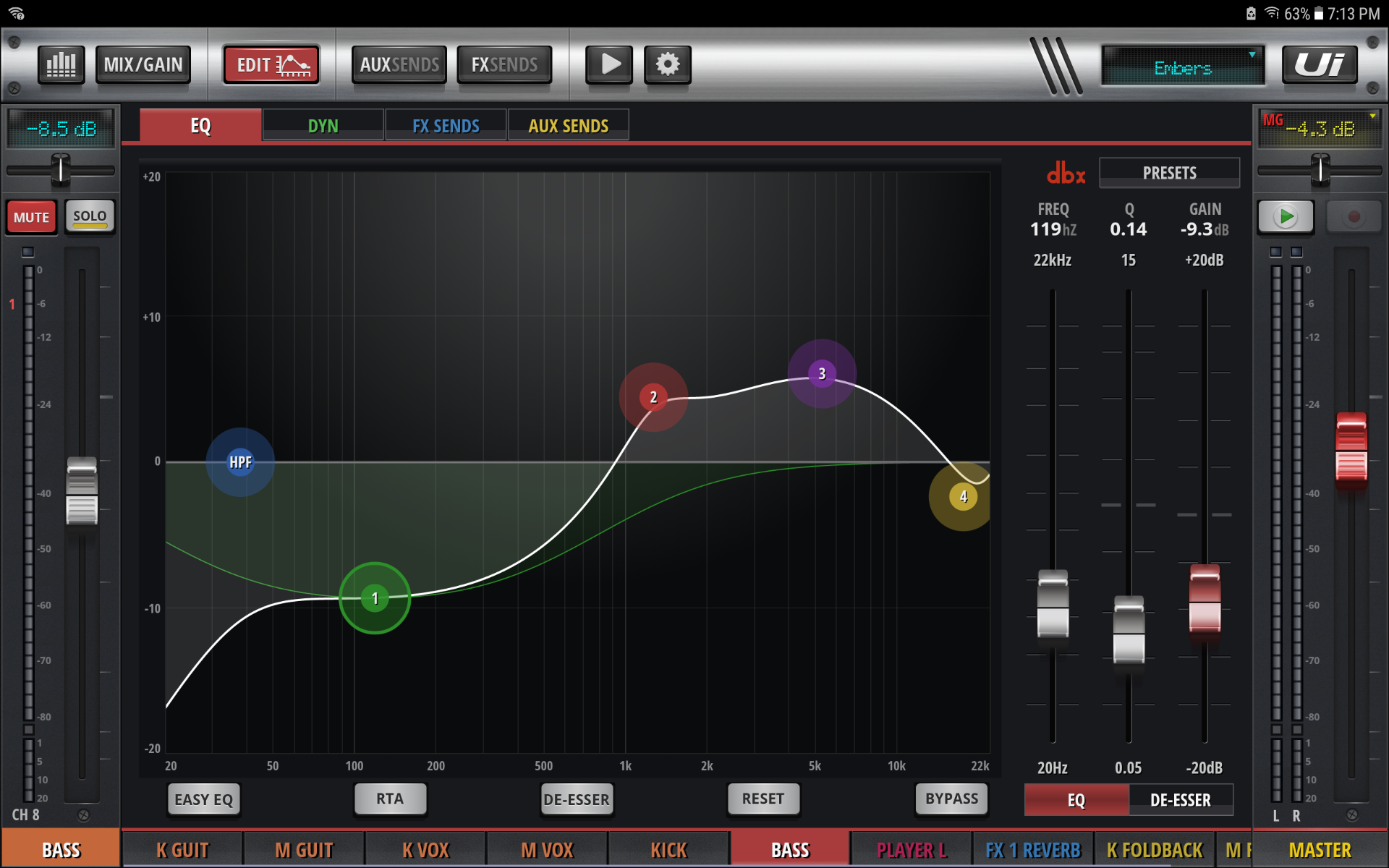
It's taken me a while to get around to getting a screen shot of the eq on my bass line from our last gig but here it is. This room is so muddy its not funny. I'm sure you probably wouldn't ever play a room so small but if you did you'd want to roll that bass knob way back.