• TalkBass has been independent since 1998. Add your voice.
    Create a free account to reply to discussions, view embedded media, and browse with fewer display ads.
    Join freeLog in
    Want zero display ads or expanded classifieds tools? Compare plans.
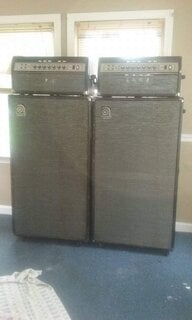
crash cours on tube amps

Never run a tube amp without a load (speaker), I think those Fenders want a 4 ohm load, you will get less power if you use an 8 ohm speaker for ex. Tube amps are the opposite of SS amps, it is better to run them at too low an impedance than too high. Always turn them on with the standby switch in the off position and wait at least 30 seconds to turn the standby to the on position, you'll wear out your power tubes too soon if you don't do that. I'm sure there are other things but those are important. They are not as delicate as people will have you believe and tubes last a lot longer than people who haven't owned them will say, there is nothing to be afraid of with a tube amp, just make sure you have the proper load on them when they're on.
 
  • Like
Reactions: Mvilmany and Bigbri
so an 8 ohm impedance would be better? I have an 8 ohm 419 cab

Whenever possible, the ideal situation it to have the total impedance of the speakers match the output impedance of the amp. They don't necessarily act like solid state amps where you get X power with an 8 Ohm load and X+ with a four Ohm load.

Tube amps, transfer the max energy to the load when everything matches.
Some amps have switches to accomplish a match, some have a jack to be used with the first speaker and another to be used when adding a second cab.

Your best bet is to go on line and find a user's manual and see what it says about using speakers with the amp.

Be sure to never operate a tube amp without any speakers connected.
 
Always turn them on with the standby switch in the off position and wait at least 30 seconds to turn the standby to the on position, you'll wear out your power tubes too soon if you don't do that.

Standby is a myth, they are for valves run at way higher voltages than ones for instruments.

If the amp does funny wrong sounds, or gets quieter on its own, stop using it and get it fixed by someone competent. Old valve amps are pretty capable of sort of working for ages while they are going wrong and wind up with lots wrong if you don't get them sorted.
 
Standby is a myth, they are for valves run at way higher voltages than ones for instruments.

If the amp does funny wrong sounds, or gets quieter on its own, stop using it and get it fixed by someone competent. Old valve amps are pretty capable of sort of working for ages while they are going wrong and wind up with lots wrong if you don't get them sorted.

Well I stopped using it at a certain time and my power tubes wore out a lot quicker than usual, was the only change I did. My amp has SS diodes in the power supply I was told to use it as the surge was not good for the power tubes. I'll keep using it.
 
  • Like
Reactions: Sartori
Well I stopped using it at a certain time and my power tubes wore out a lot quicker than usual, was the only change I did. My amp has SS diodes in the power supply I was told to use it as the surge was not good for the power tubes. I'll keep using it.
The standby switch cuts the plate voltage to the tubes. The filaments stay on. Therefore the tubes stay in their warmed up condition. Standby will quiet your amp without having to turn it all off, like when you take a break during a gig. The amp will be ready to go as soon as you take it out of standby.

It does allow you to turn the amp on in stages. Filaments first, then plates. It might affect the inrush current, but I would think not a lot. It can depend somewhat on amp design.

Warm up time can be different between tubes types and dependent on age. If the plates are on during warmup you might get some odd voltages going on, especially with a tube rectifier. With solid state rectifiers, the plate voltage would be immediately available. But the other tubes might not like having full plates on while warming up. It makes sense to me to allow the tubes to fully warm up before applying plate voltage.

We use to condition a new tube in our FM radio transmitter before putting it into service. We would run it for at least two hours with filaments only before applying plate voltage. It helped to extend tube life. We'd get fewer infant mortality failures if we let the filaments "bake in" for a couple of hours before hitting the plates. I don't know if that would apply to instrument amps though. But it sure seems like it couldn't hurt.
 
Last edited:
  • Like
Reactions: Sartori
Warm up time can be different between tubes types and dependent on age. If the plates are on during warmup you might get some odd voltages going on, especially with a tube rectifier.

I have read that it is ok to not use the standby when first turning on an amp with a tube rectifier as the rectifier also takes just as long as the rest of the tubes to warm up so your high voltage won't hit the power tubes full force right away like one with a solid state rectifier. I think transmitter tubes' cathodes get stripped without using the standby because of the very high voltage that's applied but hey what do I know. I've been reading on standby switches tonight after reading this thread and I guess some of the other experts also don't believe standby switches are necessary but I'm going to keep using mine.
 
Most tube amps unlike their solid state brothers put out the same power at all their rated Load levels where SS the power cuts with increased load. So if your tube amp puts out 120 watts at 8 ohms it will put out 120 watts at 4 ohms and if rated for it also 120 watts at 2 ohms. There are some tube amps that are not like this but most of the ones I have seen, used and Owned were like that Except the Peavey Alpha bass.
 
  • Like
Reactions: Sartori
I have read that it is ok to not use the standby when first turning on an amp with a tube rectifier as the rectifier also takes just as long as the rest of the tubes to warm up so your high voltage won't hit the power tubes full force right away like one with a solid state rectifier.
And that may very well be true in many cases. Unlike with the SS rectifier where you do have stable full HV pretty much right away, the voltages present with a tube rectifier have not stabilized. It's just the unknown nature of it that concerns me. In any case the tubes aren't working too hard as long as you have hands off the bass. I just like the idea of letting the filaments warm up sufficiently before doing anything else to the tubes. YMMV.
 
  • Like
Reactions: bobyoung53
@agedhorse has his work cut out for him in this thread. :roflmao:

Transmitting tubes are physically completely different animals from the receiving tubes you see in SVTs, etc.

They use a directly heated, thoriated tungsten filament. The largest tubes use water cooling for the filament supports, and take several minutes to gradually bring the filaments to full power and avoid mechanical failure. The few smaller (KW class) tubes that have cathodes require several minutes of filament before applying B+ because the cathode or grids (some are gold plated) will get stripped if high voltage is applied to a "cold" tube. This phenomena doesn't exist in receiving tubes because of the lower B+. Now, if you were running 2KV on the plates of your KT88s...

Treating your receiving tubes (that's what all tubes that aren't transmitting tubes are called) like transmitting tubes won't hurt anything. Is it necessary? Consumer electronics never had a standby switch - and your average TV had a heck of a lot more tubes in it than your SVT.
 
Last edited:
  • Like
Reactions: Old Garage-Bander
You might consider the age of the amp. How old is it? If it's really old you might want to have a tech check the amp out. Older components can break down (leaking capacitors). The tech can also check out the condition of the tubes.
 
Never run a tube amp without a load (speaker), I think those Fenders want a 4 ohm load, you will get less power if you use an 8 ohm speaker for ex. Tube amps are the opposite of SS amps, it is better to run them at too low an impedance than too high. Always turn them on with the standby switch in the off position and wait at least 30 seconds to turn the standby to the on position, you'll wear out your power tubes too soon if you don't do that. I'm sure there are other things but those are important. They are not as delicate as people will have you believe and tubes last a lot longer than people who haven't owned them will say, there is nothing to be afraid of with a tube amp, just make sure you have the proper load on them when they're on.

I used to use a 1971 SVT with an EV 15b TL cab at 8 ohms. A lot of the time that was enough so I didn't always use 2 15's or the 4 ohm 810. The amp was always blowing fuses so I retubed it at almost 400 bux and ended up selling it before I knew exactly what it was. Now I've read this could have it been running the svt at 8ohms that was the problem?