• TalkBass has been independent since 1998. Add your voice.
    Create a free account to reply to discussions, view embedded media, and browse with fewer display ads.
    Join freeLog in
    Want zero display ads or expanded classifieds tools? Compare plans.

Crooked neck plate?

Status
Not open for further replies.
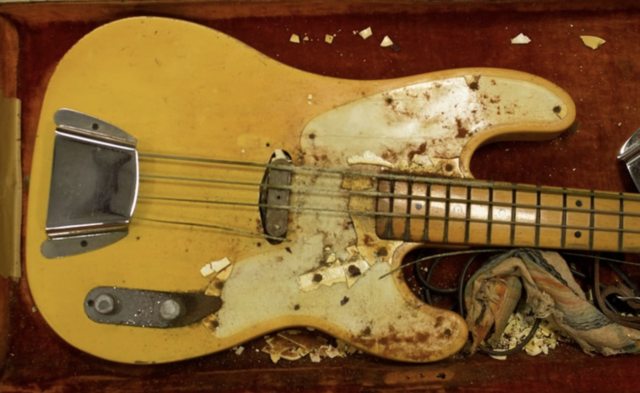
remember that time Fender used those imploding pickguards :D
1Qplexol.jpg
 
I'd be fine with it, but would probably try to loosen and twist the plate before re-tightening. Functionally, there is zero difference between a plate that is one degree to the left or right and the finish isn't exactly pristine. I'd look at the overall package rather than nitpick on little things on a relic'ed bass.
 
Have you tried loosening the screws, twisting the plate to the left, and holding it there while you re-tighten the screws? Often, there's enough clearance in the holes in the body that the neck plate can be shifted out of position like that if you aren't paying attention when you tighten the screws. Sloppy assembly technique, but not necessarily sloppy machining of the holes.

If necessary, you can slightly enlarge the holes in the body to get the neck to seat on there straight.
My first thought exactly. I hate to break it to you guys, but virtually ever bass made of wood has a little "play" in it's construction. Wood moves, shifts, contracts, expands, etc.

Loosen the screws, turn the plate, see if you can hold it straight and then tighten them up.

Again, just like Bruce said, it should have been caught. But I bet it's not a "defect".
 
I can't imagine how that even happened. Those holes should be drilled by a CNC machine, which would never do that sloppy of a job. The fact that that came out of Fender's Custom Shop reinforces some of the things we were talking about on another thread yesterday.

The sad thing is, if you have them fix it (redrilling stuff) you'd likely end up with enlarged holes in the body (which is bad, as the neck could easily shift way out of place) but visually would be hidden under the neck plate, and the holes in the neck would be drilled right next to/overlapping where they were first drilled, which could easily be a structural issue. If there's any way to get your money back, do it and run (to Sadowsky or Lakland, or Lull, or pretty much anyone else).

That's just criminally bad work, and for them to not notice it in the factory, that's 2 strikes, which, on a high priced instrument is a strike out to me.
 
That is SO sad that Fender let that out the door on a high line instrument. I have to wonder if it is intentional on a relic instrument and I'm just not getting it? Either way I would really consider returning it myself unless the bass was absolutely magical to play. I also wonder if it is worth a phone call to the CS to get the skinny on it. Maybe it really IS part of the vintage emulation and the detail is lost on me, the OP, and others.
 
  • Like
Reactions: Rocknroller4
If it were mine, personally - I'd be less than thrilled with the extra "attention to detail" that my money had just bought. I'd first see if it can be simply straightened, and if so I'd probably be inclined to keep it - but only after thoroughly going over everything else like solder joint, neck fit, finish flaws, bridge alignment, etc., that you probably shouldn't take for granted at this point with it. I mean, if they can't get something as simple as the neck plate alignment straight, what else was done half-baked?

Either way (keeping it or returning it), I would be inclined to send a photo attachment of that to back Fender, along with an e-mail expressing my dissatisfaction with the quality that's coming out of their Custom Shop. These are the most expensive instruments Fender offers and when the basic QC is surpassed by almost any $100 bass on the market, they should be made aware of it in no uncertain terms. Best of luck! :thumbsup:
 
Last edited:
That would be a LOT of clearance in the holes in the brand new neck to allow that much angle to the screws.

I’m not not curious of the outcome of a post-purchase realignment attempt, but if I were super attached to that specific neck and body would probably do full photographing with a digital caliper measuring two points on the treble side and two on the headstock then bring it to a dealer/licensed tech and let them bear responsibility for doing the screw & plate realignment attempt.

Were it me I’d just bring it to the dealer and tell em I want another bass (unless I bought it off of the rack for a Too Good To Be True price, not as a custom order)

~~~

I don’t think anyone addressed that last point yet: was this purchased for a surprisingly great price or specially ordered?
 
That would be a LOT of clearance in the holes in the brand new neck to allow that much angle to the screws.

<SNIP>

I agree with this. My basses (cheap to expensive) do not have THAT much slop in the body holes that they would allow a plate (and potentially the neck) to rotate THAT much. You could force the plate to the position shown in the OP but it would naturally want to relax to a straight position. Or in the case of the OP bass the plate could be forced straight but 'home' is most likely where is it now. It will find its way back home over time. I believe the body holes (and thus the neck holes) are all drilled in the positions to cause the neck plate to be crooked. Whether this is by design or error is unknown. The only other consideration I can think of is that if ONE screw hole is drilled very far off angle (not perpendicular to the body / neck) or out of square with the plate / other screws it could cause the plate to be rotated (that screw tightened first) then the other screws tightened may cause this issue.
 
I take more care than that with the parts basses I build. On a Custom Shop? I thought the point was that you were paying extra for extra attention to detail by master builder. That would just make me wonder what else they missed in QC.

I've assembled parts basses (for far less $$ than a Fender Custom Shop) and never had a neck plate turn out crooked like that.
 
Status
Not open for further replies.