• TalkBass has been independent since 1998. Add your voice.
    Create a free account to reply to discussions, view embedded media, and browse with fewer display ads.
    Join freeLog in
    Want zero display ads or expanded classifieds tools? Compare plans.

Crossing That Bridge

Or just a waste of time and money.
0000.jpg

I was once a believer in high mass bridges. However, my ears and experience with them has since made me reach the conclusion that there’s far more hype than substance to their claims.
:thumbsup:

About the only reasons I can think of to swap out a bridge are either because: (a) the one you have is broken or otherwise defective; or (b) you don’t like the way your current bridge looks.
(c) another bridge actually does things your current bridge doesn't do.


IME/IMO: the "high mass" thing is bs. any differences that i've noticed were/are minimal at best. but: i buy them for other features that the simple, bent-steel bridges don't allow (e.g., weight, string spacing, extra extension in some direction or another, yada yada). however, the bent-steel bridge on my backup works fine on that ax (and it happens to have great sustain!).
 
IMO the only reason to upgrade a bridge is for additional adjustment capabilities. Added mass hasn’t translated to added sustain for me. But my new bridge on my P Bass does allow better fine tuning for intonation & setups.
 
I lived through the days when this idea took root; we'd trade out the typical Fender bridge for some massive, Alembic-influenced brass monster that contained enough metal in it to melt down and make a trumpet or soprano sax.

It doesn't work that way. It doesn't supernaturally alter the tone to any great degree, mystically increase sustain, etc., whether it's some cheap pot-metal alloy all the way to titanium. It just doesn't. In my experience the opposite is true: A well made light bridge on a resonant body is about all the advantage you might achieve, but that's more than a little subjective on my part.

Now there are basses with fairly bogus bridges where you may get tired of the tops of the allen screws scraping your palm or fingers if you play down there, the adjustments seem pretty sloppy, it just feels and performs in a way that makes you think there must be something better. Then, that's when I'd update a bridge to improve performance in terms of much better adjustments by design and machining.

But I've yet to find some 'WONDER BRIDGE' that will suddenly make a big improvement in a given bass. There's just more to it than that. Now if you want one for functional improvements of the adjustments it offers, that IS real.

But we all have different ears and perception and other guys think they hear it, and that's fine. For me, I don't.
 
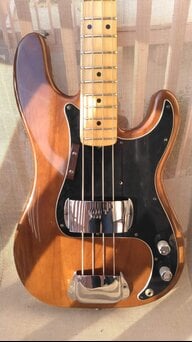
Fender High Mass Wide 4-String Bass Bridge. 53.89
If I replace my stock MIM bridge with the above bridge
will I notice any improvement in sustain resonance or improved attack?
Is it a direct drop-in replacement?

Or just a waste of time and money.
It is a direct drop-in replacement, and it’s a good bridge. It won’t do anything major for your tone, though. I got a slightly more punchy attack with my MIM Jazz. YMM, as always, V.
 
As mentioned, it's a simple upgrade. There are other drop-in bridges that are less money. I got a high(er) mass bridge new for $10.

If you are cutting yourself on your existing bridge, for example, that's a good reason to get another design.
 
I was once a believer in high mass bridges. However, my ears and experience with them has since made me reach the conclusion that there’s far more hype than substance to their claims.

yasss

I know too many people who bought them, played with them, and either you couldn't tell a lick of difference, or even they admitted, in time, that it didn't make a big impact.

I agree about the balance though.
 
  • Like
Reactions: 40Hz
I was scratching my GAS itch and did that very thing about the time the pandemic started last year, MIM stock Fender bridge to Fender Hi-Mass. I played it for about a month before selling. IMO it did little to add any sustain and really did little to add anything positive to my tone. It was an upgrade, but to me it was just ever so slight. I ended up dropping a few more cents and got a direct drop Hipshot A-Style bridge. It was the best thing I’ve ever done for this bass (‘05 MIM Deluxe Active Jazz). It lost some of the clanky Fender sound, but did wonders to expand sustain and made it sound much more refined. That’s as far as I’m gonna go to alter the Fender tone, no PU upgrades for me. As for the action, it did raise the bridge height and had the local shop set up after my failed efforts. It didn’t bother me, but I have heavy fingers and prefer this bass’ action pretty high at 4.5-5mm at the 12th (for now). Hopefully this may assist you in your quest, good luck!
 
Last edited:
Depends.

Science is absolute and standing wave and vibrations transfer mathematics are non-negotiable. So “yes”.

Leo did it and some people like the way it looks and use “I like” as a philosophical argument against physical laws. So “no”.

Depends which side you are on.
Quantifiable metrics or traditional aesthetic?
 
  • Like
Reactions: TrustRod
Different. Not better.
Nothing against Hi-Mass (except the added weight).
1st "bass accessory" I ever bought (other than strings) was a Badass II - a long time ago.
But I just finished reverting my last remaining Hi-Mass to standard/traditional Fender bridge. (on a Squier classic vibe 60s J)
Even my Geddy now sports a "'75 reissue" bridge.:eek:
 
I believe that the original concept was that the denser the material used in the bridge parts, the less absorption of the string vibration thereby the longer sustain available. That always sounded like a reasonable scientific design. But after 43 years of handling, tuning, testing, repairing, restringing, upgrading, not to mention playing, thousands of many kinds of string instruments, there are a few other factors which have some influence also: The particular piece of body wood (no two are exactly alike), the same goes for the neck, the material the nut is made from, you get the idea. Even the person playing the instrument.