

Enjoy the benefits of a premium membership!
Upgrade Account
-
TalkBass has been independent since 1998. Add your voice.
Create a free account to reply to discussions, view embedded media, and browse with fewer display ads.
Join free Log in
Want zero display ads or expanded classifieds tools? Compare plans.
You are using an out of date browser. It may not display this or other websites correctly.
You should upgrade or use an alternative browser.
You should upgrade or use an alternative browser.
Double Bass Current makers, qualities of instruments they make (on topic)
- Thread starter Blakewdm
- Start date
More options
Who Replied?
I spent a pleasant hour (while everyone else was at lunch, thus no nerves!) playing this bass when we had our get-together at VCC. It was my favourite of the three that Seth brought up.

In the competition display room, I would say that, either playing the basses or standing relatively close to someone else playing them, it was hard to get a sense of the basses' bottom (especially when 2 or 3 people were playing at once). So maybe I was influenced more but the "cut through" qualities of the instruments in the room... and they may indeed be bigger, rounder and deeper in the hall.
I think the point I was struggling to make (and I appreciate the comments and patience above) was that there seems to be a narrowing of style/tone/tastes in modern bass design as the nature of modern playing evolves.
Thanks all.
Louis
I think the point I was struggling to make (and I appreciate the comments and patience above) was that there seems to be a narrowing of style/tone/tastes in modern bass design as the nature of modern playing evolves.
Thanks all.
Louis
In the competition display room, I would say that, either playing the basses or standing relatively close to someone else playing them, it was hard to get a sense of the basses' bottom (especially when 2 or 3 people were playing at once). So maybe I was influenced more but the "cut through" qualities of the instruments in the room... and they may indeed be bigger, rounder and deeper in the hall.
I think the point I was struggling to make (and I appreciate the comments and patience above) was that there seems to be a narrowing of style/tone/tastes in modern bass design as the nature of modern playing evolves.
Thanks all.
Louis
Yeah, it was pretty impossible to hear much in any of the rooms, competition or dealers. That's why I'm so glad they went in the hall.
On the other hand, playing some basses in the room made those with an exceptional tone stand out more. I felt that the Hachez, for example, was identifiable as a great bass, even with all the background noise. In fact, after playing about 40 basses, only the basses that really were remarkable left much of an impression.
As for whether makers are converging on some time of new standard sound, I'm not sure I noticed such a trend. I will say there are many, many good makers around these days!
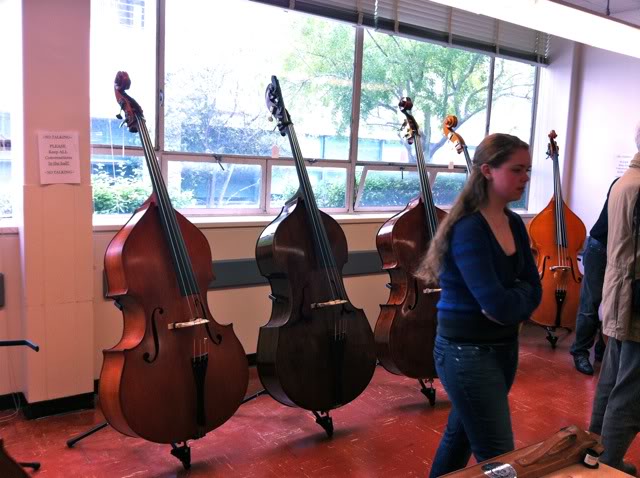
You can see not a lot of room to hear or play these basses:
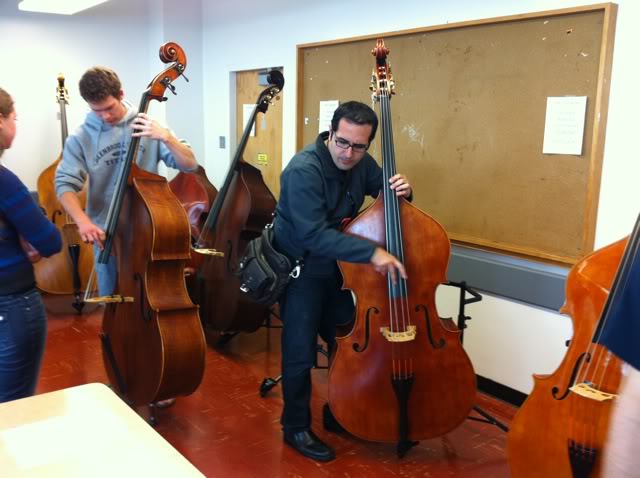
(I think that's Russell's new bass being played by guy in grey sweatshirt!)
Speaking of exceptional basses, this one didn't suck:
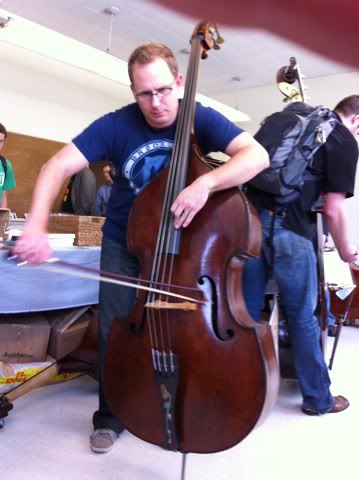
In fact, I'd recommend it to anyone looking to launch the top solo career of the next fifty years. You all should be able to guess what I decided to play on it!
(I think that's Russell's new bass being played by guy in grey sweatshirt!)
Speaking of exceptional basses, this one didn't suck:
In fact, I'd recommend it to anyone looking to launch the top solo career of the next fifty years. You all should be able to guess what I decided to play on it!

Ok, I finally found my notes on all of the competition basses played in the concert hall. It was a really fascinating experience to hear these great basses played back to back.
Chuck Israels, great jazz bassist and pizz demonstrator, made the comment that it was difficult for him to tell the jazz possibilities of an instrument when strung with orchestral strings, as most were. He encouraged makers to use a hybrid string if they want a jazz assessment made.
Since there is a discussion on deep/dark vs. bright going on here, I'll list the makers and my very basic impression of their bass' arco sound.
Deep/Dark
Aaron Reilly - nice bass (I think this bass had Evahs)
Steven Reilly
George Martin - brittle uppers
Chris Roberts - deep mellow
Bill Lakeburg - deep singing
Arnold Schnitzer dark, projecting upper register
Mario LaMarre - deep and centered
Steven Krattenmacher - nice big deep sound
Eric Roy - singing, dark
Bright/Midrangy
Guy Cole (bit nasal)
Gianfranco Fiorini - projects
Alex Friedman - clear tone
Seifert - bright G stands out
Gerard
Other Comments
Chris Savino - singing, weak E
Seth Kimmel - lovely, singing
B Puglisi - big sound
Marin Penning - nice bass
Hatchez - nice!
Nick Lloyd - nice!
David Jorgensen - button on pizz, new sounding
S Scaramelli - big pizz, nice bass (spiros)
I played a few of these basses and the one that I found really inspiring was Aaron Reilly's. Maybe my favorite sound in the hall, too.
Chuck Israels, great jazz bassist and pizz demonstrator, made the comment that it was difficult for him to tell the jazz possibilities of an instrument when strung with orchestral strings, as most were. He encouraged makers to use a hybrid string if they want a jazz assessment made.
Since there is a discussion on deep/dark vs. bright going on here, I'll list the makers and my very basic impression of their bass' arco sound.
Deep/Dark
Aaron Reilly - nice bass (I think this bass had Evahs)
Steven Reilly
George Martin - brittle uppers
Chris Roberts - deep mellow
Bill Lakeburg - deep singing
Arnold Schnitzer dark, projecting upper register
Mario LaMarre - deep and centered
Steven Krattenmacher - nice big deep sound
Eric Roy - singing, dark
Bright/Midrangy
Guy Cole (bit nasal)
Gianfranco Fiorini - projects
Alex Friedman - clear tone
Seifert - bright G stands out
Gerard
Other Comments
Chris Savino - singing, weak E
Seth Kimmel - lovely, singing
B Puglisi - big sound
Marin Penning - nice bass
Hatchez - nice!
Nick Lloyd - nice!
David Jorgensen - button on pizz, new sounding
S Scaramelli - big pizz, nice bass (spiros)
I played a few of these basses and the one that I found really inspiring was Aaron Reilly's. Maybe my favorite sound in the hall, too.
I played a few of these basses and the one that I found really inspiring was Aaron Reilly's. Maybe my favorite sound in the hall, too.
Aaron's bass was great, I really like his work, and his price is very reasonable as well. I know one bassist that was at the convention has commissioned one since.
Of course, I'm biased since Aaron is also about the nicest maker/dealer on the planet. He brought most of those basses over to my house this winter!
My only concern was about his decision to use slab cut tops- not many folks doing that. I live in a dry climate (Denver), so I'm always worried about how that will translate into longevity.
But sound wise, it had the deep, dark, classic orchestra sound, with the subwoofer low tones. I can't help but wonder how Aaron is influenced by all those great Engish basses he is selling currently- the James Brown, Lott, and the V. Panormo.
Chuck Israels, great jazz bassist and pizz demonstrator, made the comment that it was difficult for him to tell the jazz possibilities of an instrument when strung with orchestral strings, as most were. He encouraged makers to use a hybrid string if they want a jazz assessment made.
Apparently Belcanto's don't count has a hybrid string
 as many makers had Belcanto's on, and most of the basses in these pics look like they have Belcanto's. He should have just come out and said what he really meant...I want you to put Spirocores on, not these Belcanto's. I agree, Belcanto's aren't the best for pizz. I personally like the pizz sound of Belcanto's but I like the pizz sound of Evah's better.
In my (amateur) opinion, the true quality of a bass really shows when bowed, as you can hear and feel the resonance more, and arco creates more complex tones/overtones.
Apparently Belcanto's don't count has a hybrid string
I think the G and D Bels can be usable for jazz, but I haven't heard the A and E Bel that make it for me, jazz-wise. Evahs, Oblis, Doms, etc. would be better choices if they are going to test for jazz pizz. Moroki and Murray would have been fine demoing arco with spiro weichs or solos tuned down, too. I understand why Chuck would be upset, having to play these great basses with inappropriate strings for his part of the demonstration. Almost pointless, and he probably felt a bit dissed by the whole thing...
Regarding your "true quality of a bass" statement, it can be divided into jazz pizz and arco playing, or we can rate a bass on both qualities with the same setup and strings. With that criteria in mind, most of the basses in the competition were not good jazz pizz basses, as the makers chose to set them up.
I can't help but wonder how Aaron is influenced by all those great Engish basses he is selling currently- the James Brown, Lott, and the V. Panormo.
I heard the James Brown played by a great player, it was phenomenal sounding. That is a bass! I think Aaron is going for that old school thing.
I think the G and D Bels can be usable for jazz, but I haven't heard the A and E Bel that make it for me, jazz-wise. Evahs, Oblis, Doms, etc. would be better choices if they are going to test for jazz pizz. Moroki and Murray would have been fine demoing arco with spiro weichs or solos tuned down, too. I understand why Chuck would be upset, having to play these great basses with inappropriate strings for his part of the demonstration. Almost pointless, and he probably felt a bit dissed by the whole thing...
Probably.
I think the G and D Bels can be usable for jazz, but I haven't heard the A and E Bel that make it for me, jazz-wise. Evahs, Oblis, Doms, etc. would be better choices if they are going to test for jazz pizz. Moroki and Murray would have been fine demoing arco with spiro weichs or solos tuned down, too. I understand why Chuck would be upset, having to play these great basses with inappropriate strings for his part of the demonstration. Almost pointless, and he probably felt a bit dissed by the whole thing...
... as did I, and I'm sure not a few other makers, for being chastised for having the 'wrong' string choice on our basses. Still, I thoroughly get his point and his frustration. Hence my response during that stage session, when I brought up Seth's point from a week earlier here in Vancouver that perhaps the ISB could institute a standard string make and model for competitions. It would make direct comparisons between instruments a lot more practical. Of course this would be a difficult decision. Perhaps a membership-wide vote, with players and makers being able to cast ballots for which string to use in the next ISB competiton? Not for playing competitions of course! But for the makers' competition it would make a whole lot of sense, and considering Seth Kimmel's awards and experiences in both VSA and ISB competitions I take his word on this as having some value.
I've since changed my bass to Spirocore stark on the E and A. The E is much better for pizz, a nice big round tone and sustain, and it's not bad with the bow. The A is likewise decent now pizz, but slightly less satisfying for arco as it tends to have a bit too much of that metallic Spiro quality. Not so much that a player can't quickly adapt the bow technique... but it'd be nice to find a better compromise. I tried with the Belcanto A at first, but pizz it's just not quite strong enough on my small bass to match the clarity of the D and G. Still, this mixed set is certainly a lot more satisfying than my initial stringing of a full set of Spirocore weichs. That was just way too metallic, too twangy, and didn't bow well at all.
Seth's point from a week earlier here in Vancouver that perhaps the ISB could institute a standard string make and model for competitions. It would make direct comparisons between instruments a lot more practical. Of course this would be a difficult decision.
Could work, but we all know individual basses respond so differently to all these strings. I think the makers should still make their own choices, but they should be prepared to be scolded, and to disappoint the audience if the strings don't work well in both genres.
Well that's just the thing though; how many bassists use the same string, or even the same bass, for both general genres? I so a lot of setup work for 'classical' players, and a lot more for jazz, folk, and other primarily pizzicato players. The sounds each camp are looking for are distinctly different. The sustain usually wanted by pizz players is decidedly anathema to a classical, orchestral player, for whom a darker and more brief decay is usually wanted when playing pizz. The intense arco power an orchestral player needs on all strings to fill the largest halls requires a good bass of course, but also a 'conservative' soundpost position to go with it, else control when played very hard is completely lost. A 'jazz' post position will, with most basses, cost a classical player this sort of control. And I could go on... but realise that my editing needs work, so will leave it at that for now. Basically I'd suggest either a standard string choice, agreed upon by the greatest numbers, or having separate competitions for basses in arco and pizz categories. Either one would provide makers with a more practical way of getting their sound setup just right, and players and listeners with clearer choices. Guys like Chuck wouldn't need to worry about the arco basses, and the arco players wouldn't need to fuss over the nasty bowing qualities of Evahs or Obligatos or Spirocores, or even Velvets should a jazz bass maker so choose.
- Jan 24, 2002
- 2,117
- 950
- Disclosures
- NS Design / AER Endorsing Artist
I'm not a maker, but having a standard string choice seems like a bad idea to me. Different basses respond to different strings in different ways. If the makers all knew they would have to present their instruments with a particular string, that could affect various building decisions they make along the way. In other words, it could have a stifling effect on the maker's creativity.
Anyhow, isn't part of what's being judged in the set up decisions? If people didn't like the strings you picked, isn't that your problem?
Anyhow, isn't part of what's being judged in the set up decisions? If people didn't like the strings you picked, isn't that your problem?
Another option is to have the strings changed out for the jazz testing. A few guys with drills should do the trick pretty easily...
That'd work for the steel core strings... but with some of the more rubber-band-like types, Velvet and Evah and Obligato for starters, that would probably require that testing happen on separate days. I'd be up for that certainly. Not every maker is there though, as some ship their basses, so it'd require some permission checkboxes on their entry forms and included extra strings to use. A bit cumbersome, but perhaps worthwhile if thorough testing is really wanted.
I noted that a couple of the judges experienced 'moments' on stage the Wednesday morning where a couple of basses they'd tried the Monday were sounding very different to them. In at least one of these cases - I think it was Chuck testing a bass - it almost seemed as though an award opportunity was missed, as he commented that he hadn't liked it at all during judging, but quite liked it on Wednesday. Just one of those things, and yeah, there are a lot of variables. Seems he was putting it down to settling in with strings/setup rather than the hall (the judging was done in a mid-sized theatre across from the public display and testing classroom) being bigger.
I noted that a couple of the judges experienced 'moments' on stage the Wednesday morning where a couple of basses they'd tried the Monday were sounding very different to them. In at least one of these cases - I think it was Chuck testing a bass - it almost seemed as though an award opportunity was missed, as he commented that he hadn't liked it at all during judging, but quite liked it on Wednesday. Just one of those things, and yeah, there are a lot of variables. Seems he was putting it down to settling in with strings/setup rather than the hall (the judging was done in a mid-sized theatre across from the public display and testing classroom) being bigger.


