• TalkBass has been independent since 1998. Add your voice.
    Create a free account to reply to discussions, view embedded media, and browse with fewer display ads.
    Join freeLog in
    Want zero display ads or expanded classifieds tools? Compare plans.

Custom Blender Idea - Help me think this through

Look at Saturnworks pedals. Pretty inexpensive and a few different options based on what your looking to do. This is the one I have specifically. I have 2 outputs out of my Boss TU2 tuner which is first in line. One out goes direct to this pedal which is at the end of line before my amp. The other out goes thru my pedal chain and then into the other input of this pedal. Can control either input with individual footswitch, and has volume control to adjust either input as well. I set my clean level 25% higher than my dirt level as the dirt tends to have higher gain anyway.

Only downer here is when I activate my tuner, the bypass output is still active and not muted, happens to be my dirt. No biggie I just turn the dirt signal off at the Saturnworks so its just a matter of stomping 2 times/places instead of one and its only when I need to tune.

View attachment 1058491


I've seen those around but not heard much about them. Good to know they do decent work.
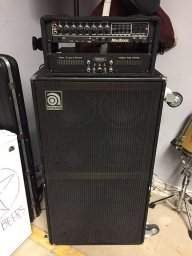
 
I'd be also good to have two dedicated outputs (one for each signal path) just in case if you prefer to biamp in the future.
Just run the loop "open", going from effect(s) to amp without coming back to the mystery pedal. Then the mystery pedal's output (i.e. clean/HPF signal only since the other one never got blended back in) goes to the other amp.

And that's all the more reason to put a phase switch on the loop, since you'd be dealing with phase-flipping amps as well as pedals!
 
"How many footswitches and what do they control?" does seem like a rabbit hole, especially if you're thinking you might use it to run two amps...at that point you'd probably need an "A / B" switch and a "both / either" switch, or an "on / off" switch for each side. But then you might also want a master bypass, so you can get a straight clean signal unaffected by HPF and blend control...
 
I sent money to Azure Skies yesterday to have this built (rendering is mine and not at all final, just a way for me to keep track of all the features). Essentially it's two loops with independent high and low pass filters on each channel, and the ability to mute each channel or bypass the loops entirely
H:LPF blender 2:16:2017.png
 
This is a VERY interesting idea.
It sounds like it does copy the A+B function of the LS-2, but buffed and shined especially for bass Distortion.

Have you thought about a Tonestack instead of a HPF for the dirty loop? This could also make sense.
For the final stage, maybe a LPF and HPF could give more utility. If that Tonestack was, for example modeled after the one in the Fuzzrocious BDPG, it might pump out some massive lows, that could be tamed with a HPF.

I'd take that one with two switches, one to activate/bypass the loop and one to activate/bypass the final LPF/HPF.
 
Have you thought about a Tonestack instead of a HPF for the dirty loop? This could also make sense.
For the final stage, maybe a LPF and HPF could give more utility. If that Tonestack was, for example modeled after the one in the Fuzzrocious BDPG, it might pump out some massive lows, that could be tamed with a HPF.

I'd take that one with two switches, one to activate/bypass the loop and one to activate/bypass the final LPF/HPF.

I have thought about a tone-stack on the dirt loop. At one point I wanted to be able to carve the mids on the clean and fill the gap with the mids of the dirt. However, I think I really just want to get some clean lows.


I played around with some filter modeling in the DAW last night. I split the clean and dirty signals, then ran various filters and settings on each. I found that for the clean, I really wanted to be able to pass filter content as low as 400-500 Hz. As I brought the frequency higher, it felt like two layers of sound with the dirt, instead of a unified signal. I also found I didn't need a brick wall pass filter, but more of a strong shelf eq on the dirt, at 2,000 - 4,000 Hz, going -10 to -15 dB. I only worked with my fuzz. I need to try the same fiddling with my overdrive and distortion boxes.
 
I have thought about a tone-stack on the dirt loop. At one point I wanted to be able to carve the mids on the clean and fill the gap with the mids of the dirt. However, I think I really just want to get some clean lows.


I played around with some filter modeling in the DAW last night. I split the clean and dirty signals, then ran various filters and settings on each. I found that for the clean, I really wanted to be able to pass filter content as low as 400-500 Hz. As I brought the frequency higher, it felt like two layers of sound with the dirt, instead of a unified signal. I also found I didn't need a brick wall pass filter, but more of a strong shelf eq on the dirt, at 2,000 - 4,000 Hz, going -10 to -15 dB. I only worked with my fuzz. I need to try the same fiddling with my overdrive and distortion boxes.

Nice. I found that also. I chose to have such a wide range of H/LPFs on both High and Low channels to have the option of essentially running two loops if I ever wanted
 
  • Like
Reactions: monsterthompson
I have a One Control Mesquite Blender w/ BJF Buffer I'll sell you. I was going to list it in the classifieds, but I'll give you first crack at it. $85 + $10 shipping in the CONUS. It has a true bypass, defeatable buffer, phase switch, and blend control. No LPF though. Works great, I just don't need it anymore.
 
I have a One Control Mesquite Blender w/ BJF Buffer I'll sell you. I was going to list it in the classifieds, but I'll give you first crack at it. $85 + $10 shipping in the CONUS. It has a true bypass, defeatable buffer, phase switch, and blend control. No LPF though. Works great, I just don't need it anymore.
That's a nice offer, but it is missing many of the features I want for this project, so I'll pass.
 
Spent a little time messing with the filters in the Photon fuzz. My general conclusions are that you want to avoid scooping out a big frequency range in the mids (lol) and if you've got overlapping mids, being able to adjust volumes and EQs is very helpful - I'd say EQ would probably be more important on the dirty signal than the clean

If you have EQ in play, the LHPF route on each channel is a lot more flexible than a crossover; but you can probably get in trouble more easily this way too.
 
Two ideas. Why not add a buffer buster/passive pickup emulator to the send of the dirt loop? This would make it easier to put the Noble first and still have the dirt act right.

I'm actually currently using the Noble to attenuate the signal before it hits the dirt. Having the gain control on the pre-dirt loop would handle that same function. Fair point though.
 
Instead of a high pass and a low pass after each of the channels why not have one knob control both so there's no crossover/space between the frequencies

My modeling in the DAW with pass filters is showing that I don't want a pure crossover. The sounds I like best have some overlap/doubling. The crossover was an initial idea. I thought I'd prefer that method. I certainly see the benefit of a crossover preventing the carving out a valley.
 
  • Like
Reactions: Veldar
A
My modeling in the DAW with pass filters is showing that I don't want a pure crossover. The sounds I like best have some overlap/doubling. The crossover was an initial idea. I thought I'd prefer that method. I certainly see the benefit of a crossover preventing the carving out a valley.

Ahhh okay, sounds smart I'll have to mess around with that myself
 
  • Like
Reactions: monsterthompson
An idea : instead of having a LPF and a HPF knobs, why not have one to control the crossover frequency, and another to control the gap / overlap between HPF and LPF ?
Seems more natural to me, you can adjust the crossover frequency with one knob instead of two, and fine tune what each channel receives by adjusting the gap/overlap.
(This is similar to having volume+blend knobs on a bass, as opposed to volume+volume)
 
An idea : instead of having a LPF and a HPF knobs, why not have one to control the crossover frequency, and another to control the gap / overlap between HPF and LPF ?
Seems more natural to me, you can adjust the crossover frequency with one knob instead of two, and fine tune what each channel receives by adjusting the gap/overlap.
(This is similar to having volume+blend knobs on a bass, as opposed to volume+volume)

Already discussed this, just a few posts above.


Haven't gone through with this yet. Still thinking about it, and still want it. However, I'm not playing bass in live settings often enough to use it. I'm considering a CoG Mini 66 for my "travel" board, because it has some of the features I want with this blender, and it's a very small package. Maybe if I can move some gear, I can justify this build :)
 
Zoiks! I missed this thread when it was begat.

My kind of thread!


Pedal graphic found :)
8b3d063f71b6e81985feb57a4f5b2f24.jpg

Great graphic.

'Tis but a bit of scratch, to get this build off and running.


So, any more thoughts on stompers?

Apart from a full bypass, and on/off for the distortion channel, I'm thinking an on/off for the LPF on the clean channel might be useful — total of 3 stompers.

A stomper for the phase switch might be useful if you've got lots of phase-inverting pedals in the distortion channel and you're switching those up a lot or having a few on at a time in different combinations.