• TalkBass has been independent since 1998. Add your voice.
    Create a free account to reply to discussions, view embedded media, and browse with fewer display ads.
    Join freeLog in
    Want zero display ads or expanded classifieds tools? Compare plans.

Daisy chain jumping two or more SVTs together?

I tried jumping the channels on my old SVT and it reminded me of Hendrix daisy chaining his Plexis. I found this thread about that:
Invalid Link Removed
In there they're saying it sounds better using an A/B/Y box and Y cable to use two amps at the same time.
With SVTs, could a person plug in to the Channel 1 low bottom left input, jump from Channel 1 bright upper left into a second head's Channel 1 low? And if that'd work, then could someone plug into Channel 1 low, jump from Channel 1 bright to Channel 2 low, then jump from Channel 2 bright to a second head's Channel 1 low (and jump the second head's Channel 1 bright to Channel 2 low)? If that were done, would the second amp sound brighter overall than the first amp because of the input into the second amp coming from the Channel 2 bright of the first amp? Would it probably sound better to just use an A/B/Y on two SVTs that each have their own channels jumped?
I have one SVT; just thinking of possibilities.

 
All those scenarios should work, though I haven't done it myself. As for the sound, I have jumped my vintage SVT's channels where I plug in my bass into the normal ch 1 and jumped to ch 2 using the bright input of ch 1 into the normal input of ch 2 and it sounded normal, so I would expect jumping that way between amps wouldn't cause the second SVT to be brighter, as it's the same basic thing. And unless you want to switch between them, I wouldn't use an ABY switch because it will cut your bass' output in half going to each channel or amp, whereas jumping channels won't.

Another option I'm reasonably sure you can do is use the ext amp jacks to plug in one SVT to the other and then your first SVT becomes the master controller and the second one becomes a slave controlled by the first amp's preamp. My good friend Dino the Ampeg Guy explains how you can do that with modern SVT's using the preamp out and power amp in jacks in this video, and if memory serves me, the ext amp jacks on vintage SVT's can accomplish the same thing. However, I would like a second opinion on that from someone who knows for sure.

 
I think if you went crazy your sound would change as every amp you jumped to would drop your input impedance. And at some point your pickups would not have enough current to drive that many inputs. I don't have the schematic here so I can't do the math but I would guess somewhere around 8 jumpered together would mess things up. Now what you would be doing with 8 svts is another story.
If someone could chime in on vintage svts that would be good. On any modern amp what jimmy and dino said is the best way.
 
Another option I'm reasonably sure you can do is use the ext amp jacks to plug in one SVT to the other and then your first SVT becomes the master controller and the second one becomes a slave controlled by the first amp's preamp. My good friend Dino the Ampeg Guy explains how you can do that with modern SVT's using the preamp out and power amp in jacks in this video, and if memory serves me, the ext amp jacks on vintage SVT's can accomplish the same thing. However, I would like a second opinion on that from someone who knows for sure.


Yup, that's what I used to do and they're labeled the same, preamp out on first head to power amp in on second head (70's), sounded great and the first preamp controlled both amps, both have the same volume, turn up the first amp's volume and both increase in volume, same for tones etc. The preamp on the second head is inoperable like that, you are only using the power amp in the second one. Don't stand too close to the cabs though or you will hear nothing else on the stage, guess how I found that out?
 
Can they hear you now?

I imagine that vertically stacking two 810’s would be a chore. I’d leave the heads on the floor rather than topping off the cabs with them.

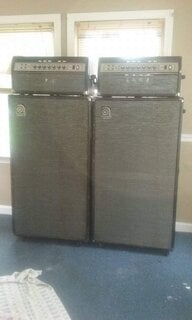
They can still hear me:laugh:. I used to stand the two cabs side by side and put the heads on top like in my avatar, I mostly used one head though. Putting the head on top of the cab is always the worst part and is usually when I try to get some help. With one head I used to shake the soundman's booth which was about 20' in front and off to the left. He brought it to my attention one day, didn't bother him though, we were one loud band, three piece, the guitarist used a nice old white twin twelve Fender Bassman cranked for his guitar.
 
  • Like
Reactions: beans-on-toast
Alright cool. The ext amp or preamp out power in thing is good to know. Thanks for that.
beans-on-toast, how about laying the 8x10s horizontal, stacking four, and using two SVTs running 2 ohms to two cabs each so you'd have a 32x10 with two heads on top? :D Just get a friend to bring a forklift to the stage.


 
Last edited:
  • Like
Reactions: beans-on-toast
Alright cool. The ext amp or preamp out power in thing is good to know. Thanks for that.
beans-on-toast, how about laying the 8x10s horizontal, stacking four, and using two SVTs running 2 ohms to two cabs each so you'd have a 32x10 with two heads on top? :D
Why not just buy a 3210? Or even better, a 3610?

Nancy Me Giant SVT.jpg
 
  • Like
Reactions: beans-on-toast
I wouldn't use an ABY switch because it will cut your bass' output in half going to each channel or amp, whereas jumping channels won't.
I'm curious, why won't jumping out of the bright socket change the signal level? I'm no amp designer, but AFAICS if you jump channels you are taking a parallel connection off the input to the first valve, and feeding it through a series resistor and capacitor to get to the other socket, which seems to my very limited knowledge to be much the same as a Y cable, but with the series resistor and cap.
 
I'm curious, why won't jumping out of the bright socket change the signal level? I'm no amp designer, but AFAICS if you jump channels you are taking a parallel connection off the input to the first valve, and feeding it through a series resistor and capacitor to get to the other socket, which seems to my very limited knowledge to be much the same as a Y cable, but with the series resistor and cap.
You're asking the wrong guy. I suppose it's because there's an amplifier stage between channels when there's not one in a Y, but someone more techie than me will have to answer you with the data. All I can tell you is that jumping channels never seemed to cut down on output when I did it.
 
You're asking the wrong guy. I suppose it's because there's an amplifier stage between channels when there's not one in a Y, but someone more techie than me will have to answer you with the data. All I can tell you is that jumping channels never seemed to cut down on output when I did it.


There is no active buffering between channels when you jump them. The only difference from using a Y is the signal must pass through the circuitry for the bright input which includes a 100k resistor and 470pf capacitor in parallel. FYI the 100k and 470pf circuit forms an HPF.

The input impedance for both channels is 5.6meg, so I don't think running a Y would be a problem. You would end up with 2.8meg which is still a very high input impedance that would not drastically load the pickups.

I believe the high input impedance on channel 2 is also why the jumping the signal through the bright circuit in channel 1 does not produce the obnoxiously bright response you might expect in channel two. Here is why: When you use just a bright input on one of the channels, the input impedance is a bit lower than 47k which shortens the time constant of the 470pf capacitor and shifts the HPF to a higher frequency. But when you jump the inputs the 47k shunt resistor is not shunted to ground, so the capacitor sees a 5.6meg load which shifts the frequency of the HPF down. At least that is what my puny little brain sees.
 
Last edited:
  • Like
Reactions: JimmyM