• TalkBass has been independent since 1998. Add your voice.
    Create a free account to reply to discussions, view embedded media, and browse with fewer display ads.
    Join freeLog in
    Want zero display ads or expanded classifieds tools? Compare plans.

Dead spots/notes and Fenders

Dirk Diggler

Supporting Member
Mar 3, 2004
4,298
2,821
Anytown USA
Ok seeing all these threads on Dead Spots and Dead Notes I have a question.

I haven't witnessed the issue on Fender basses personally, and it got me thinking.
I get that it might be an issue specifically with bolt on necks.

The question I would ask is this issue specific to Fender and perhaps Squires?

I can't recall seeing a thread with a G&L or Musicman and Sterlings with dead spot complaints.
It seems to me these very Fender like relatives should all be suffering the same issues since construction is very similar.

It will be interesting to see other folks experiences, like I say I have not seen the effect in person yet.
 
@micguy does an easy-to-understand overview of the physics of dead spots in this post...


One thing to keep in mind is that pretty much all bass necks have dead spots, because the frequency range of a bass overlaps with the resonant frequency of most necks. Dead spots can vary in severity and the necks on your basses might have spots too subtle to notice unless you're actively seeking them out.
 
New '78 P had a dead spot, added a J pup for other reasons and dead spot went away. Don't know if it was the pup, may have been the rout for the pup. I don't play single pup basses anymore and don't seem to have dead spot trouble. And bolt ons only.
 
Last edited:
If you find one particularly objectionable you can add mass to minimize or relocate the dead spot to be less obvious. The '80's saw a variety of brass or steel plates to add headstock mass. The Fathead was one thatcomes to mind.
1769870565531.jpeg
 
  • Wow
Reactions: Hurricane Jimmie
Yeah, there was this whole thread recently about an acoustic bass guitar with bad dead-spots. The original sold and regretted didn't have them, the replacement after regret did:

 
Ok seeing all these threads on Dead Spots and Dead Notes I have a question.

I haven't witnessed the issue on Fender basses personally, and it got me thinking.
I get that it might be an issue specifically with bolt on necks.

The question I would ask is this issue specific to Fender and perhaps Squires?

I can't recall seeing a thread with a G&L or Musicman and Sterlings with dead spot complaints.
It seems to me these very Fender like relatives should all be suffering the same issues since construction is very similar.

It will be interesting to see other folks experiences, like I say I have not seen the effect in person yet.
I’ve been using Fender basses since the 60’s. in my experience the only time I experienced dead spots they were due to acoustical sound cancelation or dead worn out strings.

To insure I don’t end up with a bass with dead spots, the first thing is I don’t buy basses unless I have my hands on them first. The first thing I do before plugging into an amp is I play each note and listen to the sustain. If all the string are dead, don’t expect much sustain. (Which some really like) If there is sustain, there will be sustain when you plug it into an amp unless there is frequency interference.
 
Almost every bass is going to have some kind of dead spot. It's more a matter of degree than anything. I've had people tell me their bass is dead spot free and after playing it for a minute I've found at least one note I would consider a "dead spot". The worst dead spot I've ever encountered was in a Status Graphite set-neck. The bass I've owned with the most dead spots: a tie between a Fender Precision and a Warwick Streamer Stage 1 neck-through.
 
I’ve been pretty successful at mitigating dead spots over the years by tightening the neck, bridge and headstock hardware. It’s often surprising how “incomplete” the assembly process sometimes is. Also, changing strings can make a significant difference - especially if you’re reducing the tension of a string with a dead spot.
 
I haven't witnessed the issue on Fender basses personally, and it got me thinking.


It will be interesting to see other folks experiences, like I say I have not seen the effect in person yet.


Do not, I repeat , do not start looking for dead notes now. Once you hear them you cant ever go back to the time when you didnt.

I’ve owned at least 100 basses , and each of them , regardless of brand , materials or construction , all the long scale ones had a dead spot on the G string, usually around the B or C. The short scale ones also had them , I just can’t remember the exact notes.

So basically , consider yourself lucky that you haven’t paid enough attention to hear the dead notes , because believe me , they are there in your bass right now.
 
I have played hundreds of Fender basses and every one of them had a dead spot. Some of the dead spots were very pronounced while others were subtle.

I think dead spots are much like neck dive. It's a phenomenon that often goes unnoticed. However, once noticed, it can become anywhere from obsessively bothersome to trivial for the player.

I never "experience" neck dive until a friend of mine took my favorite bass apart and mentioned that the body was so ridiculously light that it must have neck dive when assembled. Sure enough, when he put it back together I immediately noticed it. Still does not bother me and I am only reminded that it even exists when I read these threads. Today, I still find it to be the most comfortable bass I have ever played. Hell, now that I think about it, maybe I actually prefer a little neck dive?
 
This was where carbon fibre necks came in: The resonances were well past audible frequencies. The first time I played a L-series Steinberger it was spooky: Every note from Open E to the last note up at the top of the G-string was dead even, like a keyboard. Modulus and G Goulds are like this although the wood bodies may subtract a bit from this in certain cases.

And even on Fenders, while most may have a dead or soft spot, not all do. Again down to the variance in wood from piece to piece, and the harder/stiffer a wood neck is, the chances of a soft spot go down.
 
  • Like
Reactions: joeLowB
This was where carbon fibre necks came in: The resonances were well past audible frequencies.
Horsefeathers. Yes, carbon fiber is stiffer, but it's also 3x the density of maple. If you want to take the resonance frequency of a bass neck from approximately 50 Hz (the lowest resonant mode is one that typically doesn't affect basses, but it does show up on headless designs sometimes) to past 20 kHz, you would need a modulus of elasticity of about 10 to the 18th power Pa (assuming similar density) - that surpasses anything we have available on Earth, or that we know of in the cosmos. There's a square root in the math, and higher stiffness materials are also typically denser than wood, which means even diamond, which is the best we have in terms of stiffness falls very far short of what's required for your goal. All that means, for something the size and shape of a bass neck, it's gonna resonate in the audio spectrum.

All necks (even the Kramer aluminum ones I had in the past) have areas on the neck where there is reduced sustain. Whether or not you call something a dead spot is an arbitrary subjective judgement.

And, by the way, as wood does age, that dead spot that "appeared or disappeared" magically? Yeah, it can actually happen. One of the good things about a roasted neck is, since it is already aged, if it's good to start with, chances are you are good for the duration. If it has a dead spot, however, it's yours for life.

If you have a bass that has a bothersome dead spot, my suggestion is try tuning it to D standard - that'll often mitigate it enough to where it's not a problem. If you have a bass that (to your perception) doesn't have a dead spot, my suggestion is don't go looking for one. Once you find it (it is there to some degree), it's impossible to forget that it's there.

Oh, and no, making a bass with a neck through or glued in neck doesn't get around the Physics. It'll still have "areas of reduced sustain" if not outright dead spots. No getting around it.
 
Last edited:
Take your Fender bass and play it through a set of good headphones. Pluck the G string in the 4th-7th fret. Every Fender/Squier J or P I ever played had a dead spot in that region. The ones with "No dead spot" had that one fret where the overtones are diminished and it won't sustain as long as the others, but it's subtle and harder to notice.
But it's there nonetheless.

My Fender P bass had it in the 5th fret, quite pronounced.
Then I restrung it with heavier gauge strings and tuned it down a full step to D standard. Now the dead spot is in the 7th fret.
 
  • Like
Reactions: joeLowB
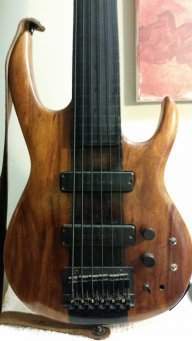
I’ve had basses with very prominent dead spots ( all of them were factory made) and basses without a disruptive dead spot ( most of them headless or multilaminate necks, most of them made by myself from selected wood or carbon fiber). Headless neck is my no.1 cure for dead spots.
 
I’ve had basses with very prominent dead spots ( all of them were factory made) and basses without a disruptive dead spot ( most of them headless or multilaminate necks, most of them made by myself from selected wood or carbon fiber). Headless neck is my no.1 cure for dead spots.

The absolute worst dead spot (by far) I have ever encountered was on a headless bass. The open A string was a dull thud - it had no sense of pitch whatsoever.