• TalkBass has been independent since 1998. Add your voice.
    Create a free account to reply to discussions, view embedded media, and browse with fewer display ads.
    Join freeLog in
    Want zero display ads or expanded classifieds tools? Compare plans.

Dedicated Instruments for tunings

I'll just say it... I hate Eb tuning.... It feels like my bass just changes character, tone, and the strings just feel all loose and floppy. Not to mention the odd occasion I look down and I'm not fretting the note I am playing.

So I was thinking of dedicating 1 instrument full time to Eb tuning and putting on some new strings. My theory is they get stretched out on E tuning and feel loose and floppy when I tune down. So if I only have it tuned to Eb and never higher, the string will feel like they always have the proper tension. Yea? No?

So for stage performances, will have a dedicated instrument for each tuning, and then get a hip-shot for my E instrument for the 1 or 2 drop-D songs we play and just deal with 1 floppy string. The one D tuning song we occasionally play will just be tuning the Eb down

I know this is common for the stage but I am curious if anyone is 100% dedicating 1 or more instruments to special tuning to avoid floppy string syndrome?


I do this with my slide guitars.
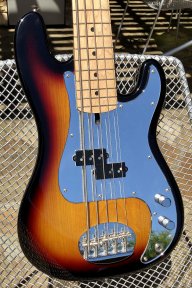
 
I used to have this problem, then I went to a 5er. As you get older, and the singers you play with get older, the need to take things down a step or more increases. When I only player 4's, I think I had 3 different basses to handle the various situations. Now, one bass will do.
 
I'll just say it... I hate Eb tuning.... It feels like my bass just changes character, tone, and the strings just feel all loose and floppy. Not to mention the odd occasion I look down and I'm not fretting the note I am playing.

So I was thinking of dedicating 1 instrument full time to Eb tuning and putting on some new strings. My theory is they get stretched out on E tuning and feel loose and floppy when I tune down. So if I only have it tuned to Eb and never higher, the string will feel like they always have the proper tension. Yea? No?

So for stage performances, will have a dedicated instrument for each tuning, and then get a hip-shot for my E instrument for the 1 or 2 drop-D songs we play and just deal with 1 floppy string. The one D tuning song we occasionally play will just be tuning the Eb down

I know this is common for the stage but I am curious if anyone is 100% dedicating 1 or more instruments to special tuning to avoid floppy string syndrome?
This is precisely what I do. At least two artists I work with tune down a half step, so I find it's much easier. I actually now have two basses down a half step, one main and one backup- one of the groups I play in does a bit of traveling. Plus it's nice to have options.
 
They're floppy cause they're the appropriate gauge for E tuning, not cause they're stretched out. You're gonna want heavier strings to compensate for the downtuning.
Disagree. I find it's unnecessary to move to a heavier gauge string. Just simply loosen the truss rod and/or raise the action when tuning down if things get too 'floppy'.
 
I stick to six strings. I’ve suggested this before but I think six strings in standard tuning is pretty much the definitive and most versatile evolution of the electric bass.
The low B extends the range to include basically every nite you could possibly need when playing with guitarists, wind or keyboard instruments, and preserves the fourth interval so everything is in a logical position.
While the high C doesn’t feature in many bass lines, it adds the ability to pull off chords and melodic lines in a way that wouldn’t be practical otherwise, and again having an even number of strings means it’s logical and easy to continue scale patterns up without shifting hand positions.

Most importantly, you look more sophisticated and people assume you’re a better player, so if you spend the whole show playing root notes in 16ths fellow musos in the audience will take it as a show of restraint, and won’t know you can’t think of any better ideas.

Re: playing with guitarists in alternate tunings, I played in a band with one guitarist in drop D and another in D standard. Brought my trusty Ibby SR so at the start, everything was in the third position for me.
Initially it was irritating, but after a few months it turned out there were two big positives:
a) I was forced out of my comfort zone so my fluency and fretboard knowledge came on leaps and bounds, and;
b) when we started writing originals it helped push us away from the lazy default of every riff starting on the guitarist’s lowest open string, so we ended up with songs in all sorts of keys, in turn opening up new timbres in terms of open vs fretted strings etc.

I’m biased, but from where I stand I can see only advantages.

TL;DR don’t retune, get a six instead.
 
I've recently been tuning this bass to B-E-A-D and having a ton of fun.
No money is made above the 7th fret, right?
Most classic/pop/funk/disco/cw songs are easily transposed down a 1/2 step.
It forces you to use different positions and fingerings, which I really like.
Plus, I can always tell who the string players are in the audience :smug:
I think the graphite strip really helps keep the neck stable enough to handle the extra tension without bowing.
Might be worth a shot?

IMG_4884.jpeg
 
Short answer yes. I sometimes have one bass in E, on in Eb and one in C so when I'm practicing or jamming along to albums I'm not tuning up and down.

My band mainly plays in Eb and C. Whether or not the song was recorded in E standard or in Eb we play it in Eb. We also have a C set which is a slew of Queens of the Stone Age tunes. We shake the house with those songs.

Most of the songs we cover were recorded in E standard, but my two guitarist sing and the half-step down is bit more comfortable for them and also our lead guitarist is hugely inspired by Slash and EVH so he's more at home in Eb.

Sometimes we jam with a keyboard player, that's when he and I will tune in standard, and he still plays super inspired.

I like playing in Eb, but I've noticed whenever we play in standard, the heavier songs are less sludgy. Our recordings sound better. I also notice my improv and feel is often noticeably better when I play in standard, which I'm not clear why that's the case but I have noticed when listening back.

Sorry for the long post, but if you're interested here's my basses and how I have them strung:

I play D'Addario Chromes. I definitely feel the difference between E and Eb and different gauges but I don't mind the differences at all as long as the bass is setup properly.

I read a few posts that were spot on, that's where string gauges really make sense and should be considered. For example: My '65 Precision is strung with .045 thru .100, it has a ton of character: buttery smooth great focus and if I dig in it can growl. It was the life of the party until my '70 Precision (rebuilt) came to town. It's my big booty GF who can cook. She's monster and it loves the .050 thru .105. My '57 AVRI also has .50 thru .105 has a wide board and right now also in Eb but I can get those strings to work in C. When we used to play out, I string my C bass by buying the "lightest" gauge 5 string set I could find (.132, .100, .080, .065), definitely less flop!
 
Blind people navigate the world by counting steps between landmarks in their world. Ray Charles (though he could probably afford nice hotels) always stayed at Holiday Inns - because the layout of the rooms (at least in that era) was the same, no matter where you went. There was an old joke about how Helen Keller's parents used to punish her - moving the furniture. As insensitive as that joke might be, it's true - if you're used to doing something without looking, re-arranging things makes it a lot harder. I play without looking at the fretboard much (again, LOTS of practice so I don't need to look to see where my fingers are) - I know where I'm going, I use my eyes to gather cues from other musicians, from the audience, etc. Move where the notes are on my fretboard, it's like re-arranging the furniture to a blind person.

Perfect pitch is relative pitch taken to the extreme. Relative pitch means you can figure out from where you are, how to get to the right note - you have some memory of where the right note, is, but it doesn't persist - you can adapt, because your memory is flexible. Perfect pitch means your memory is NOT flexible - it's not about where the note was a few seconds ago, it's always in the same place; you can't move it in your mind - it's THERE. If you played a virtual reality game, where things in the virtual world (what you're seeing) were exactly the same things as in the real world, but every thing was 10 feet North of where you saw it, you'd be bumping into things, and falling off ledges all the time. Pretty much the same thing in this case - I have a mental picture of where to go that doesn't change; by re-tuning the bass, someone has moved the real world on me.
Perfect pitch doesn’t cause me any problems tuning down to E flat. Playing half a step down is a different story. Transpose a song an entire step and I’m generally fine, but move it half a step and I have to actively fight the constant feeling I’m out of tune.

And playing bass is easy compared to singing. I used to do some harmonies behind a guitarist who insisted on tuning half a step down. Our second guitarist, who has the best ear for harmony of anyone I’ve ever met, once said I was just about the only singer he knew who usually sang sharp when I was off pitch. My brain was just constantly trying to correct up to the original pitch.

It was actually so bad that when we played Feel Like Making Love, I wasn’t sure if I was on pitch without watching Larry (guitarist #2). If I got the stink eye, I knew I was off.
 
I use 2: 1 in standard tuning with a Hipshot drop tuner, and 1 tuned down to Eb. We group the songs the Eb is needed for together so I've only got 2 instrument changes.

The more I think about it, the more this seems to be the way to go. Which means my Areodyne and Geddy will have to stay at standard tuning and I will need TWO (2) new basses. I've been eyeballing the new Duff deluxe, and and the P Bass deluxe with the jazz PU and neck. If I can find a blactkop, that would be a unicorn and a great Eb bass.
 
  • Like
Reactions: Woofer
I am curious if anyone is 100% dedicating 1 or more instruments to special tuning to avoid floppy string syndrome?

I just dedicated my Jazz bass for DGCF tuning as of two weeks ago. And that's how it's going to stay with no tuning up and down in order to maintain stability.

Here's what I did...
I got the light set of GHS Pressurewounds (40-96) to try out on my Yamaha a month ago for the standard tuning and really like the way they feel in term of stiffness and overall playability. So, I got the medium set (44-106) of the same strings to try on my J for DGCF as they work out to be roughly the same tension as the light set in EADG.

PW lights tuned to EADG = 147.2 lbs. in total tension.
PW mediums tuned to DGCF = 148.5 lbs. in total tension.

They're working out great!
 
  • Like
Reactions: TexasEdition
My band plays in low tunings for 4-string bass (BEAD and AEAD), and I have a bass purposely set up for each of those tunings. Different string gauges, purpose-made nuts, and specifically tuned set-ups. It can be a bummer to have so much money tied up in two basses with only slightly different tunings, but the difference in the low string tension I get is worth the investment, IMO.
Who is cutting those nuts? And how did you get them to relate to the purpose intended?
 
I've gotten somewhat hooked on the Digitech Drop pedal. It's not a perfect solution, but it gets the job done with a click.

I used to do the dedicated drop tune bass, no more.
How does that track on fast stuff and flurries? Do you find yourself adjusting parts or playing any more sparse to clear up any tracking response?
 
A local luthier. I give them the strings and the tuning I want, and they make it work :thumbsup:

I tried my hand at cutting nuts and failed miserably, so these days I leave it to a professional.
You going with the gauges already picked out. OR getting what should work nice compared to standard tuning gauge of your usual choice from the luthier
 
You going with the gauges already picked out. OR getting what should work nice compared to standard tuning gauge of your usual choice from the luthier
I use the Kalium Tension Calculator to figure out appropriate gauges for the scale length of my bass and the tuning I want, and then I buy strings that are those gauges. I give the luthier the strings I want to use. Makes it a lot easier.