
Enjoy the benefits of a premium membership!
Upgrade Account
-
TalkBass has been independent since 1998. Add your voice.
Create a free account to reply to discussions, view embedded media, and browse with fewer display ads.
Join free Log in
Want zero display ads or expanded classifieds tools? Compare plans.
You are using an out of date browser. It may not display this or other websites correctly.
You should upgrade or use an alternative browser.
You should upgrade or use an alternative browser.
deltalite 2512 cab designs.
- Thread starter blackmail man
- Start date
More options
Who Replied?
thanks  I've had trouble finding suitable grill materials locally, so I ended up just ordering a batch of grill cloth and getting the job done right.
At the time ordered it I was tossing up whether to cover it in tweed, blonde Tolex or clearcoat, and this cloth would work for all my options
As for the jack, the was something in the tonal profile that I just couldn't tame. I can see why people say they are loud, because they make your bass stick out like dogs balls, without much juice.
But to me it was all upper mids and no real guts, all bite and no balls.
Great design, and I had a blast building it, but not for me...
I've had trouble finding suitable grill materials locally, so I ended up just ordering a batch of grill cloth and getting the job done right.At the time ordered it I was tossing up whether to cover it in tweed, blonde Tolex or clearcoat, and this cloth would work for all my options
As for the jack, the was something in the tonal profile that I just couldn't tame. I can see why people say they are loud, because they make your bass stick out like dogs balls, without much juice.
But to me it was all upper mids and no real guts, all bite and no balls.
Great design, and I had a blast building it, but not for me...
Shivers... I just got a chance to put my cab on the scales.
A nice 36.5 pounds vs. the quoted 45 pounds for just ONE of my aggies
Mission accomplished
A nice 36.5 pounds vs. the quoted 45 pounds for just ONE of my aggies
Mission accomplished

Shivers... I just got a chance to put my cab on the scales.
A nice 36.5 pounds vs. the quoted 45 pounds for just ONE of my aggies
Mission accomplished
That's a nice weight. Can you say a little about your bracing?
Don't know if your speakers are broken in yet, but wonder how the sound compares to your Aguilars.
The bracing scheme is inspired by the fEarful 1212, with a centre brace, top to bottom, on each panel, with two cross braces notched in.
These meet nicely in the corners
I've included front to back, side to side and top to bottom braces to tie all the panels together.
All the bracing is 9mm ply, about 40mm wide.
The speakers are broken in (they were actually in the Aggies for about 6 months) and they sound a lot smoother than in the Aggies.
I modelled the Aggies with these speakers in it to compare with my design, and I managed to smooth out the low mid hump a few db, and by the sounds of things smooth out the upper mids a bit too
These meet nicely in the corners
I've included front to back, side to side and top to bottom braces to tie all the panels together.
All the bracing is 9mm ply, about 40mm wide.
The speakers are broken in (they were actually in the Aggies for about 6 months) and they sound a lot smoother than in the Aggies.
I modelled the Aggies with these speakers in it to compare with my design, and I managed to smooth out the low mid hump a few db, and by the sounds of things smooth out the upper mids a bit too
The bracing scheme is inspired by the fEarful 1212, with a centre brace, top to bottom, on each panel, with two cross braces notched in.
These meet nicely in the corners
I've included front to back, side to side and top to bottom braces to tie all the panels together.
All the bracing is 9mm ply, about 40mm wide.
That sounds very good.
The speakers are broken in (they were actually in the Aggies for about 6 months) and they sound a lot smoother than in the Aggies.
I modelled the Aggies with these speakers in it to compare with my design, and I managed to smooth out the low mid hump a few db, and by the sounds of things smooth out the upper mids a bit too
My impression is, you prefer the sound of the new cab, except perhaps on the top end. Any thoughts of playing with port tuning at this point?
At this stage, yea, I prefer the sound a lot more
The top end isn't really an issue, as I can eq it out, and I play with earplugs in, so I don't think I'd notice it much in normal gigging situations.
I'm waiting to play at one of my regular bars to get a better feel for how it performs, as I've only had it going at church, which the best sounding venue I play in
Port wise, I have no plans as yet. Low end extension is pretty satisfying as is, so I'll stick with it for as long as I feel necessary.
Also, thanks for the conversation it's nice to find someone on a forum who is genuinely interested in a project and helping someone get the most from it
The top end isn't really an issue, as I can eq it out, and I play with earplugs in, so I don't think I'd notice it much in normal gigging situations.
I'm waiting to play at one of my regular bars to get a better feel for how it performs, as I've only had it going at church, which the best sounding venue I play in
Port wise, I have no plans as yet. Low end extension is pretty satisfying as is, so I'll stick with it for as long as I feel necessary.
Also, thanks for the conversation
it's nice to find someone on a forum who is genuinely interested in a project and helping someone get the most from it ... Also, thanks for the conversation
You're welcome. I can't claim any help; the design is all yours, and well-conceived. Of course, you borrowed from the fEARful, but the ports are an interesting twist.
Look forward to seeing the finalized version.

OP, that's some nice work, man.
Forget all that stuff I was saying on the first page. My drivers turned out to be something different than what I thought they were, (Avatar spec dlII2512's). Anyway, since then I got ahold of some actual stock spec emi. DLII2512's. Tried them at a gig in a pair of 112's I did for a pair of carvin drivers I have that ends up being pretty close to your cab. The pair together ends up around 4.5 -4.6 cu.ft. (128-130L) tuned ~45hz and they worked admirably. From the sound of it, figured I could raise the tuning a little bit too so I know what you're hearing there. I usually biamp that little rig to an alpha6 but ran them one-way at the gig to hear the difference between them and my other ones.
Maybe a little odd I ended up running something so close to your cab but hey, it worked great. Nice cab you've got there.
The deltalites run a little bit hotter than the carvins do so on the drawing board is a 1212/66 using those and the alpha6's. Should end up being a pretty compact cab that plays loud and can take some power thrown at it. Pretty much all I'll need as when that one runs out of gas, I'll be in the PA.
Nice job of using a combination of spine and cross bracing too. Even with crossbracing, I find it's good to have a spine here and there too to stiffen things up around driver cutouts or because you can't always put a crossbrace where you need one. You can't glue them on the back of a handle and handle placement is dictated by whatever balances and carries the best. Can't glue them to the back of magnets either.
Forget all that stuff I was saying on the first page. My drivers turned out to be something different than what I thought they were, (Avatar spec dlII2512's). Anyway, since then I got ahold of some actual stock spec emi. DLII2512's. Tried them at a gig in a pair of 112's I did for a pair of carvin drivers I have that ends up being pretty close to your cab. The pair together ends up around 4.5 -4.6 cu.ft. (128-130L) tuned ~45hz and they worked admirably. From the sound of it, figured I could raise the tuning a little bit too so I know what you're hearing there. I usually biamp that little rig to an alpha6 but ran them one-way at the gig to hear the difference between them and my other ones.
Maybe a little odd I ended up running something so close to your cab but hey, it worked great. Nice cab you've got there.
The deltalites run a little bit hotter than the carvins do so on the drawing board is a 1212/66 using those and the alpha6's. Should end up being a pretty compact cab that plays loud and can take some power thrown at it. Pretty much all I'll need as when that one runs out of gas, I'll be in the PA.
Nice job of using a combination of spine and cross bracing too. Even with crossbracing, I find it's good to have a spine here and there too to stiffen things up around driver cutouts or because you can't always put a crossbrace where you need one. You can't glue them on the back of a handle and handle placement is dictated by whatever balances and carries the best. Can't glue them to the back of magnets either.
Thanks
Now that the grill cloth came in, I've finally been able to finish it!
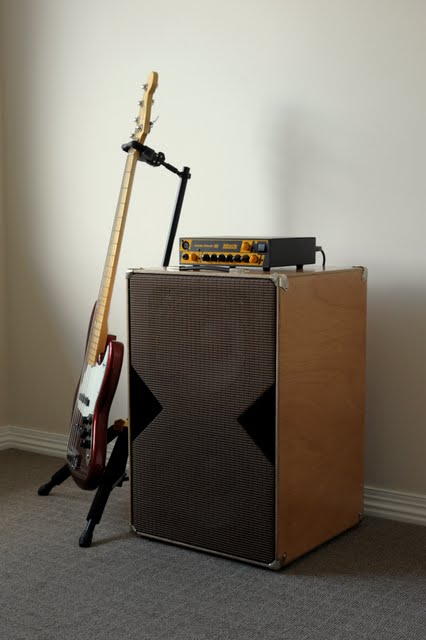
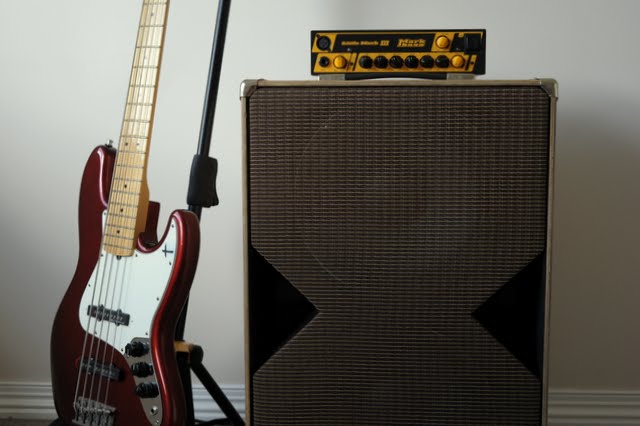
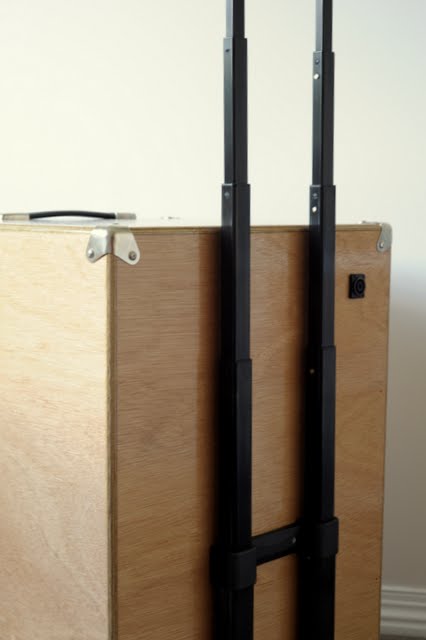
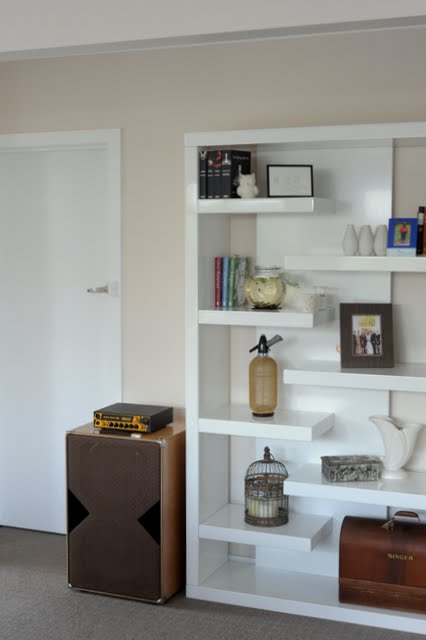
one of the parts of the design brief was that it must look good in the lounge room (as requested by the wife) so, here it is
I also got around to doing the "sugar test", running a sweeping sine through it with a sprinkle of sugar on the cone to find the where the cone rests.
strangely (or probably not that strange) it's tuned a fair bit lower than I shot for, coming in at 42hz instead of 50hz.
I checked my port measurements and they all line up with what WinISD suggested, any thoughts on what has happened?
Now that the grill cloth came in, I've finally been able to finish it!
one of the parts of the design brief was that it must look good in the lounge room (as requested by the wife) so, here it is
I also got around to doing the "sugar test", running a sweeping sine through it with a sprinkle of sugar on the cone to find the where the cone rests.
strangely (or probably not that strange) it's tuned a fair bit lower than I shot for, coming in at 42hz instead of 50hz.
I checked my port measurements and they all line up with what WinISD suggested, any thoughts on what has happened?
been following this thread, that's some beautiful work  I'm very fond of those drivers so nice to see them used in different configurations
Interesting re your actual tuning vs calc'd, I'm not a WinISD hotshot by any means but in my experience I always wind up w/a lower tuning and I really try to take into account volume by all the internal bits Hopefully one of the gurus will chime in shortly.
I'm very fond of those drivers so nice to see them used in different configurations Interesting re your actual tuning vs calc'd, I'm not a WinISD hotshot by any means but in my experience I always wind up w/a lower tuning and I really try to take into account volume by all the internal bits
Hopefully one of the gurus will chime in shortly.Man, that thing looks classy, really, really professional.
As for the port thing, WinISD is accurate when using round pipe or tube type ports but it overshoots it when using shelf ports. Apparently using a cab wall as part of the ports makes the tuning end up a little deeper than predicted. Perhaps your ports suffer from this because they use the wall? Could be a little off on the real internal volume with the bracing and funky driver basket shapes but that wouldn't put you off by that much.
There's some talk of correction calculations and a link to another online port calculator in this thread. http://www.talkbass.com/forum/f15/cab-building-question-about-shelf-port-length-823673/
Can double check your work against that. It may mean going in and cutting an inch or so off your ports but I'd wait with that until you get a few gigs with it under your belt. Having the lower tuning roll the bottom down like that can be a big help in bad rooms.
Again, nice work, much nicer than my utilitarian black boxes.
As for the port thing, WinISD is accurate when using round pipe or tube type ports but it overshoots it when using shelf ports. Apparently using a cab wall as part of the ports makes the tuning end up a little deeper than predicted. Perhaps your ports suffer from this because they use the wall? Could be a little off on the real internal volume with the bracing and funky driver basket shapes but that wouldn't put you off by that much.
There's some talk of correction calculations and a link to another online port calculator in this thread. http://www.talkbass.com/forum/f15/cab-building-question-about-shelf-port-length-823673/
Can double check your work against that. It may mean going in and cutting an inch or so off your ports but I'd wait with that until you get a few gigs with it under your belt. Having the lower tuning roll the bottom down like that can be a big help in bad rooms.
Again, nice work, much nicer than my utilitarian black boxes.
Thanks heaps I'm very happy with the result!
This may become a bit of an obsession for me, as I've already started designing a few more cabs
I'll do a bit of calculating with these new numbers so I can be a bit more accurate with tuning these next few cabs
I can hear what you're saying with the low end roll off.
A lot of my normally troublesome venues performed a lot better with this cab than my aggies.
The aggies tended to boom with particular notes, but I haven't noticed with this one.
Cheers!
I'm very happy with the result! This may become a bit of an obsession for me, as I've already started designing a few more cabs
I'll do a bit of calculating with these new numbers so I can be a bit more accurate with tuning these next few cabs
I can hear what you're saying with the low end roll off.
A lot of my normally troublesome venues performed a lot better with this cab than my aggies.
The aggies tended to boom with particular notes, but I haven't noticed with this one.
Cheers!
Cool thanks!
It must be time for me to buy that loudspeaker cookbook so I can really get my head into this stuff
It really satisfies the nerd in me
thanks! It must be time for me to buy that loudspeaker cookbook so I can really get my head into this stuff
It really satisfies the nerd in me
Nice to see the finished product. That grill gives it a unique look. Nice that it also has a high WAF.
Others have addressed this already. Since triangular ports have been rare here, it would be useful for future builders to know more about the variance from predicted to actual. In WinISD, for a 125 liter box with round port area of 242cm2, I get a 10.3cm port length for 50hz, and a 20cm port length for 42hz. Almost a 2:1 ratio...
What was your port length?
My thought as well. A happy accident, perhaps.
I also got around to doing the "sugar test", running a sweeping sine through it with a sprinkle of sugar on the cone to find the where the cone rests.
strangely (or probably not that strange) it's tuned a fair bit lower than I shot for, coming in at 42hz instead of 50hz.
I checked my port measurements and they all line up with what WinISD suggested, any thoughts on what has happened?
Others have addressed this already. Since triangular ports have been rare here, it would be useful for future builders to know more about the variance from predicted to actual. In WinISD, for a 125 liter box with round port area of 242cm2, I get a 10.3cm port length for 50hz, and a 20cm port length for 42hz. Almost a 2:1 ratio...
What was your port length?
Deltalites really benefit from a lower tuning anyway. In that sized box, 42is much closer to optimal than 50.
My thought as well. A happy accident, perhaps.
billfitzmaurice
Commercial User
- Sep 15, 2004
- 16,860
- 278
- 76
- Disclosures
- Owner, Bill Fitzmaurice Loudspeaker Design
Only when they are very narrow. I measured some cabs with round ports center mounted and triangular ports corner mounted, same area, same length, they came in exactly the same Fb.As for the port thing, WinISD is accurate when using round pipe or tube type ports but it overshoots it when using shelf ports.
Only when they are very narrow. I measured some cabs with round ports center mounted and triangular ports corner mounted, same area, same length, they came in exactly the same Fb.
I remember you posting that somewhere about triangle ports in the corners.
What defines "very narrow" in a shelf port? I've never gotten them to come out right by just following WinISD's calculated lengths. This would be stuff around 2" high x19-20" wide. Is it a ratio of height to width or just a small dimension like an inch tall or something.
I'd be interested in knowing what difference corner ports (two walls) vs. mid baffle triangular ports (one wall) would have in calculating post length...


