• TalkBass has been independent since 1998. Add your voice.
    Create a free account to reply to discussions, view embedded media, and browse with fewer display ads.
    Join freeLog in
    Want zero display ads or expanded classifieds tools? Compare plans.

Depth without rate/speed?

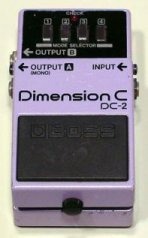
Roland/Boss Dimension series, used ones are $$$$$$$$$$$$$$

dimensionC.jpg

Dimension-D.jpg


Behringer cloned the Dimension C twice, the CC300 (switches only) and CD400 (knobs!!! ugh!!!). They seem to have been pulled off the market.


I know what your talking about, that's what I try to get out of chorus. I just want to fatten up the sound without any modulation. On my m60b I have a detuner that does pretty well with that, but I'm going to try the delay someone had mentioned earlier and see how that works.
 
:hyper: I love the DimeD /DimC / clones thereof, but I was told in another thread they're not that great on Bass, ie barely noticeable. :cautious:


Callofcthulhu's latest post about the "beat" frequency explains why it's impossible to tune by ear while running a chorus pedal.

So what do "Bass" Choruses do that's so different from a regular chorus? I mean, apart from accentuating the low end, are they adding extra harmonics/overtones to those low notes for the chorus to work on?
 
So what do "Bass" Choruses do that's so different from a regular chorus? I mean, apart from accentuating the low end, are they adding extra harmonics/overtones to those low notes for the chorus to work on?

Most of them have a high pass filter in the circuit so that the bottom octave stays dry. The idea is to keep the fundamentals of the notes un-chorused.
 
  • Like
Reactions: SteveCS
Depth without modulation is exactly what is happening in a BBE Sonic Maximizer...
The circuit subtly phase shifts (=small delay) the highs and lows differently, I think with the goal of lining up the frequency peaks a little (move lows back, move highs forward, leave mids alone).
I don't know if Sonic Max is popular with bass players anymore/these days, but it seems like that circuit does exactly what OP is talking about.
 
To be slightly more precise about what is going on in a chorus pedal from what a couple people have already said...

A chorus is just a delay pedal with modulation. The modulation detunes the wet signal against the dry. Rate sets the speed of the modulation, while depth usually sets the delay range that is used (ie a 10ms width up to a 50ms width or something like that). This usually results in up to a few cents (maybe 20-50 for pretty high depth settings) of detuning. So that's why a higher depth setting makes it sound "fatter" because there is more detuning going on (because of the increased changes between delay times). You can minimize the warbliness by reducing the rate as you increase the depth. A moderately high rate (like 3/4 up) can sound nice and shimmery with a lower depth setting. But as you increase the rate you have to decrease the depth or vice versa to avoid going into sci fi alien effects territory.

So a detune effect just avoids the modulation entirely. So you can have a static detune amount (usually measured in cents) and it just stays there forever (unless you change it manually).

But a lot of the warmth and fatness of cranking the depth on a chorus pedal comes from that little bit of animation you get from the LFO modulation. A detune essentially is a much different sound. You might want to try a phaser with a low rate setting, because I think that might be closer to what you're looking for. It sounds like you don't really care for the character of chorus pedals (which are kind of love or hate these days), but a phaser, even though it works in a somewhat similar way, has a much different character.
 
  • Like
Reactions: blindrabbit
Dominick How 'bout the Invalid Link Removed?

30MSFace2-1000x1000.jpg

KEELEY said:
Keeley 30ms Automatic Double Tracker. The stereo effect pedal offers an array of studio style doubling effects used for creating thicker, fuller sounding instruments. Also included in the effect pedal is a reverb that simulates the famous chamber in Studio Two. The Keeley 30ms is designed to work with guitar, bass, keyboard, even vocals...


The Keeley Engineering 30ms Automatic Double Tracker pedal can be used in mono with a built in “Abbey Verb” reverb control, or in stereo as the Double Tracker Pro. The 30ms offers altered and detuned effects like a chorus pedal might sound, only without the regularity of a LFO oscillator in Dimension Mode. In this mode you have the ability to create up to two different voices for a stereo double tracked field. The user controls the tuning and delay for results that are stunning mono or through two amplifiers in stereo. Abbey Mode offers something more similar to a conventional chorus in that it simulates synched tape decks running in parallel with varying tape speeds. Stereo or mono this mode gives players a wide, lush sound without sounding like a conventional chorus pedal. Lastly the team at Keeley created a unique Slapback Mode for rockabilly sounds. The Slapback is now a double tracked echo with the two altered voices. Add the Keeley Abbey Verb to this mode to create really new effects.

In Stereo Double Tracker Pro mode the unit drops the reverb channel in favor of complete control over the double tracked voices. Each of the two voices can be tuned up to 30 cents sharp and flat. Those voices are then delayed by up to 30 milliseconds for subtle to very distinctive doubling sounds. The user can program by internal switches the wet output to have either dry and effected sounds, or just the effect, giving them true double tracking in stereo, live.
 
I bought a Boss DD500 recently and it can do exactly what you're looking for and is super tweakable. What sets it apart for me is the Tera Echo mode. I bought the unit for bucket brigade delay and Tape echo sounds thinking the Tera Echo was gimmicky from what I had gathered from youtube demos. It turns out you can tweak interesting reverbs with that mode. It's more in the ballpark of the Earthquaker Afterneath i. e. multiple delays smeared to produce reverb, even if the effect is more subtle than the Afterneath.
What I'm saying is as far as delays go, this pedal is really awesome to get sounds from traditional to experimental.
I actually found inspiration by watching videos about the keeley 30ms double tracker and itching to A/B it with the patch I came up with on the DD500.
 
This thread got me thinking more about delays too, and yes the Nemesis looks great! I'm also looking into things like slow speed phasers as well. Modulation is fun. :)

"D-1"

Bingo!

BR – Right on the money. OP, you should just get a delay capable of delay times that match that of chorus or possibly even as short as a flanger's.

Here's a good explanation of the psychoacoustic effect of modulation's delay times of various such effects from [Invalid or Expired Link Removed], of particular note is the range of delay where the sound changes from seemingly "one event" to perceiving "two events" (30 milliseconds):

"The Haas Effect

One of the coolest things about the Flanger/Doubler is that it has a built-in doubling effect. To understand exactly what this is, we have to start at the beginning with the Haas Effect. The Haas Effect is a very useful psychoacoustic theory that states that a delay of 40 milliseconds or less (depending on which text book you read - sometimes it’s noted as 30 milliseconds) is not perceived as a distinct event. That means that if a delay on a snare drum was set to 50 milliseconds, you would hear two separate events - the initial snare hit, then the delay. But if you set the delay to less than 30 milliseconds, the two would blend together and you’d hear them both as a single event.

This is important because it means that a short delay of less than 30 milliseconds can be used to thicken a sound that seems a bit thin, or it can be used to “stereoize” a mono track by panning the dry track to one side and the delayed to the other. Regardless of how you use it, the Haas Effect is a very powerful, if sometimes overlooked tool in your mixing toolbox."

Useful delay settings from SoS:

"Slap-Back Delay: 20-80mS delay, no feedback.

Tunnel Echo/Resonator:
2-10mS, feedback as high as possible without going unstable.

Tempo Delay:
60/bpm gives you the delay time of 1 bar in seconds. Divide this delay time by four to give you the delay time per quarter note.

Echo:
100-300mS with feedback. The higher the feedback level, the more repeat echoes.

Vibrato:
3-10mS, dry signal off, modulation rate 3-8Hz, depth set by ear.

Phasing:
3-10mS, mix control 50/50, modulation rate 3-8Hz, depth set by ear. Try Feedback Invert if you have it.

Flanging:
5-50mS, mix control 50/50, modulation rate 3-8Hz, depth set by ear. Increase feedback to make effect more dramatic. Try Feedback Invert if you have it.

Chorus:
30-100mS, mix control 50/50, modulation 3-8Hz, depth set by ear. Little or no feedback. Increasing feedback creates a rotary speaker effect."

PS: Another tidbit from SoS:
"• PHASE INVERT
And now that mysterious phase invert button or parameter that your unit may or may not have; the effect of this is most noticeable on effects that use a very short delay time, particularly flanging. By inverting the phase of the signal fed back to the input, it allows different harmonics to be accentuated by the filtering process, and so gives a choice of two types of tonal coloration, one usually sounding thinner than the other; which one you use is entirely a matter of personal choice. On longer delay times, the invert facility will produce little or no subjective change to the sound."


I'm geeking out here :wacky:, 'tis a very interesting topic to me. :smug:


For your reverb, I'll suggest getting one that doesn't affect the low end, only the mids and highs get the effect. Even better if it has pre-delay settings that you can muck about with. Depending on how you're intending to use your reverb, you could set the pre-delay longer for making it sound like a bigger hall/space.

Another cool trick is to put reverb only on the delay trails (still keeping that short chorus/flanger delay setting), not on the dry signal.
That ought to fatten things up for you while retaining clarity and pitch definition. :thumbsup:

Ok, since a delay can simulate some of the modulation effects, what else, besides the delay pedal, would I need to create a resonator-type effect, a la the resonator in the Source Audio Orbital? I should probably ask this in the SASS thread as well...
 

Latest posts