
Enjoy the benefits of a premium membership!
Upgrade Account
-
TalkBass has been independent since 1998. Add your voice.
Create a free account to reply to discussions, view embedded media, and browse with fewer display ads.
Join free Log in
Want zero display ads or expanded classifieds tools? Compare plans.
You are using an out of date browser. It may not display this or other websites correctly.
You should upgrade or use an alternative browser.
You should upgrade or use an alternative browser.
Determining a speaker wattage?
- Thread starter Axtman
- Start date
More options
Who Replied?
Destructive testing would probably be the only way to get a ballpark estimate. Otherwise, unless you can find information about the driver, I'm pretty sure the answer will be no.



AFAIK, not without destroying it.
Even if you know the driver model and can look up the RMS power rating, you really don't know how much power it can actually handle with bass. The RMS power rating basically tells you how much power the voice can handle without overheating. However, with a bass cab you also need to be concerned with how far the cone can safely move. The RMS rating is valid at higher frequencies where cone excursion is relatively small, but it may not be valid for all frequencies below 100hz. Low frequency cone excursion is determined by the driver's characteristics as well as how the cab is tuned. Put the same driver in a different cab design, and the mechanical power handling changes.
Mechanical power handling below 100hz can be significantly less than a drivers RMS power rating.
FYI Eminence publishes cab design docs for most of their pro woofers and some of their bass specific drivers.
Let's consider the 2512 which is rated 250W RMS and has Xmax of 4.9mm.
Here are excursion plots for two different ported designs:
Large Ported Design

This design is mechanically limited to 125W and requires a steep HPF set to 35hz. With 125W, cone excursion approaches Xmax a bit of above 70hz. Als,o excursion exceeds Xmas with 125W when the frequency dips below 35hz.
Small Ported Design:
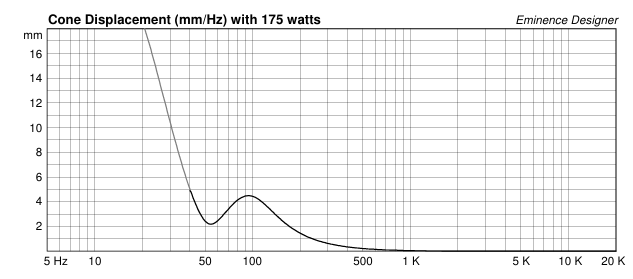
This design is mechanically limited to 175W and requires a steep HPF set to 40hz. With 175W, cone excursion approaches Xmax a bit of above 90hz. Also, excursion exceeds Xmas with 175W when the frequency dips below 40hz.
Even if you know the driver model and can look up the RMS power rating, you really don't know how much power it can actually handle with bass. The RMS power rating basically tells you how much power the voice can handle without overheating. However, with a bass cab you also need to be concerned with how far the cone can safely move. The RMS rating is valid at higher frequencies where cone excursion is relatively small, but it may not be valid for all frequencies below 100hz. Low frequency cone excursion is determined by the driver's characteristics as well as how the cab is tuned. Put the same driver in a different cab design, and the mechanical power handling changes.
Mechanical power handling below 100hz can be significantly less than a drivers RMS power rating.
FYI Eminence publishes cab design docs for most of their pro woofers and some of their bass specific drivers.
Let's consider the 2512 which is rated 250W RMS and has Xmax of 4.9mm.
Here are excursion plots for two different ported designs:
Large Ported Design
This design is mechanically limited to 125W and requires a steep HPF set to 35hz. With 125W, cone excursion approaches Xmax a bit of above 70hz. Als,o excursion exceeds Xmas with 125W when the frequency dips below 35hz.
Small Ported Design:
This design is mechanically limited to 175W and requires a steep HPF set to 40hz. With 175W, cone excursion approaches Xmax a bit of above 90hz. Also, excursion exceeds Xmas with 175W when the frequency dips below 40hz.
Calvin's dad was an audio engineer.Destructive testing would probably be the only way to get a ballpark estimate.

Loudspeaker Database is your friend.
You can measure some parameters, like DC resistance and impedance at various frequencies (to find the resonance frequency), you can measure the actual effective diaphragm diameter, overall diameter, depth and weight.
Once you have those parameters, you can look up the speaker on Loudspeaker Database, compare the pictures and hopefully arrive at your speaker. In fact, once you have the external dimensions and weight, you can likely limit the speaker model to a reasonably narrow range and then get the exact parameters you need.
Of course, it all falls apart if you have an OEM speaker since it's not going to be listed in the database.
There are two components to wattage:
First is thermal power handling. You can determine it by pushing current (DC) through it, measuring the temperature rise (and/or resistance increase). Once it gets to an equilibrium due to power compression (temperature rise stops because resistance rose enough that power dropped below what can be dissipated), that's the safe power handling.
Once the driver is inside a cab, it doesn't get the benefit of airflow, and thermal power handling capacity will be lower.
The second is mechanical excursion limits. @Wasnex already explained the concept.
You can't really test for Xmax. In theory you can test the mechanical limit when the speaker bottoms out and hits the bottom endstop.
If the speaker is overhung (voicecoil is longer than the magnetic gap) or underhung (voicecoil is shorter than the magnetic gap), you can test for where you can reasonably expect the speaker to have less distortion since mechanical response is more linear as long as inductance stays the same. You can test this by
measuring coil inductance while pushing and pulling driver diaphragm. Once it starts to drop, that's the "linearity" limit (I'm using the term "linearity" very loosely, since speakers are notoriously anything but linear).
You can measure some parameters, like DC resistance and impedance at various frequencies (to find the resonance frequency), you can measure the actual effective diaphragm diameter, overall diameter, depth and weight.
Once you have those parameters, you can look up the speaker on Loudspeaker Database, compare the pictures and hopefully arrive at your speaker. In fact, once you have the external dimensions and weight, you can likely limit the speaker model to a reasonably narrow range and then get the exact parameters you need.
Of course, it all falls apart if you have an OEM speaker since it's not going to be listed in the database.
There are two components to wattage:
First is thermal power handling. You can determine it by pushing current (DC) through it, measuring the temperature rise (and/or resistance increase). Once it gets to an equilibrium due to power compression (temperature rise stops because resistance rose enough that power dropped below what can be dissipated), that's the safe power handling.
Once the driver is inside a cab, it doesn't get the benefit of airflow, and thermal power handling capacity will be lower.
The second is mechanical excursion limits. @Wasnex already explained the concept.
You can't really test for Xmax. In theory you can test the mechanical limit when the speaker bottoms out and hits the bottom endstop.
If the speaker is overhung (voicecoil is longer than the magnetic gap) or underhung (voicecoil is shorter than the magnetic gap), you can test for where you can reasonably expect the speaker to have less distortion since mechanical response is more linear as long as inductance stays the same. You can test this by
measuring coil inductance while pushing and pulling driver diaphragm. Once it starts to drop, that's the "linearity" limit (I'm using the term "linearity" very loosely, since speakers are notoriously anything but linear).

As a curious tween I once plugged a speaker into an AC outlet. I can't tell you how many watts it took, but 120 volts AC at 60 Hz will definitely destroy a speaker fast. And the sound and smell of 60 Hz is distinctive.Destructive testing would probably be the only way to get a ballpark estimate.
Thank you for VERY comprehensive answers. I was hoping to get something more of a rule of thumb that would get me in the ballpark of wattage. Voice coil diameter? Magnet size and/or weight?

Take a photo of the frame and magnet in the back and sometimes there are numbers and letters that you can then forward to Eminence or whoever the maker is. Andy may even be able to tell. OEM versions will usually not carry model names or specs but they will almost always stamp these codes in the back. Just be aware that once you blow a speaker, you are potentially presenting a no load condition to the amp and you probably have a minute or less to shut down the amp , specially a tube amp.

Destructive testing would probably be the only way to get a ballpark estimate.
I set a speaker on fire once…I guess it couldn’t handle 160 watts
 Not only did the cone go up in smoke, it burned a big hole in the grille cloth.

- Feb 12, 2006
- 60,978
- 5
- 220,736
- Disclosures
- Development Engineer-Mesa Boogie, Development Engineer-Genzler (pedals), Product Support-Genz Benz
No even remotely accurate rule of thumb, sorry.Thank you for VERY comprehensive answers. I was hoping to get something more of a rule of thumb that would get me in the ballpark of wattage. Voice coil diameter? Magnet size and/or weight?
If you post a picture, I might be able to identify it.
As a curious tween I once plugged a speaker into an AC outlet. I can't tell you how many watts it took, but 120 volts AC at 60 Hz will definitely destroy a speaker fast. And the sound and smell of 60 Hz is distinctive.
A little something like this?I set a speaker on fire once…I guess it couldn’t handle 160 watts
 Electrical burning sure is a distinctive smell, you aren't lying about that lol.
Ever put the voice partially through the front of the cone? I can't recommend it. Neither could my father, he laughed yet was not thrilled. A week later was my first real gig. He collected.
A little something like this?
Yeah that's it


