• TalkBass has been independent since 1998. Add your voice.
    Create a free account to reply to discussions, view embedded media, and browse with fewer display ads.
    Join freeLog in
    Want zero display ads or expanded classifieds tools? Compare plans.

DI XLR out (add phantom) into amp 1/4" in

Hello Talkbass,

I'd like to ask for an advice. I did not find an answer for this in the forums, please let me know if there's an existing thread.

I have the RNDI and I very much like its sound. So much that I'd like to plug it into my amp. The RNDI needs phantom power so a cable alone would not solve the problem. I found there's the EBS Stanley Clarke acoustic preamp that has XLR input with phantom power. Then there's something like Quad Cortex that has XLR input with phantom.

But is there a solution that would simply transform XLR into 1/4" TS jack and also provide 48 volts to the XLR?
 
Last edited:
  • Like
Reactions: Dominic D
It can be done, but it won't be not cheap or eloquent.

The output level of the RNDI is listed as +11.5dBu. This is a fairly hot, line-level signal. An instrument level preamp typically cannot handle this hot of a signal without some sort of inline pad. You also have the problem that you need to provide phantom power to the RNDI, while isolating the input of your amp from phantom power. Both could be accomplished with a suitable mic splitter like a Radial JS2 or JS3.
upload_2022-11-15_3-23-33.jpeg


The Radial JS2 and JS3 have a max input of +25dBu, and they also have a 30dB pad to knock the signal down to instrument level.

You will need to use something to provide phantom to the XLR. The phantom power will pass through the mic splitter's direct thru to the RNDI. Then you will take the signal off one of the mic splitter's transformer isolated outputs. The transformer isolated output will provide a signal without phantom power.

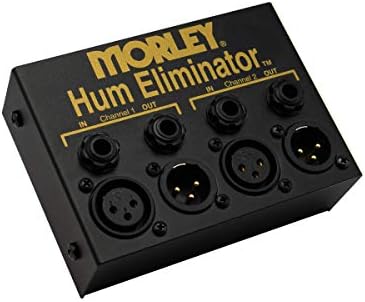
To convert from XLR to 1/4, you can try an adapter. The best way to do it would be to use something like a Morley HE-2. The HE-2 is a pair of 1:1 isolation transformers.

41ftqJQxhVL._AC_SY350_.jpg
 
Thank you for the replies! Wasnex’s solution does sound a bit expensive and complicated to serve that single purpose.

Maybe the Stanley Clarke preamp would be a good (and less expensive) choice plus I’d get a very nice EQ and I could go directly to a power amp.
 
  • Like
Reactions: Wasnex and Zbysek
It may color your sound somewhat, but I gather you could use a small 4-channel mixer to go from bass into RNDI into a mic input on the mixer that provides 48v phantom and usually has 1/4 outputs that you can turn down enough to play nice with some amps, especially if it has a padded input for active instruments.
Again, putting a mixer in between may color your sound somewhat but would work.
 
There are in line phantom supplies that will do the job, then an adapter into the amp. If the DI is transformer isolated on the output, the adapter must connect XLR pin 1 to pin 3.

Depending on the amp, you may also need a pad.

Probable not worth the hassle.
 
If the phantom power and signal share the same ground and do not need isolation transformers, the problem can be reduced to the way it's done for active RF antennas.

A single line carries signal and power, with common ground, usually a coax line. Each end has a coil and a capacitor, diverging from the line. The capacitors route the signal. The phantom power source puts power onto the line through a coil that blocks the AC signal to prevent losses. The capacitor passes what signal remains. The coil/cap pair at the other end do the same thing, but routing power to the load, and via cap to the other end for the signal.

If the existing signal is large, needing a pad, you can certainly afford some loss. :) That means this simple scheme might work. The coils will need to be bigger than for radio frequencies, a big enough inductance to block bass audio frequencies. Likewise, the caps must be big enough to pass them. It may be easy to build this based on parts normally used for simple low power passive crossovers, along with an XLR connector and a jack socket, and an input DC socket for the power.


EDIT: You'd also need to know the input and output impedances to keep it this simple. In RF that's easy because it's standardised, maybe not so for audio.
 
Last edited:
  • Like
Reactions: Wasnex
It can be done, but it won't be not cheap or eloquent.

The output level of the RNDI is listed as +11.5dBu. This is a fairly hot, line-level signal. An instrument level preamp typically cannot handle this hot of a signal without some sort of inline pad. You also have the problem that you need to provide phantom power to the RNDI, while isolating the input of your amp from phantom power. Both could be accomplished with a suitable mic splitter like a Radial JS2 or JS3.
View attachment 4874198

The Radial JS2 and JS3 have a max input of +25dBu, and they also have a 30dB pad to knock the signal down to instrument level.

You will need to use something to provide phantom to the XLR. The phantom power will pass through the mic splitter's direct thru to the RNDI. Then you will take the signal off one of the mic splitter's transformer isolated outputs. The transformer isolated output will provide a signal without phantom power.

To convert from XLR to 1/4, you can try an adapter. The best way to do it would be to use something like a Morley HE-2. The HE-2 is a pair of 1:1 isolation transformers.

41ftqJQxhVL._AC_SY350_.jpg

Minor correction -
The maximum output level is +11.5dBu. Referring to clip point.
Maximum input level is about +21.5dBu.
The RNDI drops the signal level from input to output about 10dB.
 
  • Like
Reactions: Wasnex
Sorry if this is the wrong direction but do you line out to the FOH? If so, use the FOH board with phantom power to drive the RNDI. That is what I do and I run the input to my amp from the RNDI as well.

From the rupertneve site...

View attachment 4874334

The THRU connection is a direct connection to the INPUT.
If he is trying to send the RNDI sound to his amplifier this will not work.
 
One thing to keep in mind is that cabinets hugely color the sound on most cases. Chasing that "soundboard" sound gets expensive on the amp and cabinet side. Just because you pass the sound from your rdni in, it is unlikely that will come out unless you have invested in some amp headroom and some quality cabs that approach full range. For me the solution was a Quilter bass block and a hard to source Audiokinesis cab. Other full range cabs are out there, but none are cheap.
 
Mr. Neve designed this device to do one thing really well: provide an interface from a low level, unbalanced, high impedance source -- a bass guitar -- to a balanced, low impedance mic input. In pursuit of this goal, he strove to make the RNDI as transparent and uncolored as it could possibly be. Theoretically, it has no discernible sound of its own and imparts no particular 'magic'. And as @Medicine Man pointed out, any subtleties it might impart are likely to be lost when you plug into an amp and speaker system, especially after you go through the gymnastics of powering it and reconverting the low-impedance, balanced signal BACK into a form suitable for a high impedance, unbalanced input to an amp. IMO, you'd be better served finding a preamp you like, the output of which you can use the RNDI on to do what it does -- supply a DI signal to a console. It's a really nice DI, but it was never intended to be used as an instrument preamp.
 
Thank you for the replies! Wasnex’s solution does sound a bit expensive and complicated to serve that single purpose.

Maybe the Stanley Clarke preamp would be a good (and less expensive) choice plus I’d get a very nice EQ and I could go directly to a power amp.

Depends on the input levels the preamp can handle. You probably still need an inline pad. The nominal level of the XLR input is -30dBv...about -27.8dBu. It may not handle the line level output of the RNDI very well.

Shure makes a couple of different attenuators. The A15AS passes phantom, and is switchable between 15dB, 20dB, and 25dB.


IMHO using the RNDI as intended and getting a nice preamp is a better option (YMMV).
 
  • Like
Reactions: Redbrangus
Depends on the input levels the preamp can handle. You probably still need an inline pad. The nominal level of the XLR input is -30dBv...about -27.8dBu. It may not handle the line level output of the RNDI very well.

Shure makes a couple of different attenuators. The A15AS passes phantom, and is switchable between 15dB, 20dB, and 25dB.


IMHO using the RNDI as intended and getting a nice preamp is a better option (YMMV).

Did you see my reply to your previous comment?
Maybe I am misunderstanding something...
The RNDI reduces signal level from input to output by 10dB.
The maximum input level is +21.5dBu (it can take line level input) so the maximum output level is +11.5dBu. This refers to clip-point, not operating or nominal level.
So if you plug an instrument in, like a bass, the output will be 10dB lower. If anything, some amplifiers may not have enough gain for a low output instrument.
 
Last edited:
Two of the Markbass models have 48-volt phantom power option on their XLR inputs.

Little Mark Tube 800 – Markbass
https://www.markbass.it/product/little-mark-tube/

Of course, this is quite an expensive option, but if you want the RNDI tone, if any, embedded into your signal, this is, maybe, the simplest way. I tried the same thing with my Telefunken TDA-1 DI into the Little Mark Tube 800 and the result was pretty good actually!
 
Did you see my reply to your previous comment?
Maybe I am misunderstanding something...
The RNDI reduces signal level from input to output by 10dB.
The maximum input level is +21.5dBu (it can take line level input) so the maximum output level is +11.5dBu. This refers to clip-point, not operating or nominal level.
So if you plug an instrument in, like a bass, the output will be 10dB lower. If anything, some amplifiers may not have enough gain for a low output instrument.
This is not correct.

The specs refer specifically to maximum input and output levels.

There can (and is) gain available to take a lower level signal and amplify it within the bounds of the maximum output level. (note that my comment applies to the 1073 ad Portico family of products and not the RNDI)

[edit for clarity and accuracy]
 
Last edited:

Latest posts