So I finished an analysis that might be the end-all comparison between 4ths and 5ths tunings and am illustrating how they're different. I wanted to set this off as a separate thread as an objective analysis instead of my other thread about my experiences adapting to 5ths tuning.
The tl;dr version is that the advantage of 4ths is compactness of scales. 5ths has a larger spread for scales but more compactness and elegance of major and minor chords.
So the basic thing everybody knows: 5ths is in a way worse than 4ths bc there is more shifting involved (assuming you are trying to avoid shifting). The smallest major scale in 5ths has to span at least 6 semi-tones. 4ths tuning is very compact across 3 strings and requires no shifting (using one finger per semi-tone approach).

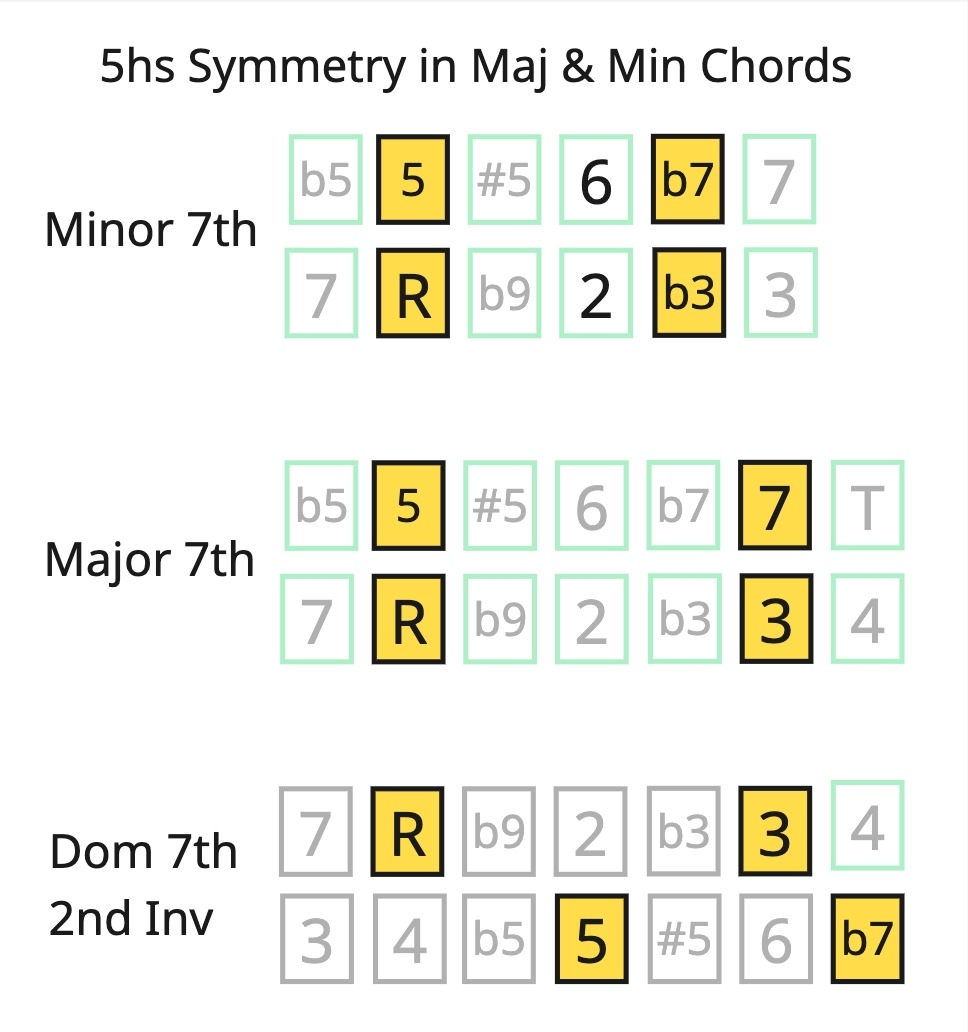
Lets talk about how 5th's can be advantageous, esp in Jazz. Specifically for Minor and Major 7ths chords, there is a physical symmetry. Yes shifting might be involved but it's the same distances being shifted across two strings. Minor chords might require no shifting. Dom chords are less elegant. When it comes to soloing, how you grasp the frame of the hand can be helped by this physical relationship. Please note that the Dom chord shown here is with it on the higher string which you need to see the following image.
When I take these fingering positions and map them how how they show up in a 251 progress across the fingerboard. Blue notes are the minor 2 chord, Yellow is the tonic major. Again, the beauty of the symmetry is maintained even across the Major 251 progression. This is what you get if you try to make it compact as possible. Note that I'm leaving off the 7th from the 5 chord, meanwhile you get the 7th for the ii and I chords for free.
Minor 251 is not as elegant but represented at the bottom in the same fashion.

Now to compare major 251 in 5ths to 4ths tuning. 5ths is slightly the winner if you attempt to play the progression only on 2 strings bc of this symmetry. I think most players in 4ths tuning avoid this specifically so shifting is minimized.

When we look at both spread in similar ways across 3 strings it's about the same. They both span 5 semi-tones if played in the same way. 5ths is somewhat a mirror of 4ths. Played asending you get root inversion in 4ths vs 1st inversion in 5ths. Note that the V chord needs to be played across 3 strings in 5ths while in 4ths a shift is involved. Certainly you can argue that 4ths would simply use a R-3-5 config and keep a similar framing but then the footprint would be larger than 5ths. Depends on how you want to look at this problem.

In the end, I'm lead to believe it's about economy of motion in 4ths (or lack of it since you're generally shifting less) but larger reach in 5ths. 5ths has clearer chord layout when it comes to major and minor chords while 4ths can be more convoluted. Given that my brain likes usability and the symmetrical gripping of chord tones I'm happy with 5ths. It's easier for me to cognitively see and grasp.
One huge drawback tho with 5ths is that much of jazz bass language was created for 4ths, so there is a huge advantage 4ths has there in terms of tradition. Esp things like open strings and certain lines the greats play can be a little more difficult to execute in 5ths but it can be done.
If there's interest, I'll analyze in a future post where the two tunings differ when playing melodies and how much of an advantage 5ths has in double stops (including maybe some of the transcription examples of Red Mitchell's playing I've done).
What do people think of this?
The tl;dr version is that the advantage of 4ths is compactness of scales. 5ths has a larger spread for scales but more compactness and elegance of major and minor chords.
So the basic thing everybody knows: 5ths is in a way worse than 4ths bc there is more shifting involved (assuming you are trying to avoid shifting). The smallest major scale in 5ths has to span at least 6 semi-tones. 4ths tuning is very compact across 3 strings and requires no shifting (using one finger per semi-tone approach).
Lets talk about how 5th's can be advantageous, esp in Jazz. Specifically for Minor and Major 7ths chords, there is a physical symmetry. Yes shifting might be involved but it's the same distances being shifted across two strings. Minor chords might require no shifting. Dom chords are less elegant. When it comes to soloing, how you grasp the frame of the hand can be helped by this physical relationship. Please note that the Dom chord shown here is with it on the higher string which you need to see the following image.
When I take these fingering positions and map them how how they show up in a 251 progress across the fingerboard. Blue notes are the minor 2 chord, Yellow is the tonic major. Again, the beauty of the symmetry is maintained even across the Major 251 progression. This is what you get if you try to make it compact as possible. Note that I'm leaving off the 7th from the 5 chord, meanwhile you get the 7th for the ii and I chords for free.
Minor 251 is not as elegant but represented at the bottom in the same fashion.
Now to compare major 251 in 5ths to 4ths tuning. 5ths is slightly the winner if you attempt to play the progression only on 2 strings bc of this symmetry. I think most players in 4ths tuning avoid this specifically so shifting is minimized.
When we look at both spread in similar ways across 3 strings it's about the same. They both span 5 semi-tones if played in the same way. 5ths is somewhat a mirror of 4ths. Played asending you get root inversion in 4ths vs 1st inversion in 5ths. Note that the V chord needs to be played across 3 strings in 5ths while in 4ths a shift is involved. Certainly you can argue that 4ths would simply use a R-3-5 config and keep a similar framing but then the footprint would be larger than 5ths. Depends on how you want to look at this problem.
In the end, I'm lead to believe it's about economy of motion in 4ths (or lack of it since you're generally shifting less) but larger reach in 5ths. 5ths has clearer chord layout when it comes to major and minor chords while 4ths can be more convoluted. Given that my brain likes usability and the symmetrical gripping of chord tones I'm happy with 5ths. It's easier for me to cognitively see and grasp.
One huge drawback tho with 5ths is that much of jazz bass language was created for 4ths, so there is a huge advantage 4ths has there in terms of tradition. Esp things like open strings and certain lines the greats play can be a little more difficult to execute in 5ths but it can be done.
If there's interest, I'll analyze in a future post where the two tunings differ when playing melodies and how much of an advantage 5ths has in double stops (including maybe some of the transcription examples of Red Mitchell's playing I've done).
What do people think of this?
Last edited: