
• TalkBass has been independent since 1998. Add your voice.
    Create a free account to reply to discussions, view embedded media, and browse with fewer display ads.
    Join freeLog in
    Want zero display ads or expanded classifieds tools? Compare plans.

Double Bass Differences Between German, Italian, etc...

I recognized that that was your intent and I agree with your point of view. My point was that any ambiguities in the labeling can be removed by simply providing a bit of information.
 
...because an Italian anything is usually something made in Italy. Then again, is Subaru a Japanese car? Hmm... made in Tennessee. It's a car made by a Japanese company. If the Italian maker's son takes over the business but was born in the USA, then are the basses he makes Italian?

I think many of these (non)issues can be solved by being explicit. One can point out that this or that bass is made in the "Italian style" by this or that maker. By providing a bit of information, one need not get hung up on the definition of a label.

When Gennaro DeLucia carved a bridge for me, I didn't figure I had an Italian bridge. I did figure that I was fortunate to have a bridge carved by an Italian master. I wasn't conflicted. :)
Subarus are built in Indiana - maybe you're thinking of Nissan.
 
Matt, have a look here

Bass Cafe, Upright, Double Basses For Sale

... and see whether you can make any rules of thumb to determine a "school" of making.

Let alone where a bass id FROM, or who actually made it.

Elsewhere on their site they make an attempt to identify "typical" features of each school of bass making but these are so broad as to be in my view meaningless.

eg: here are some common "identifiers"

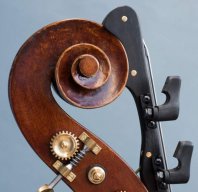
German - Gamba corners, flatback, outside linings, hatpegs, "plate" tuners, flatter arching
Italian - violin corners, deep-set neck, individual tuners, higher arching
English - large, wide, flatback, individual tuners
French - double button decoration, "french" style tuners, wide centre brace on flatbacks
Bohemian - blockless neck/body joint. hatpegs. etc
Viennese - weird long scroll :-)
American - "attached" FF tabs

As soon as I add something I can think of an exception, except perhaps the wide centre brace on french basses of a certain age, and the viennese scrolls.

OK ... so if you see those features you are tending towards those "schools" ... but honestly there are so many exceptions any rule of thumb soon becomes pretty meaningless!

Sometimes a maker has such a unique style that the ID can be narrowed down quite well, but then there are apprentices in the same shops copying the master's basses using the same styles and molds ...

Basses are totally confusing.
 
Matthew, I understand there are a lot of exceptions, man. I'm just trying to get in the ballpark. I don't think in terms of black and white on this stuff. I'm not looking for meaning, just info. I don't mind that basses are confusing. It can be part of the journey and part of the fun.
 
Ah yes, you're right. I went back and fixed it. My original point still holds, of course. :)

I'm not sure its a very good comparison - individual maker vs global corporation...

If a car assembled in the USA by American workers from parts made world-wide for a company (Fuji Heavy Industries) whose head office is in Japan is a 'Japanese' car, what do you call a double bass assembled in the USA from Romanian parts? :D I'm not trying to be contentious, I just think its not a clear analogy.

As far as I'm concerned, a bass made in New York is an American bass, one made in Saxony is a Saxon bass, etc.

A DB made in England by an Italian (Panormo) is an English bass; one made in Chicago by an immigrant named Bohmann is an American bass. A DB labelled 'Anton Wilfer' that was made in Montreal is a Canadian bass...

We have American Steinways and German Steinways, right? ;)
 
Matthew, I understand there are a lot of exceptions, man. I'm just trying to get in the ballpark.

Yeah that's cool, man. And I think the list above is a start and will get you into the ballpark!

Hmmm that got me thinking ... what are the identifiers of the Chinese School of Bassmaking? (opportunity for luthiers' cracks to follow, but be happy with your Shen, it's one of the best ones.)
 
I'm not sure its a very good comparison - individual maker vs global corporation...

If a car assembled in the USA by American workers from parts made world-wide for a company (Fuji Heavy Industries) whose head office is in Japan is a 'Japanese' car, what do you call a double bass assembled in the USA from Romanian parts? :D I'm not trying to be contentious, I just think its not a clear analogy.

As far as I'm concerned, a bass made in New York is an American bass, one made in Saxony is a Saxon bass, etc.

A DB made in England by an Italian (Panormo) is an English bass; one made in Chicago by an immigrant named Bohmann is an American bass. A DB labelled 'Anton Wilfer' that was made in Montreal is a Canadian bass...

We have American Steinways and German Steinways, right? ;)

Jake, I agree with you! I think you misunderstood the point I was trying to make. I was simply pointing out the potential vagaries and ambiguities in agreement with Matthew.

I said, ..."is Subaru a Japanese car? Hmm... made in Indiana. It's a car made by a Japanese company."

I think the analogy is dead on. I didn't say that Subaru is a Japanese car. Rather, I left each person to answer the question for him/herself. The global manufacturer vs. individual is not germane, as I see it. Analogous to my Subaru example, New Standard basses are assembled in the USA from German parts. Are they German basses? Well, I would call them American basses. My overall point was and is that one need not get entangled in all of this. All one has to do is communicate clearly about whether one is talking about origin of manufacture, "school" of building, origin of parts, etc. One you have the information, as in the NS example or the Subaru example, then bickering over what to call it is, IMO, a waste of time. It's neither informative nor helpful.

By the way, I don't know of any basses that were or are assembled in the USA from Romanian parts. Do you? Gee, could you be thinking of a specific company? Wait, let me think... I do know of one that imported Romanian-built basses a while back, sold them as imported basses, and then started building their own from the ground up. Hmm... maybe you have another builder in mind or perhaps you were just posing a hypothetical.

Now to the larger issue raised about having a dedicated thread. Here's how I see it. Whether a thread discussing the identification of "Italian," or "French," or "German" basses would be informative really depends upon whether the categorization is useful. If there is so much overlap (variance) across the categories as to make them useless, then it's a futile exercise. If I understand Matthew's point of view correctly, he believes it to be futile. I'm not so sure. Here's why.

Many, many times over the years, people have posted asking for a bass to be ID'ed. On many occasions, experts will weigh in clearly agreeing that the particular bass is a "German shop bass," or an "Italian bass from the 1800s" or the like. I think it's reasonable for someone to ask what characteristics these people are seeing that lead them to these definitive identifications. That's what I think was Matt R.'s request. The truth is that there are prototypical examples.

Now, there have been many times (perhaps just as many) where arguments rage for days about the origin of a bass. These usually involve instruments that are not prototypical at all. Such examples speak clearly to Matthew's point.

I'm left thinking that it would still be useful to specify what defines the prototypical categories.
 
drurb said:
I think it's reasonable for someone to ask what characteristics these people are seeing that lead them to these definitive identifications. That's what I think was Matt R.'s request. The truth is that there are prototypical examples.

Somebody gets it! Yes this was my point. And it's more of a suggestion than a request. It doesn't even have to be a separate thread. It could be an addendum to the newbie thread somehow.
 
Arnold just posted this in a classifieds thread:

" "from the workshop of Arnold Schnitzer...": New Standard basses are made in Germany. They are set up and varnished here in the USA."

I think he sets the necks here, but I could be wrong. Anyway, what he posted is an excellent example of what I was discussing. He's explicit about the detail so people know about his basses. No point getting involved in what those basses should be called.
 
A DB made in England by an Italian (Panormo) is an English bass; one made in Chicago by an immigrant named Bohmann is an American bass.

Wait. Just in from the internet on my Bohmann DB: Apparenty Joe's wife (also know at that time as: "The little woman") was having her "Time of the month". Joe takes her back to the old country to mellow her out, and in frustration, decides to carve a big ole' fiver in the old Country.

Now what?

 
Wait. Just in from the internet on my Bohmann DB: Apparenty Joe's wife (also know at that time as: "The little woman") was having her "Time of the month". Joe takes her back to the old country to mellow her out, and in frustration, decides to carve a big ole' fiver in the old Country.

Now what?

In that case, it's Bohemian. Period! :D