OK well here's what *I* think.
We could write up a bunch of generalisations, but then for every generalisation there are a bunch of exceptions. It depends what actually you mean by "ID"
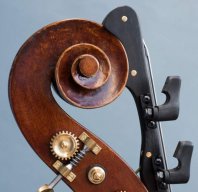
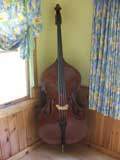
If you are trying to classify a bass in a "school" you look at outline shapes, scroll shapes, construction methods inside and out, hardware, varnish, perceived age, labels, marks etc. So its a kind of "looks like ..." classification. But anyone can build "In the style of" someone else so it doesn't really give any clues to origin, in my view.
If you are trying to find out WHERE the bass was made you could look at the "Looks like ..." then maybe add the materials used, do a bit more detective work on the label, if you think it is the original label (not always the case!) but more often, find a similar looking bass with similar materials and with a "known" pedigree etc. You might or might not be able to narrow things down to a country. But a bass made from Italian maple is not necessarily made in italy. And a bass actually made in italy could be made by an established german maker in a french style. Is it italian or german or french? And a bass with a german-or italian-looking label is more likely than not to be made in China or Korea these days. And basses made in Europe or USA can easily be made of wood imported from Asia, and in any number of styles.
If you are trying to work out precisely WHO made the bass, and the bass doesn't have any genuine makers' marks or authentic labels, you have to go by things that indicate "the hand of the maker" such as carving techniques, f-hole shapes, arching, the age of the wood, varnish and so on. And these are nowhere near 100% sure either. And in an older bass, it has passed through many luthiers hands, so can be a misleading combination of work from different people at different periods.
Say you have a bass originally made in italy which has had its neck and scroll replaced in germany in a german style 100 years ago and subsequently the ribs and internal bracing were replaced in England from french material and then the tuners were replaced in an "italian" style by an american luthier. What IS that bass?
A lot of the above parameters are impossible to judge on photos alone. And don't even start to talk about fakes and copies being passed off as something else ...
I DO think the pedigree, the history, of a bass is more interesting than just the ID, even just to who owned it beforehand. I often think it is a pity that basses don't have a built-in service and owner log book like a car does. Even "lesser" basses that have passed through interesting hands would be more interesting! All basses have a character that builds with age. Some of that history, an experienced luthier can make a stab at guessing.
Think about this: in the end, what difference does it make where I was born? I am who I am, I am the product of my makers, my parents, but also influenced by everyone with whom I have had contact in the past 50 years. And by what I have learnt, listened to, eaten, and eat now, and what languages i speak. Can you ID me just by looking at me? hardly. You get a better idea (for better or for worse) by listening to me and interacting with me. Perhaps at the end, you will say, "ah yes, Made in England" but beh, what does that really mean?
Same goes for basses.
But if someone wants to try to compile a cool sticky, I won't object