
3-band EQ? Crazy, what's the knob situation look like on that Voodoo?
Sheldon normally does five knobs in a curve these days, but back in the days of voodoo, it was a slight "v" shape. They are volume, 4-pos selector knob, then 3 knobs for EQ.

TalkBass has been independent since 1998. Add your voice.
Create a free account to reply to discussions, view embedded media, and browse with fewer display ads.
Join free Log in
Want zero display ads or expanded classifieds tools? Compare plans.
3-band EQ? Crazy, what's the knob situation look like on that Voodoo?
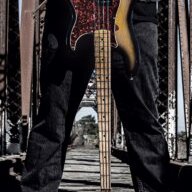
Sheldon normally does five knobs in a curve these days, but back in the days of voodoo, it was a slight "v" shape. They are volume, 4-pos selector knob, then 3 knobs for EQ.

Back then? I could be wrong but every bass I've ever seen built up to around '95(or that came stock with Barts for that matter) has 3 knobs. Volume, Blend, and concentric Bass/Treble. I've never seen a 3 band Bart equipped Voodoo which is why I'm curious to find out from FRB what the layout is.
Sweet! What's the knob layout?I have a 6 string Voodoo that has a 3 band Bart system.
Sweet! What's the knob layout?
Man, that bass, in a "signature color". What a beauty!!Volume(push-pull,active/passive)
Blend
Stacked Bass/Treble
Mid
and
Series parallel switch.
It's the 4th 6 string that Shelldon made.
Man, that bass, in a "signature color". What a beauty!!
Now that I look at it that knob layout looks sort of familiar to me, I couldn't remember ever seeing any pre-fires with 5 knobs.


It's not about a straight line between the forearm and the fingers. It's about less bending at your wrist. You can keep the fingers exactely parallel to the fanned frets if you want to, and it's much easier to do it than on a parallel-fret basses. But, even if you don't do it, there's less stress on your wrist.Please forgive the newbyish question, and I’m not sure if this has been covered…
but although I initially assumed the fanned frets were an ergonomic concept, watching the video, the angle of the frets didn’t at-all correspond with the angle of the hand (especially since the wrist tends to bend, not like there was a straight line between the elbow and the fingers). In fact, it almost seemed counter ergonomic.
I read that the fanned fret board wasn’t a problem getting used to, but I’m not understanding the advantage. I am aware that the lower strings are longer, which might be an advantage, but is that what it’s about?
Again, sorry for my lack of understanding on this concept.

Just an FYI for any reading this thread who have not played a Dingwall and are budget-tight. The Combustion is the least expensive model BUT there is also a newer, little-seen, bare-bones Afterburner model as well, called the ABZ. It's an Afterburner 1 without the flamed maple top. Hand built in the Saskatoon shop and available for 2K or even a tad less.
I have a 6 string Voodoo that has a 3 band Bart system.
I took the Barts out of my Voodoo. They weren't that great, IMO.
Mark
I really trust guitarded over his judgement (knowing all the Dingwalls he owns)


 )
)