• TalkBass has been independent since 1998. Add your voice.
    Create a free account to reply to discussions, view embedded media, and browse with fewer display ads.
    Join freeLog in
    Want zero display ads or expanded classifieds tools? Compare plans.

Dingwall Super J : Vintage + modern

FCM3 said:
I'm not sure I can give you exacts on the price, but IIRC Sheldon mentioned the production Super Js will cost inbetween ABIIs and the Z basses.

My bass cost because of all the custom work plus an expensive bridge/piezo setup. Since this was a working prototype; Sheldon had to R&D everything from scratch(took literally 6-8 months to hash out what the bass would look like, scale lengths, placement of neck into the body, etc.), make it CAD, create jigs, tool everything, and come up w/ the pickups, that in it self had alot of emperical testing.

As far as color options, contact Mr Dingwall. I don't recall him saying 5 strings were in production today. who knows about tomorrow

I agree w/ both lowphat and troll. The bottomline is if you believe it worth the $$$ and you can afford it- then you can afford the price. My bass instructor (Mark White) plays off the shelf Stingrays, and ATKs. He thinks my Dingwall collection is nice, but not for him. In his opinion, he gets the tone he wants from his hands and those instruments. His choice.
So far the bass is everything I had hoped for, its tone, its playability. I wanted a workhorse bass, w/ tones of both a P bass, and a slap monsterJ. So far Sheldon was able to distill this into this bass. The shorter scale has been interesting.
frank

SOUND CLIPS PLEASE! :hyper:
 
Just a quick update,
I giged out w/ the SuperJ last nite and while it sounded great, I struggled w/ the U retro.
Maybe someone can help me and explain the relationship between the active treble and the mid sweep. I found that the treble knob pretty much controlled all the tone shaping, while the mid sweep added what sounded to my ears- as edge. But playing the bass in passive mode- the p'ups sound full, plenty of bottom, plenty of middle andlots of Dingwall likenes, even thou Sheldon modelled then after known basses. Its great to have a whole lot of Dingwall mixed into the Fender vibe.
The piezo tone played fingerstyle- wow. Tons of character, plenty of cut, and it sounded great.
I had a huge smile on my face all last nite, what an amzing bass
 
Still Buggin' For Sound Clips...
I don't have much experience with the U retro, but heres a suggestion that may assist: When I switched over to the FD-3 passives I found they were more subtle and a bit perplexing at first playing out live(I know your pups are different, so this may not apply). I found that when I plugged into a totally flat invironment hidden tonal qualities really came to life and allowed me to "get to know" my electronics on a more "one to one" basis. If you have the opportunity to plug right into a headphone amp with good cans, or into a board flat with decent studio monitors give it a go..sorry if this is post is a waste of time...oh yea(SOUNDCLIPS..soon I hope)
 
FCM3 said:
Just a quick update,
I giged out w/ the SuperJ last nite and while it sounded great, I struggled w/ the U retro.
Maybe someone can help me and explain the relationship between the active treble and the mid sweep. I found that the treble knob pretty much controlled all the tone shaping, while the mid sweep added what sounded to my ears- as edge. But playing the bass in passive mode- the p'ups sound full, plenty of bottom, plenty of middle andlots of Dingwall likenes, even thou Sheldon modelled then after known basses. Its great to have a whole lot of Dingwall mixed into the Fender vibe.
The piezo tone played fingerstyle- wow. Tons of character, plenty of cut, and it sounded great.
I had a huge smile on my face all last nite, what an amzing bass

The Retro preamp was designed to be John East's interpretation of the Marcus Miller sound. That's why you have the treble boost when you pull the treble knob--for that extra snap.

The Bass knob is boost only.

I liked the Mids set with a higher frequency range. You can add honk, or meat. :D
 
FCM3 said:
Just a quick update,
I giged out w/ the SuperJ last nite and while it sounded great, I struggled w/ the U retro.
Maybe someone can help me and explain the relationship between the active treble and the mid sweep. I found that the treble knob pretty much controlled all the tone shaping, while the mid sweep added what sounded to my ears- as edge. But playing the bass in passive mode- the p'ups sound full, plenty of bottom, plenty of middle andlots of Dingwall likenes, even thou Sheldon modelled then after known basses. Its great to have a whole lot of Dingwall mixed into the Fender vibe.
The piezo tone played fingerstyle- wow. Tons of character, plenty of cut, and it sounded great.
I had a huge smile on my face all last nite, what an amzing bass

Hi Frank,

Have you tried turning the mid boost/cut knob (top) all the way up then turning the sweep (ring) all the way down, playing a few lines on the bridge pickup, sweep the mids up a bit, play a few more lines, sweep it up a bit more etc.

I'm not advocating the use of extreme eq, but it's helpful to train your ears. I suggest starting with the bridge pickup soloed because IME that's where you'll hear the purest mids. It just confuses things if you use two pickups blended.

Once you get a feel for what the boosted mids do for the bridge pickup, then repeat the exercise using the neck pickup soloed.

I haven't played much with cutting mids other than to pull out some upper mids for slap. But I don't think it cuts as well when you do that.

Bassmonkeee's right about the treble pull/boost. I thought it was a redundant feature until I tried it for slap. It's really cool.
 
Just got an email from Sheldon. He is looking at end of June for first order fulfillment on Super J's. Price list was included in his email - range for the Super J about $2450 to $3000 depending on options; like passive or active, maple or morado board, J or P pickup in the neck position, D-tuner, case etc. One color to start - 3 tone. 5er maybe sometime in the future - no real plans yet.

Going to start working on my GAS on Monday when I talk to my Dingwall dealer and place an order!!!

(which means I may have an ABII 4 string for sale - contact me if interested!)
 
Pardon my ignorance, but can anyone tell me the advantages of having different scale lengths and fanned frets? I've seen a few of these instruments now, especially ERBs, and I'm wondering what the rationale is for this type of design. I looked in the "fanned fret basses" thread and saw some fantastic instruments but couldn't find an answer to this question. And how much do you have to adjust your technique to accommodate? They look to me as if some adaptation may be needed, especially for fingering of chord shapes high up the neck.

Thanks!
 
bassybill-
I'll make the explantion short as you can read all about the concept and why it works on the Link Removed website. In essence the different scale lengths allow each string to speak at its proper length by balancing tone and string tension.
"Looking inside a grand piano, we see that the string lengths vary with the pitches of the strings. But fretted instruments are traditionally constructed to a single scale length, negating the benefits of scale length relative to pitch"
Quoted from the Novax wesbite.

Bottomline you get each string to sound right. B strings that are musical and playble, and no plinky G strings. You really do feel it when your playing and hear it.
Lastly, in regards to playing a bass w/ fanned frets, I guarentee you will not have any problem playing this bass, most people take less than 10 mins to get accustom to it. The fanning is a visual distraction not a physcial one. Your hands will not notice any difference, however your ears will. It makes a huge difference
 
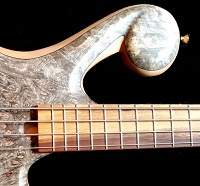
just wanted to add another couple of picts. The headstock on my bass is reversed, w/ a light amber coating (makes it looks aged), a Hipshot Drop D on the E tuner. I personally like the look of the reversed headstock, its quite functional as well, my E string is rock solid.
second is the RMC piezo/Dingwall Bridge. Sheldon did an amazing job of cutting his high mass bridge installing those gold piezo elements and wiring the bass. Whats cool is the E string mount literally hangs off the end of the bass.
Nomore bass updates i took yesterday off
cheers
frank
 
add pictures....... DOH
 

Attachments

  • Superj_rev_hdstk.jpg
    Superj_rev_hdstk.jpg
    45.8 KB · Views: 135
  • SuperJ_piezo-1.jpg
    SuperJ_piezo-1.jpg
    40.5 KB · Views: 166
I know this may sound kind of odd, or well, maybe not so much around here...

I had a dream last night, that I met you (or of course a likeness of you) and was playing the bass. Of course it was just amazing, and I was wailing (naturally, I mean, it's a dream). It even had a hidden lever in back that dropped the frets and became a fretless (this is where it got weird). I'm sure theres more that I'm forgetting, but well, thanks for the virtual woodshedding on your bass! :)

Wow, that's some serious GAS there, when it invades your dreams quite vividly.

Troll
 
Wow Frank!!

I had forgotten all about this project...has it really been two years ago since I shipped the preamp to Sheldon??

Man that came out nice bro!!

Congrats!!