
Enjoy the benefits of a premium membership!
Upgrade Account
-
TalkBass has been independent since 1998. Add your voice.
Create a free account to reply to discussions, view embedded media, and browse with fewer display ads.
Join free Log in
Want zero display ads or expanded classifieds tools? Compare plans.
You are using an out of date browser. It may not display this or other websites correctly.
You should upgrade or use an alternative browser.
You should upgrade or use an alternative browser.
DINGWALL?
- Thread starter hopfreek
- Start date
More options
Who Replied?
Roy Vogt
Supporting Member
- Sep 20, 2000
- 4,433
- 537
- Disclosures
- Endorsing Artist: Kiesel Basses, Ampeg Amplification, Hotone Ampero II effects
Pretty easy to play on one, the slanted frets are very ergonomic. I had a bit of a tussle doing chords on one of the 6 strings in the upper register. Sheldon is a quality builder and a great guy!

I've played them & the fanned frets don't take much to get used to. What threw me off was the wide fretboard & flat-backed neck. This was a Combustion. If it had a more standard neck profile & string spacing, I'd probably own one.
I have a early AB-1 , it has a Maple body and it is feather weight , under 8 lbs . And sounds and plays like a dream . Killer basses . I bought it not having ever played one either but based on all the sound samples , they sound like a bass should IMO and I was not disappointed . 

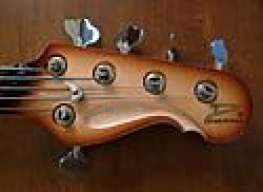
My 'home' basses are the shorter scaled "Super" series four and five strings. Home in the sense that I feel most at home on them. They feel very comfortable and natural to play. One of Sheldon's obsessions is balance, so you won't have any problems with any of his basses wanting to neck-dive on you. I've never experience a 'dead' on a Dingwall, always a big plus in my book. Being multi-scaled causes all of the strings to have similar tension and feel. If Leo would have built them like Sheldon does, they would have been the standard instead of the exception.
EA & Dingwall, C L pairing fretno!
I got to play a Dingwall a few years back in a shop (on vacation, none available locally) and I found while it was definitely different, I thought it would be something I could get used to very quickly. Mind, I've not been playing long and am not set in any ways. I plan on getting a Dingwall, eventually.
L pairing fretno!I got to play a Dingwall a few years back in a shop (on vacation, none available locally) and I found while it was definitely different, I thought it would be something I could get used to very quickly. Mind, I've not been playing long and am not set in any ways. I plan on getting a Dingwall, eventually.
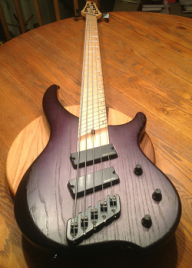
Love my ABZ5!
1st fret on B & E does take a little getting used to (37" B-string) and the upper frets are a little different -- nothing major.
Sustain on open E-string and B-string plants a smile on the face.
Even string tension across the board is very nice.
Ya gotta try one out!
1st fret on B & E does take a little getting used to (37" B-string) and the upper frets are a little different -- nothing major.
Sustain on open E-string and B-string plants a smile on the face.
Even string tension across the board is very nice.
Ya gotta try one out!
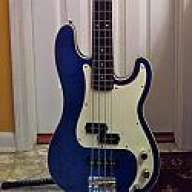
I just got a 2002 AB-1, in early July.
OMG...what a player.
My Spector Forte 4 has taken a back seat & will be sold to help fund a Super PJ.

OMG...what a player.
My Spector Forte 4 has taken a back seat & will be sold to help fund a Super PJ.

The fanned frets are pretty easy to get used to. I didn't have to think too much about them or change my technique at all. Just be a little careful playing octaves down in the first position.
To me, the biggest adjustment is your plucking hand. In my current main band, I play with a pick almost exclusively. The edge of my palm frequently rests on the bridge. But that can lead to problems when the bridge is angled. On the B or E strings I might be fine, but if I'm playing on the D or G strings I might be very close to the bridge and getting a very thin sound.
Basically, if your plucking hand doesn't move towards the neck or bridge at all while you play, then as you progress from the lowest strings to the highest pitched strings, you are automatically going to be playing closer to the bridge and getting a different sound. Whether this will actually affect your sound probably depends on a lot of things.
I don't currently play a Dingwall, but I've owned a Combustion before and currently have a custom fanned-fret bass.
To me, the biggest adjustment is your plucking hand. In my current main band, I play with a pick almost exclusively. The edge of my palm frequently rests on the bridge. But that can lead to problems when the bridge is angled. On the B or E strings I might be fine, but if I'm playing on the D or G strings I might be very close to the bridge and getting a very thin sound.
Basically, if your plucking hand doesn't move towards the neck or bridge at all while you play, then as you progress from the lowest strings to the highest pitched strings, you are automatically going to be playing closer to the bridge and getting a different sound. Whether this will actually affect your sound probably depends on a lot of things.
I don't currently play a Dingwall, but I've owned a Combustion before and currently have a custom fanned-fret bass.

Here's my opinion. FOR ME, there is Dingwall, and then there is everything else.
I bought one. Love it so much that I have second one on the build table as we speak.
Run through the Dingwall threads here. Most of us are more rabid than the Fender P guys.

I bought one. Love it so much that I have second one on the build table as we speak.
Run through the Dingwall threads here. Most of us are more rabid than the Fender P guys.
I played my first one a few weeks ago. The GC in Atlanta just got a super J in used and I tried it out and it felt incredible! My first fanned-fret experience and it didn't take any noticeable adjusting, very natural. And the sound was out of this world!
Here's my opinion. FOR ME, there is Dingwall, and then there is everything else.
Hey, if you're going to quote me, at least give me credit.

IME and IMHO, Zoomie speaks the truth - My Dingwalls are as close to perfection for me as is possible on the earthly plane.
I played my first one a few weeks ago. The GC in Atlanta just got a super J in used and I tried it out and it felt incredible! My first fanned-fret experience and it didn't take any noticeable adjusting, very natural. And the sound was out of this world!
Someone sold a Super J to GC in Atlanta? I think I just threw up in my mouth a little. Someone has got to rescue that thing before one more kid plays Smoke On The Water.
Hey, if you're going to quote me, at least give me credit.
IME and IMHO, Zoomie speaks the truth - My Dingwalls are as close to perfection for me as is possible on the earthly plane.
Don't be a thread thug !


To me, the biggest adjustment is your plucking hand. In my current main band, I play with a pick almost exclusively. The edge of my palm frequently rests on the bridge. But that can lead to problems when the bridge is angled. On the B or E strings I might be fine, but if I'm playing on the D or G strings I might be very close to the bridge and getting a very thin sound.
Basically, if your plucking hand doesn't move towards the neck or bridge at all while you play, then as you progress from the lowest strings to the highest pitched
I wonder how much of this sentiment would transfer to a grand piano. Where the hammers strike essentially Xmm from the edge of the string. What if the "optimal" number of mm utilized for each note/string, how different would and modern piano react tonally?


