• TalkBass has been independent since 1998. Add your voice.
    Create a free account to reply to discussions, view embedded media, and browse with fewer display ads.
    Join freeLog in
    Want zero display ads or expanded classifieds tools? Compare plans.

DIY 115 high power cab build

Hello!
I am planning to build a 115 cab that can handle relatively high power loads to use with my Hartke LH1000 in bridge mode at 8ohm.
I am going for mellow tone, I play 4 str p-bass, only use flats (chromes).

The driver I chose to build the cab around is the Faital 15HP1020. Here is the datasheet

Current revision of the design is a box with basic specs:
Board thickness: 15 mm (just shy of 5/8")
Total (exterior) enclosure volume: 171 lt (6 cft)
Usable volume (without wall/port/speaker/bracing volumes): 100 lt (3.54 cft)
Fb=42.21 Hz
F3=71.35 Hz
dB@40Hz=-5 dB

Response shown below (I believe this mid bump will compliment the LH1000 which has a built in "smile" with tone controls at noon):
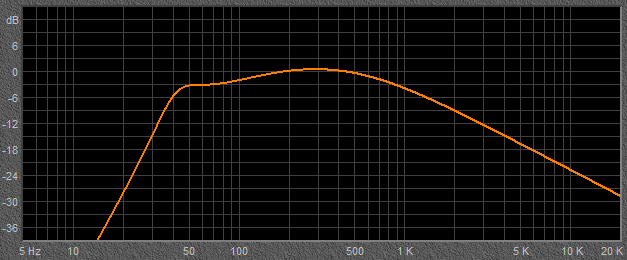
upload_2022-4-17_10-34-8.png


Excursion and port velocity at 700 watt seems to be well handled, also I don't think I will ever need this much power anyway.
Group delay shows a peak at 40 Hz of 16 ms, by 100 hz it drops below 2 ms.

As far as numbers go, I think I am happy but I lack experience so I don't know if this is going to be any good, or I will just end up with a useless and expensive driver.
Maybe the cab is unnecessarily big?
Maybe I shouldn't be so obsessed to have the fundamental 41 hz so present?
How is the high frequency response?
Is a hf+crossover obviously necessary?

I would appreciate some input from more experienced people!
Thanks!
 
Last edited:
I'd lower the volume a little bit (about 1/3) and as well tune a little bit higher which in total should provide a more smooth thus "musical" roll off shape.
The -3dB "sag" in the bandwidth ~50..150Hz should then also be gone.

Furthermore the "highish" group delay should then be flattened.

The design "as is" may work well to your taste in combination with amplifiers which provide a strong negative global feedback loop.
I assume the amplifier in quastion does provide a strong feedback control.

The design as is may be "critical" with vintage amplifiers such as a Bassman cause the design "asks" for a rather strong control by the amplifier.

Without sufficiant "control" by the amplifier the design may tend to "longish" transient response characteristics.
IME those artefacts (if present) are almost always responsible for rather "muddy" respectively "loosen" sound reinforcement at the lowish side of the frequency spectrum/bandwidth.
In combination with other cabs (the mixing thing) the artefact is often mismatched with "phase issues".
The design as is was unlikely suited to play "well" in a mixed rig of cabs.
 
Last edited:
Thanks @ThisBass for your suggestions! I will try them and see what happens.
I am not sure I understand your points about negative global feedback loop (or what exactly is this, in practical terms). How do you know if a design asks for a strong control? I suppose it is the group delay? Here is the plot to provide maybe a better understanding:
upload_2022-4-18_7-31-10.png


Thanks again for your time!
 
Thanks @ThisBass for your suggestions! I will try them and see what happens.
I am not sure I understand your points about negative global feedback loop (or what exactly is this, in practical terms). How do you know if a design asks for a strong control? I suppose it is the group delay? Here is the plot to provide maybe a better understanding:
View attachment 4662274

Thanks again for your time!


This can be already obtained by the (Roll Off)shape of the frequency response you posted above.
Yours is likely a little bit at the underdamped side of damping.

The group delay response is another "indicator" which is a little bit on the "highish" side of "delay"
The delay tells something about the time how long the driver may take (without any control by the amplifier) to "settle in" and also to "settle down around the bandwidth of f3
 
How is the high frequency response?
Is a hf+crossover obviously necessary?

For starters, your graph tells you very little about actual high frequency response. I'd suggest using a program that at least grafts in the manufacturer's response curve data (BoxSim is one free possibility), although of course measuring for yourself in the box in question or a mockup would be better yet. Six cu ft. is huge, personally I'd be shooting for two drivers at that point.
 
Last edited:
Hello! First of all, thanks everyone for your time!
I proceeded with lowering Vb to 70lt (2.472cft) and tuned to 48Hz.
This leaves me with a box with total exterior volume 127lt (4.5cft) which includes port, driver, bracing, wall volumes.
Frequency responce and delay response below. Vent air velocity and cone displacement are well handled at 700watt.
upload_2022-4-19_8-30-5.png


upload_2022-4-19_8-30-34.png


So it seems that delay is better now, the frequency responce from 50-100Hz is smoother.
But I dont know if the E string will be strong now because it sits around -9db (it was -5db before).

@Passinwind I could not find data for the high end frequency response, I tried to manually enter it by hand but it was too tedious and left it. I assumed that I could get a taste from FaitalPro frequency chart, I thought higher frequencies don't get affected too much by enclosure. Is this wrong assumption? Below the graph from the datasheet:
upload_2022-4-19_8-36-58.png


I really appreciate your help people! Thanks!
 
Last edited:
@Passinwind I could not find data for the high end frequency response, I tried to manually enter it by hand but it was too tedious and left it. I assumed that I could get a taste from FaitalPro frequency chart, I thought higher frequencies don't get affected too much by enclosure. Is this wrong assumption? Below the graph from the datasheet:
View attachment 4663290

I really appreciate your help people! Thanks!

Hand tracing is defintely tedious. Measuring for yourself, often even more so. ;)

The manufacturer's graph still provides plenty of useful information. I would probably tend to want to add a high frequency driver of some sort, but I usually seem roll that way in general.
 
Thank you! How is the frequency response and group delay at the low range now that the box is smaller?
I suppose -9db at E fundamental is something common in commercial cabs? Or else I don't see how they could manage to get away with such small encolures!
 
Thank you! How is the frequency response and group delay at the low range now that the box is smaller?
I suppose -9db at E fundamental is something common in commercial cabs? Or else I don't see how they could manage to get away with such small encolures!
It looks noticeable better for 70L vers 100L.
If I was in your shoes I'd "cutt off" another 10L of net volume which then brings you dwon to 60L.
Fb 50..55Hz might then be a good choice for tuning of the cab.

As you intend to build a "high power" cab its a good idea (anyway) to protect the driver with a HPF from over excursion at the unloaded side of frequency range <Fb
 
  • Like
Reactions: BasturdBlaster
It looks noticeable better for 70L vers 100L.
If I was in your shoes I'd "cutt off" another 10L of net volume which then brings you dwon to 60L.
Fb 50..55Hz might then be a good choice for tuning of the cab.

As you intend to build a "high power" cab its a good idea (anyway) to protect the driver with a HPF from over excursion at the unloaded side of frequency range <Fb

Another 10L? You're killing me @ThisBass :D
I suppose it is not worth it to try to keep low freqs as close to flat as possible?

As for the HPF, I will definately use one, I imagine you mean placing one before the power amp right? As far as I know building a 700ish watt HPF is not feasible due to size of the components?
In fact I was already researching TalkBass for various HPF designs, trying to chose one so that I can include it in the modeling calculations as well. I am torn between popular 12db/oct and steeper designs 36 or even 48db/oct.
 
Another question:
Do I have to worry about phase response? For example, I see in the graph that 40Hz has more than 90deg phase difference with its 1st overtone at 80Hz. Would this be a problem?
View attachment 4665522
I assume including filters will only make things worse.
This is one of the factors that we look at when designing cabinets that must play well together... all cabinets in the line must share reasonably similar phase characteristics.

If you are using this as a stand alone cabinet, then it's of no particular worry.
 
  • Like
Reactions: irakliszs
Another 10L? You're killing me @ThisBass :D
I suppose it is not worth it to try to keep low freqs as close to flat as possible?
Not really but, its not so bad at all to have at some point kinda more "musical" roll off shape with cabs that are meant to be used as instrumental bass guitar cab

As for the HPF, I will definately use one, I imagine you mean placing one before the power amp right? As far as I know building a 700ish watt HPF is not feasible due to size of the components?
In fact I was already researching TalkBass for various HPF designs, trying to chose one so that I can include it in the modeling calculations as well. I am torn between popular 12db/oct and steeper designs 36 or even 48db/oct.

If your amp in question does not already consists of a build in HPF then its a good idea to protect the loudspeaker with tools such as a "sfx Thumpinator" or a "Vong":
 
  • Like
Reactions: irakliszs
Hello again!
I ended up lowering a bit more Vb to 60 lt (2.12cft) and tuned to 40Hz.
Now it looks like this:
upload_2022-5-5_8-14-44.png


However, I discovered that I can include in graphs "Vent resonance peaks", "On-axis piston band response" and "Diffraction response shelf". I am not sure what these are, I only found some information for the vent resonance peaks. With these options turned on, I get a response curve:
upload_2022-5-5_8-17-48.png


Why does it change so much? I see that something happens due to port resonance at about 680Hz, is it bad?

Also I am having trouble with port air velocities and the port volume, I decided to go for 10% of the sound speed (about 34m/s) instead of 5% (17m/s) for my limit at full power, is this a good idea?

Thanks!
 
Last edited: