• TalkBass has been independent since 1998. Add your voice.
    Create a free account to reply to discussions, view embedded media, and browse with fewer display ads.
    Join freeLog in
    Want zero display ads or expanded classifieds tools? Compare plans.

DIY Carbon Fiber reinforcement?

BishopJP

Supporting Member
Apr 5, 2019
1,293
4,718
North Carolina
I know that carbon reinforcement has been discussed before, I am not trying to re-hash all previous discussions, but I had an idea and I am curious if I am way off base or not.

I know a guy who happens to own a carbon fiber manufacturing company and he gave me a big roll of carbon fiber cloth and it got me thinking. It is a weave; I think uni-directional fiber would be better, but maybe this would still work?

So here is my concept; if I route slots in the neck on either side of the truss rod, instead of using a solid 1/8" x 3/8" CF rod, I could wrap CF cloth around a strip of wood and epoxy it into the neck. This would make 4 layers of cloth (2 per side/slot) held rigid by epoxy.

I have heard it discussed, using CF cloth in between layers of a multi-lam neck; I feel this would have a similar effect but keep the cloth hidden inside the neck.

Below is a quick sketch, hopefully illustrating what I am talking about.
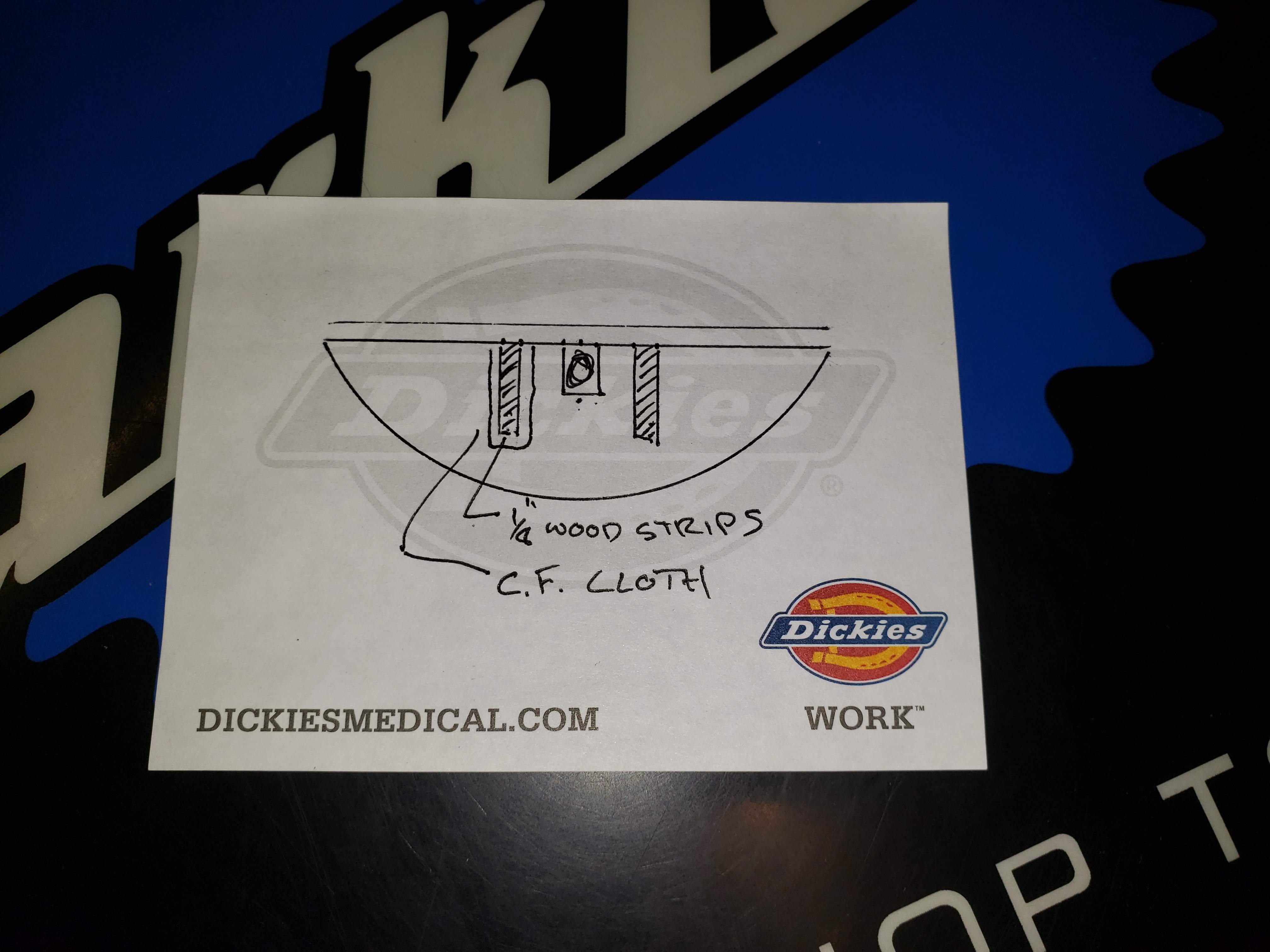
20201228_174417.jpg

bass neck cross section

I am curious whether this would work or have enough effect to make it worth the effort, if anybody has any thoughts on the matter.

Thanks in advance for any input!
 
  • Like
Reactions: Levent and Beej
If you are lucky, @Bruce Johnson will weigh in re-posting his “back strap” method with carbon fiber TOW strands along the back. I’m sceptical just cloth would make much difference, The bars are a direct mechanical resistance to bending, the strands along the back would resist stretching tension, but cloth along the top would be in compression, like “pushing a rope”. I may be dead wrong about this, but it makes sense intuitively.
 
Without re-hashing, you could get a good deal of info by reading this thread.

TLDR, you can use your cloth, though half the fiber in it is wasted, but your application approach is less than ideal (because you are trying to mimic pultruded rectangles) - you pretty much want to mash it all down as close to the back of the neck as possible along with epoxy (fill the top of the slot with wood.)

The non-ideal approach will WORK, it's just not the ideal placement of the fiber reinforcement, so you get less out of it than you otherwise could.

Other then adding a bit to the mess, you could probably comb out the useless short crossways chunks and just keep the long ones (which is the carbon tow that we buy, not woven into cloth for this purpose. if you get cloth scraps for free, might be worth it.)
 
Last edited:
@Gilmourisgod I have read what Bruce Johnson has posted about his method and I would try that, someday. It just happens that I have the CF cloth already.

Definitely agree with the the top bit of the fabric being under compression; as you said "pushing a rope". My thought was the cloth would be deep enough in the neck as to be partially under compression and partially under tension. Kinda like a tubular structural beam?
 
  • Like
Reactions: Beej and chinjazz
Hello Bishop JP;

If you've got some carbon fiber cloth, then you have a lifetime supply of carbon fiber TOW. The cloth is just TOW that has been woven into a cross hatch pattern. It's very easy to pull a bundle of TOW off of any straight edge of the cloth, whenever you need one. Having a piece of cloth makes it easy to roll it up and store it.

There's nothing wrong with your idea. You can cut a long narrow strip of the cloth and push it down into a slot with epoxy, surrounding a strip of wood. That'll certainly work as a reinforcement to add stiffness to a neck. But the one or two long strands down in the bottom of the slot will be doing all the work, taking the tension load and keeping the neck from bending. The long strands along the sides of the strips and the short strands going vertically won't be taking much load, or doing much of anything.

It would be easier to just pull a couple of TOW bundles off of the edge of the cloth. Lay them down in the bottom of the slots in a bed of epoxy, and set the wood strip down on top of them. That's all you really need to do the job.

The beautiful thing about carbon fiber isn't just that it's so strong, but that it has almost no stretch. If you grab one of those TOW bundles tightly at both ends and pull with hundreds of pounds, the stretch is barely measureable. When you set a TOW bundle of tiny carbon fibers into a bed of epoxy in a slot it creates a tension strap that will not stretch. Set that into the very back of a bass neck and it dramatically increases the necks' stiffness in bending.
 
Can you post a photo of what you have? Or a specific spec, if you know it? There are about a billion types of carbon fiber cloth, some may be more appropriate than others for your idea - and once we know exactly what you have, we can suggest something that'll be effective and easy to do (I mention "easy" because many carbon cloths will be fussy and difficult to wrap around something as small as you're describing).
 
Thanks everyone, for your input!
Also thanks to @Bruce Johnson and @T_Bone_TL for suggesting un-weaving the cloth; that honestly never occurred to me!

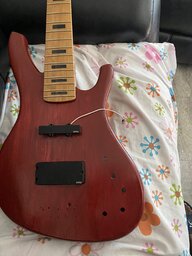
For reference, here is a pic of the cloth. I did pull out some strands and it was actually quite easy. The piece of cloth is approx 24" wide and longer so it should be long enough for a bass neck.

20201229_100453.jpg

My take-away from this discussion is that I should use CF to resist tension at the back off the neck, rather than compression at the top of the neck.
 
Your takeaway is 100% correct and a perfect way to simplify this.

That looks like plain weave fabric made from fairly light tow - probably 1k or 3k tow - which would translate to approximately 3.5 ounce or 6 ounce fabrics, if you were told the weight. Those are lighter than what most people probably use in a bass neck, so you may want several strips. You can stagger the lengths to get a gradual reduction in stiffness further out the neck if you want - like, two strips at 6" long, two at 12", and one at 18".

It's also not unreasonable to go with your original plan, using that fabric. The "penalty" versus pulling the tows out is probably a fraction of an ounce of weight, and obviously a slightly different process. A U shaped cross section of that fabric would be very stiff (the short lengths of cross weave that end up "vertical" are not wasted, contrary to popular myth - a beam needs good compression strength vertically to resist bending).

One final thought - don't overdo it. A plain hardwood neck made from typical hardwoods with a typical fretboard is already "stiff enough" to be functional and playable - adding stiffness can be really good, of course, for all kinds of reasons, but it's possible to make a neck too stiff, to the point where the truss rod is not effective. If you're on the fence, IME, it's better to go with less reinforcement rather than more. Then you can add more in on a future design.
 
Spector uses carbon fiber rectangular rods in their neck.
Here is an interview with Stuart in a factory tour. At 4 min. in, he shows the Carbon Rods they use.


With all due respect to Stuart, the practice of inlaying pultruded bars directly under the fretboard is more rooted in ease of process and tradition than any sense of actually being an ideal design. That's about the least effective design in terms of taking advantage of the properties of carbon fiber in a bass neck. On the one hand it certainly works! But it's not optimal.

A neck is basically a beam, being bent forwards by string tension. That puts the fretboard side under compression and the back under tension. (and as a secondary factor, there is some compression vertically between the two). Wood is fairly good under compression (especially species used for fretboards, like rosewood and ebony) and poor under tension (it stretches like rubber). Compounding things is the fact that the fretboard side of the "beam" is much wider and more square in profile - an ideal shape! And - the back of the beam is rounded and narrow - the worst possible shape! A bass neck is a really poorly designed beam!

What you want to do to make it better is put a material that's good under tension as deep in the neck - as close to the back - as possible. Carbon is great under tension. Putting it under the truss rod, or otherwise deep in the neck, really helps. Putting a pultruded bar right under the fretboard is basically adding un-needed reinforcement to an already overly-strong portion of the neck. It's making the lopsided design even more lopsided. It basically works through brute force.

Those spector necks getting four pultruded bars right under the fretboard could probably be re-designed to use a tenth of the carbon, placed strategically down under the truss rod, and they would end up stiffer, more stable, and lighter. A factory isn't going to do that, because it's easier to route a channel in the top of the neck and slap in a bar. Someone taking their time and building a neck at home for fun has the latitude to decide on a process that's not driven by factory repeatability and cost control, though, if they want to.
 
Also - I hope you said thank you to your friend! If that's 1k fabric and he gave you a big roll, that was quite the gift - stuff is north of $100 a yard! fabrics made from 3k are "only" $40 - $50 a yard, still a nice gift!

I most certainly thanked him profusely! Also, since he is a cyclist and I own a bike shop, there is a some back-and-forth there. ;)
 
I've used a LOT of carbon fiber across the spectrum of builds for over 20 years.

Carbon fiber beams for neck inserts cost $7 from Dragonplate. They manufacture and sell them for most of the well known suppliers who then double or triple (or more) the prices to resell them to average folks. You will spend more $$$ on the glue / epoxy to make them from your cloth roll than on a professional grade finished product.

As much as I encourage innovation and creativity, in this case I think you are better off spending the $7 and moving on. The carbon fiber cloth can be put to better use in a different area.
 
Last edited:
Ok..any time I see someone spouting the benefits of the strength of carbon fiber construction I need you to know this. Carbon fiber cloth is porous..there are air spaces between the fibers...you can pack as muck epoxy as you want in and around the fiber, but unless you vacuum bag the assembly at the proper temperature, vacuum, and time, you are wasting your time. Vacuuming the assembly draws the epoxy into the weave while eliminating air cavities, squeezing the fibers tightly..basically putting them in tension. That's how a CF rod has such great strength. CF cloth and resin without the vacuum is basically fiberglass.
 
I'm not sure I agree with that. Tow is easy to get fully wet out by hand, and when it's clamped into a neck with a hardwood caul (as is the typical "Bruce Johnson Method") there's more than enough pressure to keep things wet, and eliminate problems bagging would normally solve. The result is pretty different than fiberglass. I have a bagging setup but I don't bother to use it for neck reinforcements since doing so doesn't really make any sense.
 
Most of the professionals & commercial users that regularly give advice here DO have an excellent vacuum + bag system as part of their daily use in the shop!

If you look at the actual engineering specs, long strand carbon fiber is different than long strand glass fibers; the same with kevlar and the other common use materials, much the same way that aluminum is different than steel or titanium as a base material. How you configure and use it gets into different details- e.g: a unidirectional carbon fiber sheet will have a very different end result than a woven material processed into a cylinder.

None of this is complicated or difficult. Anyone who took a basic engineering 101 class or fabrication shop understands that their is a TON of published data and specification charts that show the uses for and against all of the materials and the tested results, including the important ones for our use in necks like Young's modulus for bending strength and tested failure points. Almost every supplier and manufacturer in existence shares this data in the same manner that bass builders include the body weight and scale length....
 
  • Like
Reactions: Beej and Joshua
I know that carbon reinforcement has been discussed before, I am not trying to re-hash all previous discussions, but I had an idea and I am curious if I am way off base or not.

I know a guy who happens to own a carbon fiber manufacturing company and he gave me a big roll of carbon fiber cloth and it got me thinking. It is a weave; I think uni-directional fiber would be better, but maybe this would still work?

So here is my concept; if I route slots in the neck on either side of the truss rod, instead of using a solid 1/8" x 3/8" CF rod, I could wrap CF cloth around a strip of wood and epoxy it into the neck. This would make 4 layers of cloth (2 per side/slot) held rigid by epoxy.

I have heard it discussed, using CF cloth in between layers of a multi-lam neck; I feel this would have a similar effect but keep the cloth hidden inside the neck.

Below is a quick sketch, hopefully illustrating what I am talking about.

View attachment 4106143
bass neck cross section

I am curious whether this would work or have enough effect to make it worth the effort, if anybody has any thoughts on the matter.

Thanks in advance for any input!
That's not how they make carbon fiber rods. Titanium is better and won't break. You can order them from KTS but you can get them from a metal stock supplier in the USA cheaper. Titanium sounds better. MTD uses it on thier American customs. These rods a inexpensive and safer to work with than carbon fiber.