• TalkBass has been independent since 1998. Add your voice.
    Create a free account to reply to discussions, view embedded media, and browse with fewer display ads.
    Join freeLog in
    Want zero display ads or expanded classifieds tools? Compare plans.

DIY Conductive Shielding Paint recipe

never had an adhesion problem with the sm stuff- just shellac to seal coat first then in with the paint. two coats an hour apart. i go with copper foil on any covers or pg's and paint in the cavities and wire tracks.

but having said that, the shellac homebrew stuff seems very do-able. besides we cut a bunch of high purity graphite at the day job and generate a whole lot of fine powder i could use.
 
That's the same SuperShield that I've been using for a long time, except I've only used it in the spray cans. That's the first I've seen the SuperShield Nickel available in liquid form in that 150ml can (which is about 5 fl oz.). I've previously only seen it sold in the tiny 20ml jars and full gallons. I may get a can of that myself, rather than order another spray can. $33 for 5 fl oz is a reasonable price.

This is the other one I've been looking at, a water-base copper shielding paint sold by Caswell. It sounds real good, but it's actually more expensive than the SuperShield Nickel, $44 for 4 oz.

https://www.amazon.com/gp/product/B00A6FO6G8/ref=ox_sc_sfl_title_9?ie=UTF8&psc=1&smid=A2YTLWSIIIEHLL

I'm thinking of dedicating a small cheap airbrush just for spraying the shielding paint. Something that I can easily close up the bottle after each use, with minimal paint loss. And these metal-flake paints do need a large nozzle.
 
As an Amazon Associate, TalkBass may receive commissions from qualifying purchases made via links on this site.
Well it arrived today I plan on using it tomorrow. The bill is shown just to show the size of the little can.
IMG_4557.jpg
 
As an Amazon Associate, TalkBass may receive commissions from qualifying purchases made via links on this site.
I wonder what I can thin it with? Acetone?

Does it say on the can what they recommend?

Edit: I just read through their technical data sheets. It's an acrylic-base paint. They sell their own brand thinners to be used with their acrylic shielding paints. The nastier thinner is basically acetone and the milder thinner is basically iso alcohol. There's your answer; acetone or alcohol. I'd use alcohol.
 
Last edited:
Cool little spray gun. Let me know how it works. I got some of the little brushes to try it with today. I read some of the amazon reviews on the paint and they talked about how heavy the fumes were so I was guessing acetone. My alcohol is only 70% so not sure that would be a god idea?
 
I detail the use of water-based Super Shield paint in post#80 here:

Building A Short Scale P Bass

Expensive, but a joy to use using disposable acid brushes for two coats and doing the drilled channels between cavities with a Q Tip. I can't phantom spraying this stuff! No thinning necessary, and the small bottole would probably do 2 basses, so it's a pretty good deal to shield a bass without cutting conductive backed copper foil, which I've used a LOT of!
 
Here's an update, from another thread:


I've also been using SuperShield Nickel for years for most of my shielding in the basses I build. I had been buying the spray cans ($38 ea!), which are very convenient. But I'd had trouble with the cans' valves getting jammed, and the cans would lose pressure long before the paint was used up. Wasting expensive paint.

So recently, I bought a can of the liquid SuperShield Nickel, and worked out how to spray it through a spray gun, powered by a compressor. I dedicated an old cheap HVLP Touch-up size gun to use only for the SuperShield. It works pretty well.

A couple of things:

The SuperShield paint is heavily loaded with particles of nickel, and they only stay in suspension for a short time. You must stir the paint thoroughly right before use, and you can't let it sit in the gun for very long.

I store the paint in the can. When I'm ready to spray, I stir the contents of the whole can, and immediately use a small ladle to scoop about two tablespoons into the spray gun's cup. Spray right away, then immediately pour the excess back into the can. Put some Denatured Alcohol in the gun, spray it for 5 seconds to clean it, and put the gun in the rack.

This minimizes waste of the expensive paint. The can is 150ml and cost $53 on Amazon. My guess is that I'll be able to shield 75-100 instruments from that can. That's not too bad. The spray cans are $38 each, and I was getting 8-10 instruments per can.

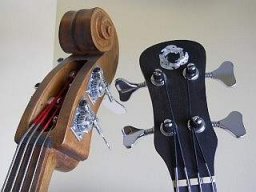
For my production model Scroll Basses, I use a plywood masking template that plugs into reference holes in the body. For specials and one-offs, I use regular masking tape and paper. I normally spray two coats about ten minutes apart. The SuperShield is fully dry in an hour.


g00154-jpg.jpg


g00155-jpg.jpg
 
  • Like
Reactions: budaz and Beej
I should add:

I bought a cheap Badger hobby-style siphon-feed spray gun, thinking I could use it for spraying the SuperShield. Nope, it didn't work at all. Even with thinning, I couldn't get the SuperShield to spray through it. Airbrush size nozzles are too small, and the siphon-feed wouldn't lift the heavy liquid.

However, I had no big problems spraying the SuperShield through a small cheap gravity-feed HVLP touchup gun. The gun cost about $20. I ran it at fairly low pressure, about 20 psi, with the fan air shut off and the needle opened fairly wide. Take out the internal filter! No thinning of the SuperShield, straight out of the can. I've set that one particular gun aside to use only for SuperShield.

I think this is a good, cost and labor efficient, way to apply shielding. If you are going to do multiple instruments over time. In labor, it's only a few minutes per instrument. We'll see how long this can lasts, but I'm guessing that the paint cost will be around $1 per instrument.