• TalkBass has been independent since 1998. Add your voice.
    Create a free account to reply to discussions, view embedded media, and browse with fewer display ads.
    Join freeLog in
    Want zero display ads or expanded classifieds tools? Compare plans.

DIY Lightweight Composite Cab Build

JohnForbesCFversion01.jpg

I nominate this for the "Sexiest cab ever shown on TB" award.
 
Zac, I was inspired by your design, and by some musician friends who are also into boats and therefore were very keen to see me build a composite cab.

I started work today on a composite 1x12 which will be an exact replica of the cab I just built out of wood. Should make for some pretty interesting A/B comparisons :)

The wood cab has a Delatlite11 2512 speaker in it and came in at 12.45kg (27.44lb). Hardly heavy, in fact it feels so darn light already I'm wondering if reducing weight should even be worth the effort. But darn it, I'm planning to have some fun building the composite cab :)

I also had one of those friends build a replica of a previous 1x12 design from Carbon Fibre (see pic). This speaker has a Beyma 112ndW in it so it was never going to be a flyweight cab, not with that driver in it. But his CF cab weighs 3kg (6.6lbs) less than my wooden one, 12kg Vs 15kg (26.5lbs Vs 33.1lbs).... and it looks much sexier don't ya think? This cab was made for an Olympic sailor by the people who made his medal winning boats, so as you can imagine the materials used and the build technique were very different to your cabs Zac. This one has divinycell foam, a mould, vacuum bagging, the works. If I had access to world class composites experts who'd do it for free, I would have went all out as well :)
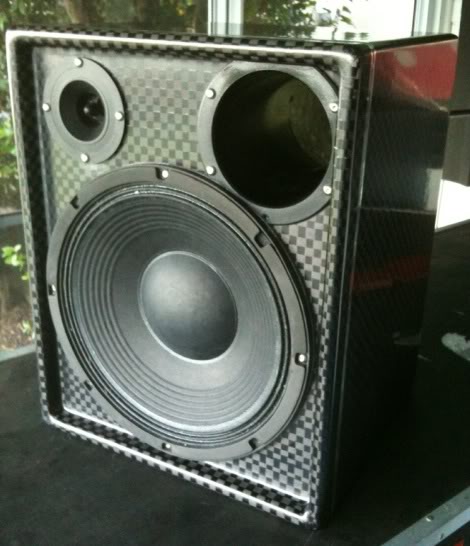
JohnForbesCFversion01.jpg
2x12 one of those please.
Would go nicely with my Ovation magnum (carbon fiber and mahogany neck).
 
I started work today on a composite 1x12 which will be an exact replica of the cab I just built out of wood. Should make for some pretty interesting A/B comparisons :)

If the science and math within this thread has left any doubt about the strength and stiffness of these panels, here's something that will put it beyond doubt!

Check this out:-

13strengthtest01.jpg


No trick photography! That's me standing what is going to be the back panel of my composite cab. It's 25mm (1 inch) XPS foam glassed on both sides with 2 layers of 12oz fiberglass and the same resin Zac used.

I weigh 82kg (181 lbs) and not only did that panel support my entire weight, it only bent 1mm with my full weight on it. Further more, this panel has exposed edges for now, so it's not as strong as it will be when the edges are bonded to the adjacent panels.

I repeated the experiment with 12mm plywood and it bent 3mm.

Does anyone still have any doubts about the strength and stiffness of these non-wooden panels? I don't see how you can after this photo. I sure don't!
 
  • Like
Reactions: Das Jugghead
Nice pic Pete!

I spent a lot of time testing different core thickness to glass ratios to get the stiffness right. I have no doubt about the capability of this material, but when you consider how light it is i see why there are doubts. Can you campare the weight of that panel to a plywood equivilant? I don't have my numbers handy but I know that exercise is very impressive.
 
. Can you campare the weight of that panel to a plywood equivilant?

I don't have anything detailed just yet, but my preliminary math shows significant weight savings.

I know the "wood only" weight of the completed cab was 7.1kg (15.65 lbs) using reasonably thin 12mm (1/2 inch) plywood . The panel I'm standing on in the pic above weighs 650 grams (1.43 lbs). So I estimate 6 of those will weigh roughly 3.9kg (8.6 lbs).

So my current guess is the completed composite cab will be roughly 3kg (6.6 lbs) lighter than the wooden cab. 7.1kg down to 3.9kg means these 25mm (1 inch) composite panels are in the vicinity of 45% lighter than 12mm (1/2 inch) ply. In other words, these panels weigh about the same as 6mm ply, which we all know would be way to flimsy to build a cab. For reference most commercial manufacturers use 15mm ply.

I'll firm these numbers up as the build progresses. I'll also start my own thread at some point so as to not hijack yours Zac.
 
To be fair, Pete, if you built a 1/2" plywood cab you'd probably do some bracing to make up for the flimsiness. Greenboy's fEarful's are spec'd to 1/2" plywood, I believe. I'm not arguing with most of your work, though. The composite is lighter and stronger, which is why I'm subscribed to the two threads.

KO
 
To be fair, Pete, if you built a 1/2" plywood cab you'd probably do some bracing to make up for the flimsiness. Greenboy's fEarful's are spec'd to 1/2" plywood, I believe. I'm not arguing with most of your work, though. The composite is lighter and stronger, which is why I'm subscribed to the two threads.

KO
I already built the 1/2" plywood version of this cab. The bracing required was minimal, merely a crucifix at the weakest point of the baffle, and therefore added virtually no weight. The front baffle needed bracing most as it was weakened by having so much timber cut out of it by way of holes for the speaker etc. The other panels seemed OK. It depends on the span, which on a cab this size was short enough for 1/2" ply to maintain it's strength. A bigger cab with longer spans might need more bracing though....

Zac didn't brace this composite cab at all. I believe he intended to initially, but as the cab came together decided it didn't need it.
 
Was a price ever discussed for these cabs?

Price to buy or cost to build DIY? I did post cost to build details way back in this thread, but no sale price. I would love to build and sell these but until I figure out a way to reduce manufacturing cost that ain't gonna happen. All the labor required eats up any profitability and as fun as building is I'm not a charity. I got mouths to feed ya know?

That said I have been doing development work in this area and making progress, just not there yet. This type of construction might have a play in the pro audio market where light weight rigs can be justified by reductions in setup/teardown labor and other transport requirements.

I don't know if cost could ever come down to the point where bass cabs are profitable. There is only so much one will pay for a bass cab no matter how light it is. Think Walter Woods or Acoustic Image amps. Notice how none of the big dogs got into this market until now? Cost of components has finally come down to the point where the market will support it. I doubt WW or AI ever made a killing on their high priced gear because volume was so low.
 
I dont see why it couldnt be a profitable business model. (economy notwithstanding)
There have been many other composite and carbon fiber products. There have been carbon fiber bass necks for years. Zon, some Musicman basses, Modulous etc. There are also all those ricer mod kits with fiber hoods and such.
I suppose the hard part would be developing an assembly process that streamlined the various steps of assembly without compromising the integrity of the cabinet.
I know I am getting older and am not happy about luggin my 60 and 75 lb cabs, much less my 160 lb cab! I am sure there are many older bassists and/or younger guys with back injuries that would be happy customers. The trick is finding a sweet spot pricewise. Seems like many companies come out with a pricey initial offering than work their way down. Of course that could leave someone sittign on a bunch of $1500 boxes that dont move no matter how good they sound.
The other option would be a super small cheaper box. Say a 2x10 neo and shoot for much less than a grand. If you could get down into $600 or less range you may have a product.


On another note, I am interested in how this kind of material would work for transmission line or folded horn type boxes. Both of those involve a lot more wood than a straight ported box. SO they tend to weigh a bit. I would love to try my hand at a horn made out of sandwhich contruction. Maybe a 2x12?
 
If you don't have the skill to do it yourself with carbon fiber, 3/8" high quality ply can come in around 20lbs for a 1x12 with a 3012HO. Similarly, 5/8" poplar ultralight ply, if you can find it, will be around the same.

It'd be neat to see someone come up with a way to make the CF stuff not labor intensive :)
 
  • Like
Reactions: 44me
I dont see why it couldnt be a profitable business model. (economy notwithstanding)
There have been many other composite and carbon fiber products. There have been carbon fiber bass necks for years. Zon, some Musicman basses, Modulous etc. There are also all those ricer mod kits with fiber hoods and such.
I suppose the hard part would be developing an assembly process that streamlined the various steps of assembly without compromising the integrity of the cabinet.
I know I am getting older and am not happy about luggin my 60 and 75 lb cabs, much less my 160 lb cab! I am sure there are many older bassists and/or younger guys with back injuries that would be happy customers. The trick is finding a sweet spot pricewise. Seems like many companies come out with a pricey initial offering than work their way down. Of course that could leave someone sittign on a bunch of $1500 boxes that dont move no matter how good they sound.
The other option would be a super small cheaper box. Say a 2x10 neo and shoot for much less than a grand. If you could get down into $600 or less range you may have a product.


On another note, I am interested in how this kind of material would work for transmission line or folded horn type boxes. Both of those involve a lot more wood than a straight ported box. SO they tend to weigh a bit. I would love to try my hand at a horn made out of sandwhich contruction. Maybe a 2x12?

I was wondering the same thing when Ilooked at BFM DR250s being built, especially the "butt" area looked like glassing would be better than the tin can method. maybe I will do a jack10 or wedgehorn10 in glass just to test out curiosity. been a year or so since ive glassed anything, maybe I can piss off the wife with some nice poly resin smells LOL.