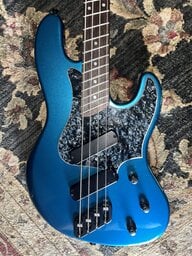
Thanks to everyone who responded to my request. As many of you have said, the best bet is a visit to the shop to examine and play the bass.
JMB.
Definitely check out what you may, or may not, buy.
Relevant/true story; The time...winter, much like now. The place...the Guitar Center near Atlantic City, NJ.
I'd gone quite a distance to buy a bass through Craigslist, only to have the buyer ghost me when I got to the rendezvous area.
(Different story, but still...what a  pratt!)
 To make the drive a little more
"worth it", I decided to check out that nearby Guitar Center for the first time.
After sampling three tiers of Fender/Squier basses...an American Standard, a Mexican-made Standard and a Vintage Modified Squier...I found the Squier to be the best of the three. Meanwhile, the American-made Jazz had a serious bow to the neck and the frets felt like a buzz-saw.
To be clear, this is not a
"Squiers are just as good as their Fender counterparts" story, 'cuz that's a whole different bag of angry weasels. In this case, I ended up
"playing detective" and it was very illuminating.
For a while, I could not help but wonder why the MIA Fender felt so completely
"off".
So, I broke the first rule of horror films...I looked up. Wouldn't you know it, but the American Standard's spot on the wall was just a couple of feet from the overhead heating vent. The fretboard was getting cooked by weeks, if not months, of dry heat blowing directly on it. That's why the fretboard had shrunk and the frets were sprouting like spring blossoms.
So, the moral of this story is to take an instrument's environment into account when sampling them. The same can apply if an instrument is within easy reach of everyone who can pass by, noodle upon and/or accidentally knock over said instrument.