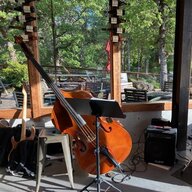
I play electric and upright. I play in a big band, jazz trio and a community orchestra. I am struggling with my decision to purchase an EUB because I use the electric and the DB for the big band and the DB for the orchestra. But I am sick of carrying the DB to big band rehearsal and messing with the amps and pickups and never having it loud enough. On the flip side, using the same mid-grade DB for orchestra just isn't cutting it. I feel I need to upgrade the DB to a more of an arco-specific set-up (with maybe some Evah or something) and get a new bass for the big band. Hence, I am looking at an EUB for this for convenience, size and loudness (obviously still want good tone). Keen on the NXTa at the moment and really don't want anything lower in quality than that. Folks who already play upright extensively - have you regretted purchasing an EUB and do you think it can really replace the real thing? Also for upright players - do you still use thumb position and solo in the same way as a regular DB? I feel like that take some getting used to. Thanks all.

Enjoy the benefits of a premium membership!
Upgrade Account
-
TalkBass has been independent since 1998. Add your voice.
Create a free account to reply to discussions, view embedded media, and browse with fewer display ads.
Join free Log in
Want zero display ads or expanded classifieds tools? Compare plans.
You are using an out of date browser. It may not display this or other websites correctly.
You should upgrade or use an alternative browser.
You should upgrade or use an alternative browser.
Double Bass Do I really want an EUB? Convince me yes or no please
- Thread starter wallyw
- Start date
More options
Who Replied?

I personally cannot stand EUB’s after playing real DB’s. For me, I might as well be playing a slab. A decent DB with a Full Circle or a Yama will get plenty loud enough. I have played both a hybrid and a ply with this setup for 20 years. For big band, you would be totally fine with a decent ply or hybrid and a proper setup/pickup, IMO. Personally, I would take that 100 times out of 100 over a stick bass.

I have never owned nor played a DB but I did acquire a good quality EUB and tried it for quite awhile. I tried hard to like it but in the end was dissatisfied and sold it.
IMO an EUB cannot be a replacement for a DB because it is missing that big, deep body resonance. It is a different instrument. Coming from a DB background I think you might miss that part of the DB tonality that an EUB simply can't create. It was that tonality that drew me to the (failed) EUB experiment in the first place. Without it, I was much more satisfied with the tone of my fretless bass guitar.
As always, other people's experience and opinions may differ (and probably will
IMO an EUB cannot be a replacement for a DB because it is missing that big, deep body resonance. It is a different instrument. Coming from a DB background I think you might miss that part of the DB tonality that an EUB simply can't create. It was that tonality that drew me to the (failed) EUB experiment in the first place. Without it, I was much more satisfied with the tone of my fretless bass guitar.
As always, other people's experience and opinions may differ (and probably will


The EUBs can be fun and very portable… but they have their own feel and sound. If that’s what your after great.
If you really want the DB sound and feel, you will probably be disappointed.
My 2cents
If you really want the DB sound and feel, you will probably be disappointed.
My 2cents
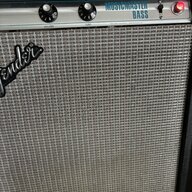
I have an 80s Clevingar Keyhole that I interchange with the double bass. While I don’t think it sounds as good as an acoustic it sounds really good. I do not hesitate to take it to a gig!
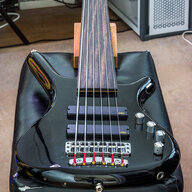
If I were still playing db, I would seriously consider eub. I actually have considered it to get back into db.
For background, I also play cello. I have a Yamaha electric cello; it plays like a standard cello and sounds similar to a standard cello. Definitely not the same, but is very good. The Yamaha eub sounds good on recordings.
For background, I also play cello. I have a Yamaha electric cello; it plays like a standard cello and sounds similar to a standard cello. Definitely not the same, but is very good. The Yamaha eub sounds good on recordings.
I used my Clevinger EUB for big band rehearsals. For me it was better than BG because I have grown up with DB and hardly be able to play BG. I think in a big band it doesn‘t make much of a difference unless it comes to quieter/slower pieces.
But I enjoy playing my large DB a lot more than the EUB which is OK for me.
I often played the EUB in a Cuban-style Latin band, but have used the DB there too. For rehearsals and tight stage space I use the EUB. Feedback was not a problem with DB using a pickup and good cab placement. But it‘s mostly me hearing the difference.
Switching to an EUB means you should try holding it or playing it for a longer time on a stand.
Personally I highly dislike the stand as I don‘t like to be fixed in position but move a bit with the bass during playing. Better to distribute weight on (older) joints with moving. Moving my body with the fixed instrument makes it harder to feel at home.
The T-foot of the eminence seems to be a good idea until you find that it doesn‘t allow any (!) turning. And I still miss the body support for distance.
I use the body support (covered with rubber foam tube to better stick to the clothes), not exactly at the same position as the shoulder of a DB, but with the same function and a straight endpin (I modified the angled one of the Clevinger because the bow takes the EUB out of position). Changed the rubber foot to a thick one where I cut the bottom in a about 40 degree angle and rounded it a bit. Then put it onto the foot and rotated it so that the bass naturally falls into my playing position.
There were good reasons for my modifications, so most EUBs might need tweaking until you feel at home with them.
I also have a cheap Stagg EUB that got some changes, mainly foam under the underlength and different bending of the upper and lower part of the body support. The main problem is the bridge that is equal height for all strings and heavy because of the thick metal adjuster parts. And the fingerboard is often not planed and hard to do because of the laquer finish that will (partly) get removed.
The cheaper ones don’t have a separate fingerboard, it is one part with the neck.
Newer model changed the tuner to DB tuners and have a separate fingerboard, but the bridge is still the old design.
I take the Stagg with me during holidays and when I go teaching by public transport (very seldom) because my other instruments are 5-stringers with a high-C.
But my DB is a 4/4 5-string that is possible to take with me in public transport (sometimes the ceiling is a bit low or it only fits in a few places), but even with wheels not that much fun to do regularly. For the first big band rehearsals I took my DB with me by public transport (bus, train, metro), but always was afraid that a potential hard braking would smash someone into it. I also took it by car, but finding a parking space was always a gamble.
You can get a straight endpin and body support for an NS instrument, but they are expensive. You might need a neck heel indicator on the back for a stick type EUB which you might need to make yourself to have the same orientation as on a DB.
I strongly recommend an EUB made/developed by a DB player if you want is as a replacement for a DB. This can get easily expensive. Have a look at a (used) Yamaha or the Italian MK EUBs by Mirko (where you can custom order some stuff too). Or perhaps learn how to avoid feedback problems (different pickup, speaker placement relative to DB body).
My DB is made for orchestra (intended to use a low B), carved, lowest wood grade which means no flames but good wood. I have it for about 35 years now and the quality is good enough for my chops. I used it for orchestra, jazz combo, big band, Tango and Latin ensemble and it worked well for any case. It took a while to make it working well (fingerboard planing, moving the soundpost, bridge reshaping, fingerboard shim to change the angle) but it is a great instrument now.
You might want to visit a good DB luthier to setup your instrument to find out if it could work better or if you want a different DB for a better sound.
A plywood DB is more robust and can work better with amplification. I won’t take my DB to open air gigs without a rain shield, that’s where I take the EUB, at least as a backup in my car.
So, you need to think a bit about that.
Check if the aspects that lead me to select and change my EUBs may apply to you too. I also got my EUBs very cheap, I wouldn’t have bought one for the regular price yet.
Also an EUB is mainly useful for music where you want to combine effects with bowing (like Eberhard Weber did). And even this is possible with a DB, but needs some modifications and sounds a bit strange when the acoustic sound is audible too.
Whenever possible try before you buy or buy only if you can give it back after a week or two.
Good luck, however you decide!
But I enjoy playing my large DB a lot more than the EUB which is OK for me.
I often played the EUB in a Cuban-style Latin band, but have used the DB there too. For rehearsals and tight stage space I use the EUB. Feedback was not a problem with DB using a pickup and good cab placement. But it‘s mostly me hearing the difference.
Switching to an EUB means you should try holding it or playing it for a longer time on a stand.
Personally I highly dislike the stand as I don‘t like to be fixed in position but move a bit with the bass during playing. Better to distribute weight on (older) joints with moving. Moving my body with the fixed instrument makes it harder to feel at home.
The T-foot of the eminence seems to be a good idea until you find that it doesn‘t allow any (!) turning. And I still miss the body support for distance.
I use the body support (covered with rubber foam tube to better stick to the clothes), not exactly at the same position as the shoulder of a DB, but with the same function and a straight endpin (I modified the angled one of the Clevinger because the bow takes the EUB out of position). Changed the rubber foot to a thick one where I cut the bottom in a about 40 degree angle and rounded it a bit. Then put it onto the foot and rotated it so that the bass naturally falls into my playing position.
There were good reasons for my modifications, so most EUBs might need tweaking until you feel at home with them.
I also have a cheap Stagg EUB that got some changes, mainly foam under the underlength and different bending of the upper and lower part of the body support. The main problem is the bridge that is equal height for all strings and heavy because of the thick metal adjuster parts. And the fingerboard is often not planed and hard to do because of the laquer finish that will (partly) get removed.
The cheaper ones don’t have a separate fingerboard, it is one part with the neck.
Newer model changed the tuner to DB tuners and have a separate fingerboard, but the bridge is still the old design.
I take the Stagg with me during holidays and when I go teaching by public transport (very seldom) because my other instruments are 5-stringers with a high-C.
But my DB is a 4/4 5-string that is possible to take with me in public transport (sometimes the ceiling is a bit low or it only fits in a few places), but even with wheels not that much fun to do regularly. For the first big band rehearsals I took my DB with me by public transport (bus, train, metro), but always was afraid that a potential hard braking would smash someone into it. I also took it by car, but finding a parking space was always a gamble.
You can get a straight endpin and body support for an NS instrument, but they are expensive. You might need a neck heel indicator on the back for a stick type EUB which you might need to make yourself to have the same orientation as on a DB.
I strongly recommend an EUB made/developed by a DB player if you want is as a replacement for a DB. This can get easily expensive. Have a look at a (used) Yamaha or the Italian MK EUBs by Mirko (where you can custom order some stuff too). Or perhaps learn how to avoid feedback problems (different pickup, speaker placement relative to DB body).
My DB is made for orchestra (intended to use a low B), carved, lowest wood grade which means no flames but good wood. I have it for about 35 years now and the quality is good enough for my chops. I used it for orchestra, jazz combo, big band, Tango and Latin ensemble and it worked well for any case. It took a while to make it working well (fingerboard planing, moving the soundpost, bridge reshaping, fingerboard shim to change the angle) but it is a great instrument now.
You might want to visit a good DB luthier to setup your instrument to find out if it could work better or if you want a different DB for a better sound.
A plywood DB is more robust and can work better with amplification. I won’t take my DB to open air gigs without a rain shield, that’s where I take the EUB, at least as a backup in my car.
So, you need to think a bit about that.
Check if the aspects that lead me to select and change my EUBs may apply to you too. I also got my EUBs very cheap, I wouldn’t have bought one for the regular price yet.
Also an EUB is mainly useful for music where you want to combine effects with bowing (like Eberhard Weber did). And even this is possible with a DB, but needs some modifications and sounds a bit strange when the acoustic sound is audible too.
Whenever possible try before you buy or buy only if you can give it back after a week or two.
Good luck, however you decide!
I'm 77 yrs old. I moved to an EUB (Yamaha SLB300) because I could no longer safely move an acoustic upright. I'd still be playing one of my acoustic basses if I could. I miss the physical feedback of the bass, and some elements of the sound.
With the EUB I get seamless amplification, ease of transport, and a sound that works in the groups I play in. I don't play arco, so can't comment on that aspect.
With the EUB I get seamless amplification, ease of transport, and a sound that works in the groups I play in. I don't play arco, so can't comment on that aspect.

JazznFunk
Supporting Member
Every time I've tried an EUB I was underwhelmed. None of them come close to the physical feeling of playing DB in terms of how you pull a sound out of it, and the tactile markers in terms of positions, etc that we all rely on with double bass are pretty much non existent. I never felt like I could dig in or remotely sound or feel the way I do playing a RDB (real double bass). Sound was basically like an electric bass on a stand.... not really my thing. I'd much rather play electric bass (fretted or fretless) versus a EUB, if I had to choose one of them.

I play Double Bass and Bass Guitar in a big band primarily. Some people love the EUBs, and get great use out of them but they didn’t work for me. My Eminence felt flimsy and sounded just OK, while my Azola Bug to me sounded out of phase and weak or something. My own take is that the EUB combines the worst features of both. I would like to try the Yamaha Silent Bass though. Chris Doky does OK on his.

I owned a BSX Allegro for a bit.
Pros:
-Looked amazing
-Quality build & company
Cons:
-Sounded awful
-Didn’t “fit” my body
-Heavier than you think
-doesn’t lay down correctly, therefore needed the display stand which was also quite heavy and one more thing to bring to the gig!
Some years later I tried a Kolstein Busetto. It had a better sound - being that it was partially acoustic, but most of the same ergonomic issues.
Maybe invest your money in a nice upright for your orchestra needs and work on your current bass to get a better amplified sound. Better pup / pre / strings / amps etc.
Good luck and keep us posted!
Pros:
-Looked amazing
-Quality build & company
Cons:
-Sounded awful
-Didn’t “fit” my body
-Heavier than you think
-doesn’t lay down correctly, therefore needed the display stand which was also quite heavy and one more thing to bring to the gig!
Some years later I tried a Kolstein Busetto. It had a better sound - being that it was partially acoustic, but most of the same ergonomic issues.
Maybe invest your money in a nice upright for your orchestra needs and work on your current bass to get a better amplified sound. Better pup / pre / strings / amps etc.
Good luck and keep us posted!
The struggle is real. I've thought many times to abandon the use of a real double bass in a big band, and use an EUB (for the same reasons you lay out). And every time I'm presented with the opportunity to switch, I do not.
Reasons:
1) as many above have commented, it simply doesn't sound the same as a double bass
2) EUB is really an electric bass with a long string length, so that means you lose the jazz snob factor
3) I lose the physical and visual landmarks of a scroll, heel, and shoulder of a real double bass
4) and most importantly, if portability and loudness are really a problem for me, and I'm willing to settle for an EUB, I might as well go all the way with it and settle for showing up with a bass guitar (and, yes, this is what I do in big band when I want to "settle," especially if there are "rock" charts on the gig).
So, no, despite the frustrations, I'm still not willing to go with an EUB.
Reasons:
1) as many above have commented, it simply doesn't sound the same as a double bass
2) EUB is really an electric bass with a long string length, so that means you lose the jazz snob factor
3) I lose the physical and visual landmarks of a scroll, heel, and shoulder of a real double bass
4) and most importantly, if portability and loudness are really a problem for me, and I'm willing to settle for an EUB, I might as well go all the way with it and settle for showing up with a bass guitar (and, yes, this is what I do in big band when I want to "settle," especially if there are "rock" charts on the gig).
So, no, despite the frustrations, I'm still not willing to go with an EUB.
Whyn't you just get a better amp and pickup?I play electric and upright. I play in a big band, jazz trio and a community orchestra. I am struggling with my decision to purchase an EUB because I use the electric and the DB for the big band and the DB for the orchestra. But I am sick of carrying the DB to big band rehearsal and messing with the amps and pickups and never having it loud enough. On the flip side, using the same mid-grade DB for orchestra just isn't cutting it. I feel I need to upgrade the DB to a more of an arco-specific set-up (with maybe some Evah or something) and get a new bass for the big band. Hence, I am looking at an EUB for this for convenience, size and loudness (obviously still want good tone). Keen on the NXTa at the moment and really don't want anything lower in quality than that. Folks who already play upright extensively - have you regretted purchasing an EUB and do you think it can really replace the real thing? Also for upright players - do you still use thumb position and solo in the same way as a regular DB? I feel like that take some getting used to. Thanks all.
What's wrong with the setup you've got for orchestral playing? maybe more arco practice is what's needed.

EUB can be cool when approached as its own thing and not as a substitute for a DB or electric bass or in cases where the size/convenience advantage over a DB is important. I think it'd work fine for taking to rehearsals but I wouldn't use it on gigs in a big band. It will look and sound really out of place IMO. Given the choice I'd rather play electric bass in a big band than EUB if upright isn't an option for some reason.

I personally cannot stand EUB’s after playing real DB’s. For me, I might as well be playing a slab. A decent DB with a Full Circle or a Yama will get plenty loud enough. I have played both a hybrid and a ply with this setup for 20 years. For big band, you would be totally fine with a decent ply or hybrid and a proper setup/pickup, IMO. Personally, I would take that 100 times out of 100 over a stick bass.
this is pretty much it..
EUBs are cool if you think they are, but man, it's really just a longer electric bass.
an upright with a pickup is superior in just about any situation for me.
i've played some really loud gigs with my laminate shen and a realist pickup.

I come from an acoustic upright background, and find the Yamaha SLB200 and SLB300 to be impressive for jazz and non-bowed stuff generally. A Fishman Full Circle on my Silent bass sounds basically the same through an amp as on my acoustic. The feel is a great approximation where it matters most, so muscle memory transfers. I'm not hung up on the subtle difference in feel and response, as it seems unreasonable to expect an identical experience anyways. I guess it's up to you to decide if the benefits are worth the trade-offs on dropping the cash on one, but for me they are.
Don't cheap out on an EUB though, you get what you pay for. The two I suggest are Yamaha SLB and Alter Ego.
Don't cheap out on an EUB though, you get what you pay for. The two I suggest are Yamaha SLB and Alter Ego.
Last edited:

I have to agree with the above comments that an EUB won’t really sound exactly like being in the room with a nice DB, but you can get damn close on many gigs with a few tricks.
About 90% of my work now is in musical theatre and despite having an incredible DB, I was never totally happy with its sound amplified, regardless of the pickup used; and trusting a sound guy to correctly mic me was taking a big risk.
I picked up an NXT-A and it's become my go-to for theatre work (and most jazz gigs, actually), but not until I figured out some tricks, the biggest of which are using IRs. I run all of my instruments through a HX Stomp where I add an IR of whatever great DB I like along with a little EQ and compression. As arco tends to be way hotter than pizz on my EUB, I just put a simple EQ block in my signal chain that cuts ~7db from the signal that I click on for bowed passages. Through both IEMs or a live amp, this setup sounds more like a “great DB in the same room” than my actual nice DB through a pickup.
If you end up upgrading your DB, or using two with different setups, the best sounding option I’ve found was blending a Remic mic and a nice pickup. Not cheap, but does sound quite good.
Let us all know which direction you end up going!
About 90% of my work now is in musical theatre and despite having an incredible DB, I was never totally happy with its sound amplified, regardless of the pickup used; and trusting a sound guy to correctly mic me was taking a big risk.
I picked up an NXT-A and it's become my go-to for theatre work (and most jazz gigs, actually), but not until I figured out some tricks, the biggest of which are using IRs. I run all of my instruments through a HX Stomp where I add an IR of whatever great DB I like along with a little EQ and compression. As arco tends to be way hotter than pizz on my EUB, I just put a simple EQ block in my signal chain that cuts ~7db from the signal that I click on for bowed passages. Through both IEMs or a live amp, this setup sounds more like a “great DB in the same room” than my actual nice DB through a pickup.
If you end up upgrading your DB, or using two with different setups, the best sounding option I’ve found was blending a Remic mic and a nice pickup. Not cheap, but does sound quite good.
Let us all know which direction you end up going!
Last edited:
Eberhard Weber ( gotta love his first name! ) is someone that when I saw him play ( several times ) sounded pretty damn good on a EUB ( 5 string ).
I have a CR5M, and I like to play it and hear it. I do not do gigs. But this is a very personal decision/choice. Hamburger/Cheeseburger.
I am certain that many folks invested in a EUB, that came from a Double Bass background, and were not satisfied. I get that.
But do what you want to do, and very best of luck with your quest.
I have a CR5M, and I like to play it and hear it. I do not do gigs. But this is a very personal decision/choice. Hamburger/Cheeseburger.
I am certain that many folks invested in a EUB, that came from a Double Bass background, and were not satisfied. I get that.
But do what you want to do, and very best of luck with your quest.

I had one by Carruthers for a minute in the late ‘90s.
It was sort of handy, but still more awkward than the BG.
Then I got a good Kay and it sounded so much better, I just couldn’t justify keeping the EUB.
It was sort of handy, but still more awkward than the BG.
Then I got a good Kay and it sounded so much better, I just couldn’t justify keeping the EUB.


