
I am wondering if the aging of the wood on solid body bass guitars over decades makes.them sound noticeably better than new ones. For example a new Fender P vs one that is 20 or 40 years old?
It's just what I was wondering

TalkBass has been independent since 1998. Add your voice.
Create a free account to reply to discussions, view embedded media, and browse with fewer display ads.
Join free Log in
Want zero display ads or expanded classifieds tools? Compare plans.
I am wondering if the aging of the wood on solid body bass guitars over decades makes.them sound noticeably better than new ones. For example a new Fender P vs one that is 20 or 40 years old?





Only if they wear bowling shirts and fedorasI think mature bassists are better lol

It's just what I was wondering
 A good, early 60s P-bass would be closer to most "modern" P-basses.
Interesting, thank you!At least one major instrument builder (Yamaha) seems to think that it's relevant, from their page on their higher-end BBP instruments:
"Any bass benefits from being "played in," a process in which the instrument matures and opens up as the stresses between the wood and finish, neck and fingerboard, and body and hardware are released, resulting in better sound and playability.
Yamaha’s exclusive Initial Response Acceleration process releases those stresses by applying specific vibrations to the completed instrument as part of the crafting process, resulting in a “played in” bass from day one."
It may be partly exaggerated and a marketing ploy, but then again Yamaha knows a thing or two about musical instruments in general, and presumably has researched its benefits. Myself, I prefer non-vintage-looking instruments cause I'm overly concerned with clean aesthetics alongside tone/playability, but that's my own personal issue lol.
I used to think there might be something to the "older wood instruments sound better" claim. Then I read reports describing the extremely carefully designed double-blind study conducted in Paris where Italian violins built in the 16th and 17th centuries (and worth millions of dollars) were compared to violins built by the best present-day violin luthiers.
Punch line: the violinists could not reliably tell the new violins from the old---and the violin most of the violinists picked as the one they'd most like to own (which they assumed was a Strativarius) had been built in 1980.
Maybe a properly set up 50-year-old solid-body bass can be more easily distinguished from an identical modern bass with identical electronics. How that would work, though, I don't know.
To those who believe it: avoid double-blind tests at all costs.
(Of course, there are plenty of counterpoint blog posts from violinists who objected to the results of the double-blind test. You can look them up, or you can just read posts from true believers in the thread you're currently reading.)
Double-Blind Violin Test: Can You Pick The Strad?



I am wondering if the aging of the wood on solid body bass guitars over decades makes.them sound noticeably better than new ones.
 (better than all the 70s Fender Ps!)
For example a new Fender P vs one that is 20 or 40 years old?
The implication of many of these posts seems to me to be that the high prices of old instruments are because of their rarity and collectibility, not how they sound and play?
) And both say "x cent" (sounds like the same )
If you don’t use polyurethane, but nitro as Fender in the 50s and 60s, to make sure the wood doesn’t dry and doesn’t spread tons of vintage goodness over the decades, you simply drown the entire body into fullerplast to make lacquering the instrument easier. At least this is what Fender did with all their „air breathing, dried“ now vintage guitars and bassesCan someone explain how wood “dries out” when it’s covered in layers of paint? Especially polyurethane?

With older instruments, it was more about the use of older mature and dried lumber that was being used.Can someone explain how wood “dries out” when it’s covered in layers of paint? Especially polyurethane?
IMO in old Fenders, it’s a case by case thing. Same thing with the newer Fenders. In general, I believe the more an instrument gets played, the better it sounds. And count me in on the neck having the most impact on the instrument’s sound, especially -acoustically. I also believe that passive pickups sound “sweeter” as they age.
I’ve played a few vintage 60’s pre-CBS Fender basses that sounded incredible. And I’ve played others that sounded ordinary. But even the ordinary sounding ones still sounded good to my ears.
In the early 80’s, late 60’s/early 70’s Fender P-Basses were my thing, mainly because they weren’t very expensive. And it was the same thing as the mid 60’s pre-CBS Fenders that I tried out. Some were incredible, some were ordinary, so I don’t believe a certain “vintage” is “better” overall from a tone standpoint.
I do believe that overall the pre-CBS Fenders had tighter neck pockets, and had better attention to detail when they were assembled.
However, the last 3 basses that I’ve bought were all bought new.
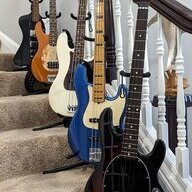
The bass on the far right was competed in late 2008. And I’ve played it for countless hours over those years. I know there’s no way to quantify it, but to me it’s sound has improved a bit since it was new. It definitely feels more resonant against my body, and when I play it unplugged in a quiet room, it resonates louder.
The U.S. and Euro Spectors both sound fantastic, straight out of their cases. I bought the Euro within the last 2 years, the U.S. I bought last Summer. Both of them are super loud unplugged, and their necks and body wings are very resonant.
I envision that they both will sound even better over time.View attachment 5315739
Not sure if anybody mentioned it, but the pickups in the 60's were hand wound. That had to create some variability.
Can someone explain how wood “dries out” when it’s covered in layers of paint? Especially polyurethane?




