I know from first hand experience that hollow body instruments like classical guitars do break in and can change dramatically from a cardboard box sounding thing when brand new to a sweet sounding instrument over time. What about solid body bass guitars? The reason I'm asking is I had researched and bought a new Mike Lull 4 string Jazz bass some time ago and I'm not really happy with the way it sounds. It's light, well built and resonant physically but it there's something missing in the tone for me. Is it going to stay this way or will it sound better if I put in more time playing it? I haven't put in much time playing it but I've tried different pickups and strings. I guess I learned an expensive lesson this time. I will never again buy a bass unplayed unless I am willing to take the loss.

Enjoy the benefits of a premium membership!
Upgrade Account
-
TalkBass has been independent since 1998. Add your voice.
Create a free account to reply to discussions, view embedded media, and browse with fewer display ads.
Join free Log in
Want zero display ads or expanded classifieds tools? Compare plans.
You are using an out of date browser. It may not display this or other websites correctly.
You should upgrade or use an alternative browser.
You should upgrade or use an alternative browser.
Do solid body basses break in over time?
- Thread starter WingKL
- Start date
More options
Who Replied?I know from first hand experience that hollow body instruments like classical guitars do break in and can change dramatically from a cardboard box sounding thing when brand new to a sweet sounding instrument over time. What about solid body bass guitars? The reason I'm asking is I had researched and bought a new Mike Lull 4 string Jazz bass some time ago and I'm not really happy with the way it sounds. It's light, well built and resonant physically but it there's something missing in the tone for me. Is it going to stay this way or will it sound better if I put in more time playing it? I haven't put in much time playing it but I've tried different pickups and strings. I guess I learned an expensive lesson this time. I will never again buy a bass unplayed unless I am willing to take the loss.
Not really. Unless you do something drastic to it like take all the finish off and soak it with sweat or sand off a bunch of the body wood, etc., it's not going to change acoustically over time in any way that you're going to notice.
So unless you mod it, you're pretty much stuck with the way it sounds.
LS

+1Not really. Unless you do something drastic to it like take all the finish off and soak it with sweat or sand off a bunch of the body wood, etc., it's not going to change acoustically over time in any way that you're going to notice.
So unless you mod it, you're pretty much stuck with the way it sounds.
LS
I hear some say that solid bodies do mellow over time, but I don't think so. My 25 year old Aria sounds the same today as it did when I first bought it. Pickups can change over time as the magnetic field weakens, but that takes a long time unless you physically shock (hit) the magnet.
If a solidbody instrument has lost it's finish down to bare wood, this will enable the wood to dry. Many solidbody guitars/basses today are built from wood that still contains a degree of moisture. When the finish (usually poly) is applied, it gets locked in, hence making said instrument acoustically resonate the same way for many, many years. Dryer wood has different acoustic properties. Some progressive thinking builders (Early Schecter, Valley Arts) actually had a drying period for the wood used on their instruments for these reasons. How your instrument resonates will transfer to the pickups, so yes, a solidbody bass will "break in". For the tone conscious, this a large part of what drives the vintage guitar/bass market.
Only irresponsible builders or really budget instruments would be made out of wood that isn't dry. Even so, it would contains some moisture, that is in equilibrium with the atmosphere. Removing your bass' finish will do nothing to change the moisture content, nor the sound, if your bass has been built properly.


Ric5
Inactive
- Jan 29, 2008
- 29,772
- 30,452
- Disclosures
- I like 5, 8, 10, and 12 string basses
If a solidbody instrument has lost it's finish down to bare wood, this will enable the wood to dry. Many solidbody guitars/basses today are built from wood that still contains a degree of moisture. When the finish (usually poly) is applied, it gets locked in, hence making said instrument acoustically resonate the same way for many, many years. Dryer wood has different acoustic properties. Some progressive thinking builders (Early Schecter, Valley Arts) actually had a drying period for the wood used on their instruments for these reasons. How your instrument resonates will transfer to the pickups, so yes, a solidbody bass will "break in". For the tone conscious, this a large part of what drives the vintage guitar/bass market.
Wood absorbs and loses moisture depending on the humidity levels in the surrounding air. It is a seasonal thing. The finish slows the process. A bass does not dry out as it ages. It will lose moisture when the environment around is dry and it will absorb moisture when the environment is more humid. If basses did keep drying out then they would eventually crack and become unplayable. A perfect environment for a bass is a constant 35% humidity level.
Wood for instruments is seasoned before it is used. Otherwise it would be unstable.
Ric5
Inactive
- Jan 29, 2008
- 29,772
- 30,452
- Disclosures
- I like 5, 8, 10, and 12 string basses
Only irresponsible builders or really budget instruments would be made out of wood that isn't dry. Even so, it would contains some moisture, that is in equilibrium with the atmosphere. Removing your bass' finish will do nothing to change the moisture content, nor the sound, if your bass has been built properly.
If you remove the finish from a bass it will change the tone. Not from humidity but because the wood vibrates differently without a finish.
Ric5
Inactive
- Jan 29, 2008
- 29,772
- 30,452
- Disclosures
- I like 5, 8, 10, and 12 string basses
Wood does harden with age ... If you ever lived in a house over 50 years old with some exposed studs or joists then try to drive a nail in the old wood as compaired to a new piece of wood.

I've read Rickenbacker uses maple that's at least 8 years old in their guitars and basses. Could be part of the seasoning process I suppose.

I've never played a Mike Lull bass, but from their reputation on here, and from your own observation, they are very well made. Since it's a Jazz Bass its construction must also be in line with your expectations in terms of the pickup configurations, the bolt-on neck construction and so on. As I understand it these basses also come with a PLEK setup, so they probably play pretty well out of the box.
Your statement "It's light, well built and resonant physically but it there's something missing in the tone for me" is very vague and highly subjective. What is this certain something that you are looking for? A more aggresive tone? A smoother tone? Growl? Bite? Silkiness? A subterannean bottom end or more sparkle? And, since it's missing in tone for you, how will you know when you've found it?
By all accounts Mike Lull maker is attentive to customer's needs and customer service. Have you tried defining exactly what you are looking for and talking it over with the maker? Or are you just trying random pickups and strings?
Your statement "It's light, well built and resonant physically but it there's something missing in the tone for me" is very vague and highly subjective. What is this certain something that you are looking for? A more aggresive tone? A smoother tone? Growl? Bite? Silkiness? A subterannean bottom end or more sparkle? And, since it's missing in tone for you, how will you know when you've found it?
By all accounts Mike Lull maker is attentive to customer's needs and customer service. Have you tried defining exactly what you are looking for and talking it over with the maker? Or are you just trying random pickups and strings?

my experience say that it does, I have a particular bass that I did not care much for the tone, after 15 years or so the tone changed for better a bunch

Guitars with Nitro finishes tend to become sweeter and "breathe" more after about 30 years. But that is only because Nitro breaks down with age as vibrations pass through it.
And although an instrument's acoustic do change with age, you will not be able to tell as easily because the instruments are electric.
And although an instrument's acoustic do change with age, you will not be able to tell as easily because the instruments are electric.
If you remove the finish from a bass it will change the tone. Not from humidity but because the wood vibrates differently without a finish.
I wonder though has anyone ever tried this.I have heard as much myself.
Sadowsky says that an 1/8" veneer top does not affect the tone of the base wood yet one is to believe a few micrometers of lacquer does?
I wonder how much of this talk is mysterium arcanum type of stuff and how much is factual and verifiable.
I wouldn't have so much incredulity here for an acoustic guitar but a solid body bass?

My opinion is a bit different. I truly believe, that the majority of the sound is coming from the neck in solid body instruments. In other words the neck and the fretboard have a larger effect on your sound than the bodywood. It's not only the quality of the wood used in the neck, but also the shape, the amount of wood (think about Stingray necks or Precision necks), etc.
Normally, necks have a finish which let the wood dry out.
So I believe, that your instrument's sound will change if you play a lot on it, and especially because your neck and fretboard will resonate on a different way. It's not only moisture, but also, the microstructure of the wood will change slightly thanks to the billions of gentle motions the resonancy causes.
This is the same for violins, double basses, hollowbody instruments, but in their case the body has a bigger factor in the overall sound, and time and practise will change their sound on a much more audible way than solid body instruments.
Normally, necks have a finish which let the wood dry out.
So I believe, that your instrument's sound will change if you play a lot on it, and especially because your neck and fretboard will resonate on a different way. It's not only moisture, but also, the microstructure of the wood will change slightly thanks to the billions of gentle motions the resonancy causes.
This is the same for violins, double basses, hollowbody instruments, but in their case the body has a bigger factor in the overall sound, and time and practise will change their sound on a much more audible way than solid body instruments.



- Jun 24, 2006
- 2,560
- 90
- Disclosures
- Endorsing Artist: MTD basses and strings; Bergantino Amps & Cabs
I know from first hand experience that hollow body instruments like classical guitars do break in and can change dramatically from a cardboard box sounding thing when brand new to a sweet sounding instrument over time. What about solid body bass guitars? The reason I'm asking is I had researched and bought a new Mike Lull 4 string Jazz bass some time ago and I'm not really happy with the way it sounds. It's light, well built and resonant physically but it there's something missing in the tone for me. Is it going to stay this way or will it sound better if I put in more time playing it? I haven't put in much time playing it but I've tried different pickups and strings. I guess I learned an expensive lesson this time. I will never again buy a bass unplayed unless I am willing to take the loss.
It takes many years, and the effects will be subtle, but the bass will change the more it is played. It is not just 'dryness', it is the fact that the wood is all resonating together that makes the difference.
Not really. Unless you do something drastic to it like take all the finish off and soak it with sweat or sand off a bunch of the body wood, etc., it's not going to change acoustically over time in any way that you're going to notice.
So unless you mod it, you're pretty much stuck with the way it sounds.
LS
Nope...it will change. But if you sand all the shiny **** off, the wood will breathe better and you'll hear it's effects much more.
If a solidbody instrument has lost it's finish down to bare wood, this will enable the wood to dry. Many solidbody guitars/basses today are built from wood that still contains a degree of moisture. When the finish (usually poly) is applied, it gets locked in, hence making said instrument acoustically resonate the same way for many, many years. Dryer wood has different acoustic properties. Some progressive thinking builders (Early Schecter, Valley Arts) actually had a drying period for the wood used on their instruments for these reasons. How your instrument resonates will transfer to the pickups, so yes, a solidbody bass will "break in". For the tone conscious, this a large part of what drives the vintage guitar/bass market.
Sort of right. Poly, IMHO, having had 3 basses covered in the ****, kills any chance of having the tone develop over time. This is why Mr. Tobias has developed his special finish which involves very light coats of both epoxy and catylized urethane. His basses 'breathe', and as such develop over time as you play them; I've never heard a bass respond to playing time as well as the MTD's. I've owned several dozen basses in my time, including three customs from a local luthier covered in thick, gooey poly that were all acoustically dead. The MTD's are as far from this as you can get - they are 'alive'; they breathe, they change radically over time.
If you remove the finish from a bass it will change the tone. Not from humidity but because the wood vibrates differently without a finish.
Very true. That's what gives stuff like the Warwicks their remarkable woody tone. And MTD's.
my experience say that it does, I have a particular bass that I did not care much for the tone, after 15 years or so the tone changed for better a bunch
Yes, indeed. That's why old Fender's sound so good - they've been played for 50 years. The structure of the wood has changed with all the resonance being applied.
Guitars with Nitro finishes tend to become sweeter and "breathe" more after about 30 years. But that is only because Nitro breaks down with age as vibrations pass through it.
And although an instrument's acoustic do change with age, you will not be able to tell as easily because the instruments are electric.
If you put both pickups on full blast. Solo the back a bit, and you'll hear the woody sound come through, especially with a light, stamped-steel bridge.
I wonder though has anyone ever tried this.I have heard as much myself.
Sadowsky says that an 1/8" veneer top does not affect the tone of the base wood yet one is to believe a few micrometers of lacquer does?
I wonder how much of this talk is mysterium arcanum type of stuff and how much is factual and verifiable.
I wouldn't have so much incredulity here for an acoustic guitar but a solid body bass?
Mr. Tobias experimented with thickness many years ago and has found the depth that has the maximum effect on tone on a bolt on instrument. 1/8th inch won't do it. His tops are closer to 1/2"; big effect on the sound.
And yes, goopey, plasticy lacquer (poly) will kill it dead. Nitro less so. Oil even less, but you'l have maintenance problems. Mr. Tobias' solution on the current MTD's is the best compromise.
My opinion is a bit different. I truly believe, that the majority of the sound is coming from the neck in solid body instruments. In other words the neck and the fretboard have a larger effect on your sound than the bodywood. It's not only the quality of the wood used in the neck, but also the shape, the amount of wood (think about Stingray necks or Precision necks), etc.
Normally, necks have a finish which let the wood dry out.
So I believe, that your instrument's sound will change if you play a lot on it, and especially because your neck and fretboard will resonate on a different way. It's not only moisture, but also, the microstructure of the wood will change slightly thanks to the billions of gentle motions the resonancy causes.
This is the same for violins, double basses, hollowbody instruments, but in their case the body has a bigger factor in the overall sound, and time and practise will change their sound on a much more audible way than solid body instruments.
Yes, precisely. The same forces are at work here. It is a SUBTLE thing, but the more you play an instrument, generally, the better it sounds. That's why some of the 25 year old Tokai's sound really good with a decent set of pickups in them.
Wood changes structurally with resonances applied over many years - end of story. Even with a finish on it, BUT the finish will inhibit it's development greatly depending on what it is, when it was applied, and how thick it is.
Cheers,
Cameron
Ric5
Inactive
- Jan 29, 2008
- 29,772
- 30,452
- Disclosures
- I like 5, 8, 10, and 12 string basses
I wonder though has anyone ever tried this.I have heard as much myself.
Sadowsky says that an 1/8" veneer top does not affect the tone of the base wood yet one is to believe a few micrometers of lacquer does?
I wonder how much of this talk is mysterium arcanum type of stuff and how much is factual and verifiable.
I wouldn't have so much incredulity here for an acoustic guitar but a solid body bass?
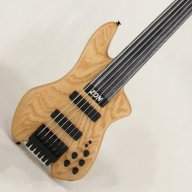
I used to have this 4003s5.
The conversion varnish was removed from everywhere but the fretboard. I finished it with tung oil. It was not unfinished but it has a quite different finish from a factory Ric. It has a noticeably different sound from a standard 4004s5.

I wonder though has anyone ever tried this.I have heard as much myself.
Sadowsky says that an 1/8" veneer top does not affect the tone of the base wood yet one is to believe a few micrometers of lacquer does?
I wonder how much of this talk is mysterium arcanum type of stuff and how much is factual and verifiable.
I wouldn't have so much incredulity here for an acoustic guitar but a solid body bass?
I have built ten bass guitars and I can tell you that stripping the finish off can totally change the sound of the wood. I've also taken off the finish from several budget basses and they started to sound more expensive due to the way the wood resonates without the thick finish.
I also have several experiences with the basses that sound dull and after a year of playing they have become much better sound wise. I even did some recordings to be sure. Unfortunately I don't have these sound samples anymore.


