• TalkBass has been independent since 1998. Add your voice.
    Create a free account to reply to discussions, view embedded media, and browse with fewer display ads.
    Join freeLog in
    Want zero display ads or expanded classifieds tools? Compare plans.

Do solid body basses losen up?

Do new solid body basses loosen up like acoustic instruments do?

I know with acoustic guitars and the like,they're very stiff from the factory and after a year or more depending on the material they loosen from vibrations and settle and become more resonant?

I'm speaking strictly from an acoustic stand point,not plugged in.

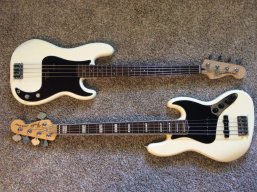
The only reason why I ask is because when I first got my RBX it sounded rather quiet and dull compared to my old p bass and now after playing it extensively over the past couple weeks it definitely seems louder...the character seems to come out more in my playing that it did before.
 
IMO/IME, there may be something happening on a very small scale due to the instrument being played. I have noticed something similar with my instruments in the past. At one time I thought it could be the lower relative humidity. However... beware of the theories from the self-proclaimed experts.;)

theories, trolls and flames. (oh, my)
:hiding:
 
They do but nothing at all like a solid wood acoustic instrument. I'd be suspicious of anyone saying it makes a noticeable difference in how a solid body sounds but I have regularly observed instruments that get played a lot over a number of years feel loose and well played....
 
Perhaps the body and all hadnt quite finished curing before you got it. With it haveing finished that process over the past month or thereabouts. Might make a small change like your describing. Supposedly over time, as in a few yrs, the wood cells have kinda aligned more fully with sound vibrations going thru it frequently over time. This would be more noticeable with acoustic instruments and solid body ones that have a louder then average voice imo. I have noticed that over time the ability to feel sound vibrations thru a solid body bass and guitar does seem to increase a bit. Even in comparing it to same model new unsold versions at a store. But that takes several months or longer and would have something to do with wood cells responding to sound vibrations. But I think this is a somewhat subjective rather then objective thing. Lol.
 
IME, solid body guitars/basses do get a little more resonant, but it takes at least 20 years of playing it, and even then, it's not a big difference if at all. IMO, 5 years would be imperceptible. and the aging of the magnets and oxidization of the enameled pickup windings makes just as big of a difference, and in most cases, more.
 
IME, solid body guitars/basses do get a little more resonant, but it takes at least 20 years of playing it, and even then, it's not a big difference if at all. IMO, 5 years would be imperceptible. and the aging of the magnets and oxidization of the enameled pickup windings makes just as big of a difference, and in most cases, more.

Yep, I agree. And it's called mojo.
 
There was a thread a while back about shaking a bass on some sort of apparatus in order to get better "aged" tone. Another supposed method was to put a bass on a stand in front of a speaker to let the sound waves do their thing on the wood. Some people passionately believe in this. I am not one of them. ;)

There is a contraption they use mainly for acoustic guitars that is the same. It vibrates it heavily for about a day or two and equals about 10 years worth of playing. Read a lot about it when I was into acoustic guitars. Most of the time a difference was heard,but it depended on the make of the guitar. IE taylors had the biggest effect as they are usually very stiff and rigid from the factory. Yamaha does this to one of their BB series and jacks the price up for it. Not sure how much it does on solid bodies.
 
I hold the opinion that individual players inbue their instruments with mojo. I realize this sounds silly from a scientific standpoint, but it's a mysterious universe.

I've played Jeff Berlin's Dean, and it sings. Victor Wooten, Will Lee, and another prominent player evaluated Jaco's recently recovered B.O.D., and they agreed that there was something extraordinary about the bass, even in its reconstructed form. I've also played a few basses owned by and gigged on lot by players I respect, and their basses also feel and play good.

It might just be the placebo effect at work, who knows, yet I do believe that players impart something into their basses.
 
Plus one.

I think there might be something to this. I personally never buy new instruments. Partly because of the mojo factor, i like the shine worn off. New basses do feel stiff and lifeless to me. Even high end models. The cost factor is another reason. All in all well played instruments seem to have soul. If it"s the wood becoming tuned to the sound, or a part of past owners imbibed in the thing. Some call it Mojo or whatever it is. I like it.
 
I might add that the builder has something to do with it. I'll bet John Kallas's basses are incredible. In fact, I did more than bet, and actually plunked down a chunk o' change to have John make a bass out of a Warmoth Jazz Bass body I've had for 10 years or so that never really came together well despite it having three different necks. I say this because I've had the opportunity to speak with John, and you can tell that he's totally passionate about Fenders, bolt on neck basses, and such. That kind of passion gets infused in the instrument's dna. I don't know what coursed through Leo's veins, but I'll bet he had some sort of spirit coursing through him that is reflected in the pre-CBS Fenders. I've also heard Mike Tobias talk about his basses sounding better after a period of time due to their loosening up from being played on.
 
Several years ago, Bass Player touched on this subject and played around with some contraption they called a "shaker table" that was connected to a servo motor being driven by a 7000 watt amp. There were several steps of recording instruments pre and post shaking and it seems there was a noticable difference. I was a subscriber to BP from '92 until mid '08 and I think the article was in one of the issues from the first few years. I haven't tried to look it up, but it's probably out there on the web somewhere.

There's a well documented process of doing this to upright basses and a long thread over on the DB side of TB. It's a process that uses an electric motor with an eccentric weight mounted to the upright bridge. THe motor is run at controlled RPM for specific time periods. I beleive the RPM is monitored with a strobe. It's a process developed by a German luthier and published in a book. I think the process was called vibration de-damping or something similar.

I have no doubt there is some stabilzation or molecular alignment or something that happens with years of playing an instrument and I also think it's possible to induce the same with some of the methods mentioned. I'm working on a few instruments using the old fashion method.....
 
IME, solid body guitars/basses do get a little more resonant, but it takes at least 20 years of playing it, and even then, it's not a big difference if at all. IMO, 5 years would be imperceptible. and the aging of the magnets and oxidization of the enameled pickup windings makes just as big of a difference, and in most cases, more.

This I believe 100%.
 
I hold the opinion that individual players inbue their instruments with mojo. I realize this sounds silly from a scientific standpoint, but it's a mysterious universe.

I've played Jeff Berlin's Dean, and it sings. Victor Wooten, Will Lee, and another prominent player evaluated Jaco's recently recovered B.O.D., and they agreed that there was something extraordinary about the bass, even in its reconstructed form. I've also played a few basses owned by and gigged on lot by players I respect, and their basses also feel and play good.

It might just be the placebo effect at work, who knows, yet I do believe that players impart something into their basses.

I think there's more than placebo. I remember hearing or reading a classical string player talking about how certain player didn't have the depth in his playing to ever truly "open up" a particular instrument. I think it's obvious that an instrument will be effected by the years of unique resonance a great player subjects it to.
 
Voodoo. Pure mumbo-jumbo and snake teeth.

Nothing gets better with age except fine wine and cheese and only to a point - Strads included!

If sound waves were so good at making another instrument more resonant, then there's a huge market for people who will pay yards of money for instruments that sat in a boiler factory for a couple of years to make it sing better.

Or - just duct tape a few instruments to the side of a Saturn V rocket motor for the ultimate shaker-trip and get what might take decades of time over with in one trip to the moon.

Everything degrades - it's devolution or entropy in the process and if getting loose and flimsy is a sign of a good bass, then I don't want it.

When/if the molecules are actually rearranged by mystical soundwaves, then all you have a handful of wood and plastic dust.

Glue gets old - paint turns to cracked flakes, ever polyurethane will deteriorate until it's not serviceable any more.

Magnets deteriorate and lose electrical output from the p'ups and resistances go UP in the electrical wiring and components.

I bet all that really happens is the strings get older (don't they?) and the player goes more deaf after standing in front of Bam-Bam on drums and 6 gazillion Watts of guitars in their ears - and SURE - things will sound different!

YOU get old - I get old - gear gets old - and even I know that's not for the better after a certain point in time.