• TalkBass has been independent since 1998. Add your voice.
    Create a free account to reply to discussions, view embedded media, and browse with fewer display ads.
    Join freeLog in
    Want zero display ads or expanded classifieds tools? Compare plans.

Do "tone pots" have a specific frequency/eq range?

CoffeeLove

Supporting Member
Aug 4, 2013
1,507
1,712
California, Central Coast
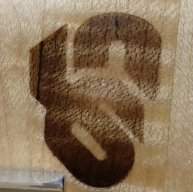
Hey all. Put some "flats" on my MTD Artist (early 2000's) and as to be expected I lots a tremendous amount of highs (passive controls, and a single tone pot). However, on my Stingray the same strings have loads of high end. I believe the pots were upgraded on the MTD, here is a picture of them.

I love the GHS Precision Flats, so not wanting to go back to a nickel or steel string. In order to get enough "highs" the amp "highs" need to be turned all the way up, which is creating too much hiss.

Any thoughts, besides new strings?

Thanks
 

Attachments

  • 20220922_185036.jpg
    20220922_185036.jpg
    197.5 KB · Views: 74
There are really two factors that determine the performance of a tone pot.

The pot's resistance sets a baseline load on the pickups. A lower load (lower resistance, i.e. 100k, 250k) tends to roll off some high end. A higher load (500k or 1M) preserves more of the pickup's natural high end. The effect of the pot is basically baked in, all the time.

The cap used determines the frequency at which highs start rolling off as you turn the control down. A higher value cap (.1uF, .05uF, .047uF) means the inflection point will be lower in frequency, so you'll lose a wider range of highs and some upper mids. A smaller value (.033uF, .015uF) means the inflection will be higher up, so you'll lose only very high frequencies. The cap only comes in to play as you turn the control down, if you leave the control all the way up, the cap doesn't matter.

Passive tone controls are basically just low pass filters. They allow low frequencies to make it to your amp, and as you turn them down, they send high frequencies to ground instead of to your amp. It's basically just a simple baseline curve determined by the pot, with a dropoff as you turn the control down, starting at a given point that's determined by the cap.

The value of the volume pot sets the baseline curve as well. If your goal is to have more highs when both controls are all the way up, my first choice would be to replace both pots with higher value pots. If you have 250k pots in there now, replace them with 500k pots. If you have 500k pots, replace them with 1M pots.
 
Also, you’re comparing one instrument with a simple passive (subtractive) tone pot against another with an active (subtractive and additive) tone circuit. The Stingray circuit is famous for having lots of treble boost. It’s literally apples and orangutans.
 
There are really two factors that determine the performance of a tone pot.

The pot's resistance sets a baseline load on the pickups. A lower load (lower resistance, i.e. 100k, 250k) tends to roll off some high end. A higher load (500k or 1M) preserves more of the pickup's natural high end. The effect of the pot is basically baked in, all the time.

The cap used determines the frequency at which highs start rolling off as you turn the control down. A higher value cap (.1uF, .05uF, .047uF) means the inflection point will be lower in frequency, so you'll lose a wider range of highs and some upper mids. A smaller value (.033uF, .015uF) means the inflection will be higher up, so you'll lose only very high frequencies. The cap only comes in to play as you turn the control down, if you leave the control all the way up, the cap doesn't matter.

Passive tone controls are basically just low pass filters. They allow low frequencies to make it to your amp, and as you turn them down, they send high frequencies to ground instead of to your amp. It's basically just a simple baseline curve determined by the pot, with a dropoff as you turn the control down, starting at a given point that's determined by the cap.

The value of the volume pot sets the baseline curve as well. If your goal is to have more highs when both controls are all the way up, my first choice would be to replace both pots with higher value pots. If you have 250k pots in there now, replace them with 500k pots. If you have 500k pots, replace them with 1M pots.

So, is this a correct assumption on my part: I have some pickups that are rather crisp/bright when used with new roundwound strings, and currently has a 250k with a .05 MFD cap. and I have to really turn “down” the tone pot to warm it up and get that brightness under control. I want to be able to roll off some of that brightness much earlier in the rotation of the tone pot, so if I leave it a 250k pot and use a .1 MFD cap, will this achieve what I’m going for?
 
There are really two factors that determine the performance of a tone pot.

The pot's resistance sets a baseline load on the pickups. A lower load (lower resistance, i.e. 100k, 250k) tends to roll off some high end. A higher load (500k or 1M) preserves more of the pickup's natural high end. The effect of the pot is basically baked in, all the time.

The cap used determines the frequency at which highs start rolling off as you turn the control down. A higher value cap (.1uF, .05uF, .047uF) means the inflection point will be lower in frequency, so you'll lose a wider range of highs and some upper mids. A smaller value (.033uF, .015uF) means the inflection will be higher up, so you'll lose only very high frequencies. The cap only comes in to play as you turn the control down, if you leave the control all the way up, the cap doesn't matter.

Passive tone controls are basically just low pass filters. They allow low frequencies to make it to your amp, and as you turn them down, they send high frequencies to ground instead of to your amp. It's basically just a simple baseline curve determined by the pot, with a dropoff as you turn the control down, starting at a given point that's determined by the cap.

The value of the volume pot sets the baseline curve as well. If your goal is to have more highs when both controls are all the way up, my first choice would be to replace both pots with higher value pots. If you have 250k pots in there now, replace them with 500k pots. If you have 500k pots, replace them with 1M pots.

Great info, thanks. How do I determine if the pots are 250k, 500k, etc...? I do not see any markings on them beyond what you can see in my picture. Thanks for the helpful input.
There are really two factors that determine the performance of a tone pot.

The pot's resistance sets a baseline load on the pickups. A lower load (lower resistance, i.e. 100k, 250k) tends to roll off some high end. A higher load (500k or 1M) preserves more of the pickup's natural high end. The effect of the pot is basically baked in, all the time.

The cap used determines the frequency at which highs start rolling off as you turn the control down. A higher value cap (.1uF, .05uF, .047uF) means the inflection point will be lower in frequency, so you'll lose a wider range of highs and some upper mids. A smaller value (.033uF, .015uF) means the inflection will be higher up, so you'll lose only very high frequencies. The cap only comes in to play as you turn the control down, if you leave the control all the way up, the cap doesn't matter.

Passive tone controls are basically just low pass filters. They allow low frequencies to make it to your amp, and as you turn them down, they send high frequencies to ground instead of to your amp. It's basically just a simple baseline curve determined by the pot, with a dropoff as you turn the control down, starting at a given point that's determined by the cap.

The value of the volume pot sets the baseline curve as well. If your goal is to have more highs when both controls are all the way up, my first choice would be to replace both pots with higher value pots. If you have 250k pots in there now, replace them with 500k pots. If you have 500k pots, replace them with 1M pots.
Great info. There are no markings on the current pots, other than what you can see in the attached picture. How do I determine what I currently have? Any recommendations on "good" tone pots, as far as quality? Thanks for the helpful info.
 
"hiss"? As in electrostatic noise? Or high end from the strings?
From any/all amps when the "highs" are cranked all the way up. I probably just need to replace the current tone pot to one that has a higher frequency range, to allow a brighter/crisper/articulate sound when using flats. I was just saying the only way to get enough highs is to crank the amps "highs" all the way up, which causes a hiss with most amps.
 
Also, you’re comparing one instrument with a simple passive (subtractive) tone pot against another with an active (subtractive and additive) tone circuit. The Stingray circuit is famous for having lots of treble boost. It’s literally apples and orangutans.
Yep, I get that. Really just looking for a solution for the MTD, which is likely a different tone pot with a higher frequency range.
 
From any/all amps when the "highs" are cranked all the way up. I probably just need to replace the current tone pot to one that has a higher frequency range, to allow a brighter/crisper/articulate sound when using flats. I was just saying the only way to get enough highs is to crank the amps "highs" all the way up, which causes a hiss with most amps.

That's not how (passive) tone pots work.

When the pot is fully clockwise, the capacitor is completely out of the circuit, and the tone pot does essentially nothing.

The only difference you can make is replacing a lower-resistance pot with a higher-resistance pot (like 500kOhm or even 1MOhm), which will make a very, very slight difference to the high frequency content.
 
  • Like
Reactions: CoffeeLove
So, is this a correct assumption on my part: I have some pickups that are rather crisp/bright when used with new roundwound strings, and currently has a 250k with a .05 MFD cap. and I have to really turn “down” the tone pot to warm it up and get that brightness under control. I want to be able to roll off some of that brightness much earlier in the rotation of the tone pot, so if I leave it a 250k pot and use a .1 MFD cap, will this achieve what I’m going for?

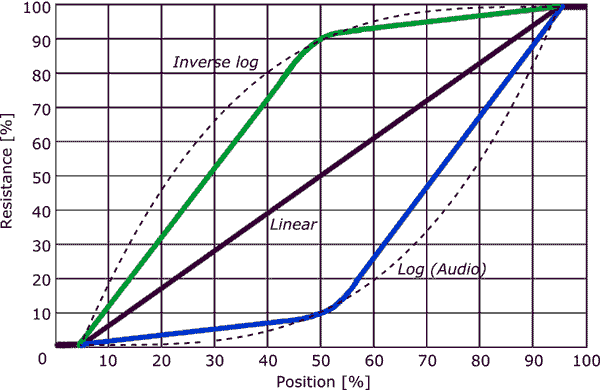
How quickly the pot affects the tone when you turn it down depends on the taper.

potentiometer_taper.png

Ref: Invalid Link Removed
 
  • Like
Reactions: Ringhammer
Anyway, the point I was trying to make is: Because the standard passive tone control is a subtractive circuit, there is no way to add any significant amount of brightness by using a different pot. The notion of a "different tone pot with a higher frequency range" isn't a thing.

If you want more brightness out of a passive instrument, you can
  • Try different strings
  • Try different pickups
  • Try different technique
  • Wire the pickups directly to the output jack
  • Use a low-capacitance cable
Or install an active treble boost circuit.
 
Great info, thanks. How do I determine if the pots are 250k, 500k, etc...? I do not see any markings on them beyond what you can see in my picture. Thanks for the helpful input.

The markings are often on the shaft side, so they are concealed when the pot is mounted.
Link Removed

Sometimes the pot value is on the back of the case:
upload_2022-9-23_15-52-40.png


Or possibly in both locations:
upload_2022-9-23_15-54-54.png
 
  • Like
Reactions: wellshuxley
Thanks all. Maybe it's time to try some different flats. The GHS Precision Flats are just too dull sounding on the B and E strings for this bass, maybe I will try the GHS Brite Flats. I have used the the GHS Pressurewounds which seems to be everybody's solution, but I have had several sets and are too far off the "flats sound" for me, and I love the feel of flats.

Thanks all
 
You would Need a passive means of creating (parralel) higher frequency from the original signal - subtract with blend

Pot is a adjustable resistor, resistance weakens the small and weak voltages (freq) first
 
Last edited:
Thanks all. Maybe it's time to try some different flats. The GHS Precision Flats are just too dull sounding on the B and E strings for this bass, maybe I will try the GHS Brite Flats.
Brite Flats are groundwounds, they're not proper flatwounds. I happen to like 'em a lot, but I wouldn't recommend them to somebody looking for flatwounds.